ELSI: Cross-Domain Effects Part 1
Where This Fits
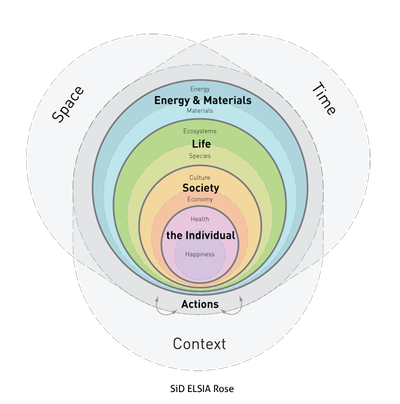
The individual ELSI domain units showed what each domain covers. This unit begins exploring how domains interact: cross-domain effects where a change in one domain cascades into others. This is where systems thinking becomes essential.
90-100 Plasterboard
1.2 40-60 Loam building board
-0.2 no data Timber boards
-26 50-90 Veneer plywood
How Domains Connect
-23 50-90 (Source: Energy Manual; Sustainable Architecture by Manfred Hegger, Matthias Fuchs, Martin Zeumer, and Tommy Stark) Example of a working document using ELSI to map an integrated value assessment of soil, to use in Natural Capital frameworks. (Jade Moors, Tom Bosschaert, 2014) An exploration like this can be quickly made using free VUE software, and be used as a brainstorm, exploration, or impact registration map.
Example of a natural capital quickscan on the value of a tree using SiD’s indicator framework. Can you guess how many bird species exist? And how many mammals? What about plants? Are there more fish than fungi species? Here’s a short list, with a rough approximation of the known and expertly guessed number of species, collected from various sources.
Kingdom Known/estimated species Bacteria 4.000 Protoctists (algae, protozoa) 80.000 Animals (vertebrates) 67.700 Of which Birds 9.000 Of which Mammals 6.500 Of which Fish 33.500 Of which Amphibians 8.000 Of which Reptiles 10.700 Animals (invertebrates) 1.272.000 Fungi 72.000 Plants 270.000 Total known species 1.750.000 Possible species (including unknown) 14.000.000 species count Using ELSI to explore the concept of ‘leisure’ in the context of a more livable city of Rotterdam (Except 2013) global health statistics, top causes of death example: healthy buildings pay for themselves We wanted to figure out what the return on investment of health and productivity measures for offices are.
Except’s science team collected data in meta-research about all aspects that may influence worker productivity. The diagram on the right shows that in a typical office, over 80% of the costs in that office are employee wages, and only 10% is office cost and upkeep. Below, a table with performance increasing measures. In total, we estimate between 10% and 20% of productivity increase can be gained through health and wellbeing measures.
This pays back the entire construction cost of a typical office in 10 years. Improvement item Productivity increase % notes and Suggestions Light 2,8 - 11,4 Natural light always better than artificial. Use wide-spectrum non-flickering LEDs, with min. 500 lux at the desk (pref. natural light), with personal control. Outdoor view
View towards substantial nature Vegetation 6 - 15 Use indoor plants, use of natural materials (i.e. stone, wood etc.) Simulated nature <1 If real nature is not possible, screens, pictures etc. have little positive impact Colors <1 Research is inconclusive about color use Air quality 4,4 - 7 Mechanical ventilation with fine particle filter (e.g. carbon active), use of materials which do not emit VOC, min 10 liters/second of air supply per occupant. Acoustics 5,4 Limit noise from outdoors, limit noise from mechanical systems, limit noise between working stations. Thermal comfort
Summer: 23,5 , 25,5 °C, Winter: 21,0 , 23,0 °C, homogeneous temp. distribution, personal control / feeling of being in control of temperature set point. Happiness score of countries according to World Happiness Report of Columbia University (2018) ELSI Rose case study: redefining health Re-Defining Health with SiD’s Systems Lens For years, health has been viewed as a mere ‘absence of disease’, which is not really informative when trying to look at what healthcare is supposed to mean and be.
In line with SiD’s definition of sustainability, health can be seen as a state of a complex dynamic system. In this view, different internal and external ‘objects’ such as hormones, food intake, and exercise interact with each other on a network level, together producing some state of the ‘health’ system as a whole.
Specifically, in order to be able to speak of health, the state of the system needs to be resilient, which means that one can recover fairly quickly and sustainably after some imbalance.
The system also needs to be harmonious, which in the case of a non-societal system such as a human body is inherent (not attacking itself), as well as autonomous, meaning it needs to be supplied with the right amount of resources to operate properly (food, water, air, physical exercise, sunlight, etc), and can freely move to seek more optimal conditions if required.
By stressing the need for resilience, and thus the ability to recover from an ailment, this definition recognizes that a person can experience physical or mental issues from time to time as part of “normal operations”.
This, as opposed to the traditional view to cure each ailment separately, is therefore more helpful in light of current trends in demography and healthcare technology. Moreover, treatment can be directed at establishing (long-term) resilience and not at mere symptom reduction. So, this view both clarifies what health is, and contributes to more sustainable ways of treating health related issues.
Applying SiD to (Un)healthy People In line with this definition of health, we use SiD as a starting point in working towards resilient physical, mental, and social systems. I’ll illustrate this by zooming in on mental health diagnosis and treatment. Research has increasingly shown that mental disorders are not fixed entities, but emerge from interactions between different biopsychosocial aspects.
On top of that, the ‘objects’ and network structures making up these mental health systems differ across individuals. When taking the systemic nature of mental health into account, it makes little sense to diagnose people with certain ‘mental disorders’ and trying to fix these using a unified approach, which is currently the case. Using SiD-like methodologies to map the system helps to achieve better goals and better solutions.
It goes without saying that SiD can be used in designing and improving other health related topics, such as cardiovascular problems related to lifestyle, or ‘vague’ chronic ailments that do not seem to have a simple cause . The resulting insights then consist of, for example, interrelations between mood, anxiety, genetic disposition, lifestyle factors, social environment, and protective factors like purpose and fulfillment, together making up a patient’s mental state.
There are multiple ways of mapping this system, both qualitative and quantitative, which can function as an individualized diagnosis. Both bottom-up and top-down approaches of analyzing the system are then used to arrive at the right intervention to shift the state of the system of individual people towards a more resilient one.
This can then include a variety of solutions in a ‘roadmap’, including medicinal, therapeutic, biophysical, psychological, behavioral and cultural aspects. If the mapped system is not too big, it’s possible to analyze the quantitative structure for most central objects that function as a leverage point in shifting its dynamics, and thus quickly find remedies.
If it is too big to map, therapists and patients can use a top-down analysis approach such as SiD’s climbing-the-hill approach to start discovering solutions in the form of iterative interventions.
Roadmaps are drawn to infer whether the effect of the interventions have the desired effect, and ‘the system’ is evaluated and updated along the road of treatment. Currently, in psychological science, studies are designed that investigate possibilities of implementing such an approach in mental healthcare, and results are expected to be published in the coming years.
Expanding beyond ‘sustainability’ To conclude, SiD can be applied beyond ‘classic’ sustainability questions onto other complex constructs in which sustainability is a desired goal. SiD can be used in designing and improving other health related topics, such as health systems on the meso level, i.e., healthcare organizations, cultural patterns affecting health, and global health systems on a macro level.
In this way, SiD enables us to see the complex world as it is and develop actionable interventions to all kinds of systems to make them truly sustainable. RAH system indicators System Level: Resilience Resilience is a system’s capacity to withstand (unexpected) external disturbances and its ability to return to a healthy state after suffering a blow.
Resilience is not to be confused with toughness or strength. For example, for purposes of personal self-defence, techniques which rely on agility and flexibility such as Aikido are more effective than those which rely on pure strength, such as body-building.
The same goes for systems: agile, flexible, and adaptive systems are more likely to be able to return to a sustainable state than monolithic and tough systems. There are many theories that have been developed and new ones in development about Resilience, and whole organizations that focus on it, like the Stockholm Resilience Center and the Resilience Alliance.
Please note that the word can be used with different meanings in different professions such as psychology, engineering, and ecology. Thinking in Resilience Resilience is a powerful concept: the degree to which something can withstand unexpected occurrences. Resilience is key for ensuring continuity of a system in the long run. By focusing on resilience, you come to the insight that goals such as growth and profit lead down fragile pathways which, in the end, serve nobody.
Replacing these with Resilience as a goal at the topmost level of decision making leads to profound improvements in system performance for all stakeholders, creates clarity where there previously was none, and leads to more effective strategies in the short and long run.
Behavior Resilience is a complex system indicator, influenced by a wide variety of network and object parameters, which change depending on the circumstances and context. Resilience tends to be more important for the sustainability of the system as a whole. In general, and in virtually all cases, higher resilience is good. Resilience is highly susceptible to system dynamics, often more so than Autonomy and Equity.
It is the most strongly influenced by the network parameters of the three RAH indicators, and less directly by ELSI indicators. Resilience responds to Autonomy and Harmony strongly, but not in a linear fashion.
Increased Harmony usually leads to higher Resilience, and a very low Autonomy also hurts Resilience, although a very high autonomy can also cause a low resilience. We’ll look further into the relationships between the network and the system parameters more in the next chapters in the network parameter chapters. Cities have become the central framework to sustain human life.
While growth may seem an attractive option for cities, considering the potential economic benefits, we are well aware that growth alone leads to undesirable cities. Applying resilience as a strategy instead of growth is a more effective means to arrive at both economic growth, and an actually flourishing city. A city wanting to improve itself can see that growth isn’t necessarily a good thing. Growth will fluctuate, and end.
While a growing city increases resource flows, this can only be temporary, and eventually it will either shrink or run into a resource shortage. This is also because with increased size, resource consumption tends to grow in a non-linear fashion, as well as overhead costs for infrastructure and management. This means that ensuring quality of life, safety, and healthy living environments during growth is no trivial task.
What will steer that, what is its target? And when growth ends, the challenge then becomes how to flourish in either condition of growth, while becoming resilient for the long run. If the city focuses on resilience rather than growth, the result is, as a necessary consequence, a more diversely-mixed, flexible, and dynamic urban landscape. It will have less monocultures of office parks and suburbs (which eventually drive traffic congestion out of bounds).
It leads to dealing differently with resource management, this costs in investment terms, but pays off in the long run with clean, healthy living conditions, lower utility and maintenance costs. It will deal with the uncertainty of fluctuation resource flows in the future, will restructure itself to allow for changes in demographics and lifestyles, and start to shape itself according to its inherent strengths.
When implemented effectively, this leads to better living conditions for all inhabitants, creating a more attractive city, attracting more businesses and investment, and which then causes economic growth. The result is a different trajectory, that leads to a completely different, better performing city, while at the same time leading to better economic conditions. Rather than growth as a driver for economic wellbeing, resilience is used as the driver instead.
Economic health is achieved through a different pathway, that simply regards economic growth as a side-effect of being a great, beautiful, healthy, and future-proof place to live and work. Creating such as ‘resilience’ policy will automatically start to influence other areas of systemic concern as well, such as energy, sanitation, poverty alleviation, infrastructure, and cultural programs.
For example, it leads to a city in which health is increased by means of biodiversity growth. It means reduced transport loads by smarter reallocation of workforce distribution. These are win-wins that aid to in concert, like instruments in an orchestra, help to achieve benefits that drive the larger goal. This way, a resilience driven strategy maximizes positive benefits on the United Nations SDG program, which helps to acquire investment funds and to achieve positive PR and worldwide recognition.
Let’s have a look at what happens when applying resilience as a central strategy for an organization. We can see the same pattern with organizations a we see in cities. For example, if a company, like most traditional companies do, focuses on maximizing profit and growth, it may succeed in doing so for a while.
That is, until something unexpected happens which it did not prepare for (not unthinkable in our volatile economy), and it’ll be costly to survive the unexpected blow. The most common method that is used to try to evade this is trend analysis, a form of predicting the future through historic analysis. Based on these trends, the expected outcomes are used as a forecast to strengthen the company where it’s deemed to be weak.
But, of course, reality doesn’t necessarily follow the trends, because trends cannot predict the future. Because complex systems can’t be predicted well, and can rapidly change states, this is a poor form of preparing for the future. Many companies can attest to this in the last few decade due to the economic crisis, and many can’t anymore because they’re now gone. If companies focus on resilience as a primary goal instead of growth, an entirely different strategy results.
This strategy is based on how to ensure the company can use system dynamics to its advantage given any number of possible situations, by building its resilience to be healthy in the long run. This may include aspects such as having a healthy, diverse, and flexible labor force as opposed to pure efficiency or growth as a focus for HR management. This allows the organization to quickly change its operations and be more resilient for rapid market shifts.
Reducing its reliance on limited resources creates economic resilience, which can be achieved by for example switching to bio-based materials instead of fossil resources, taking control of the material cycle, or establishing an industrial symbiosis with supply and delivery partners. This can be done by, for example, focusing on maximizing the company’s value for society and embedding this value, so that the company becomes unmissable for society.
Takeaway
Cross-domain effects are where SiD reveals its power. A change in energy policy affects ecosystems, health, and economy simultaneously. Understanding these connections prevents unintended consequences and reveals leverage points where a single intervention improves multiple domains at once.
Next: This analysis continues in "ELSI: Cross-Domain Effects Part 1 (continued)," which examines Autonomy and Harmony dynamics across ELSI domains.
This knowledge is free because of our supporters. Join them.