Network Parameters: Resilience
RAH for a Sustainable State
Where This Fits
You have learned the three system-level indicators: Resilience, Autonomy, and Harmony. This unit dives into Resilience at the network level, introducing the specific parameters that determine how well a system absorbs shocks and adapts to change.
Network Parameters: The Interface Between Levels
Sitting in between the system and object level, the network parameters are a powerful interface between the top-down and the bottom-up. The network level parameters help to unravel the complexities of the system level indicators, reveal complex system interactions, test and explore them, and find the object level drivers of these behaviors. This gives concrete handles on finding the best intervention points to improve system dynamics.
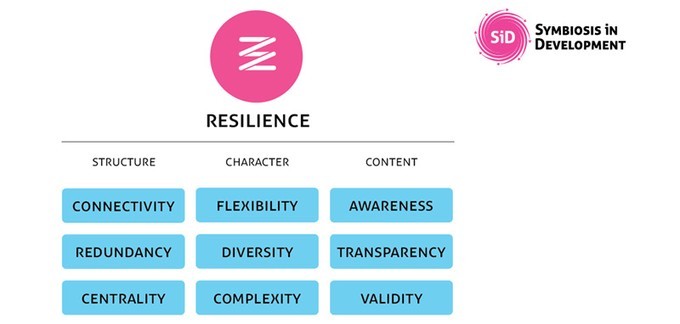
Network parameters also create a verbal construction set, allowing teams to specify and explore in detail where certain dynamic patterns come from, or can be engaged. The standardized network parameters in SiD are split into the RAH system indicators: the Resilience set is called CRAFTDCCV, the Autonomy set SSCNE, and those dealing with Harmony are called PEAIE. They have been derived from existing network science literature and refined in practice over about ten years.
The Playground of System Dynamics
On the network level we find more powerful systemic behaviors that remain hidden to us on the object level. On a network level we are no longer interested in a single flow, object, or element. It exclusively concerns itself with groups of connections throughout the system. The network is about "how," rather than "what."
The network parameters can be observed from both the top-down and the bottom-up. From the top-down, they are evaluated on how they contribute to the RAH system indicators. From the bottom-up, they are constructed by looking at the various connections between areas of interest on the object level. Because they can be approached from both sides, they are extremely flexible and derive much of their meaning from the context of the challenge at hand.
Quantifying Network Parameters
Network parameters are used most commonly in a qualitative sense. However, if need be, they can be used to construct quantitative simulation models using agent-based simulation or other techniques. Each separate ELSI element can be quantified and related with numerical analysis in relation to each CRAFTDCCV parameter.

The Resilience Set: CRAFTDCCV
CRAFTDCCV is SiD's standard set of network level parameters for Resilience. The resilience set is the most powerful of the three sets in understanding system dynamics. Understanding these basic resilience parameters allows you to develop a natural feeling for networks in general, and assess what effect a certain action may have on the resilience of the system.
- Connectivity
- Redundancy
- Awareness
- Flexibility
- Transparency
- Diversity
- Centrality
- Complexity
- Validity
There are other network parameters you can use for resilience, but in practice these are usually sufficient.
The Autonomy Set: SSCNE
SSCNE are the five main network parameters that inform the Autonomy system indicator. Taking into account these five parameters gives you a good grasp of the aspects that influence the self-reliance of the system, such as resource self-sufficiency, as well as the support it can provide to neighboring systems.
- Self-Governance
- Self-Sufficiency
- Circularity
- Network Support
- Efficiency
The Harmony Set: PEAIE
PEAIE are the five main network parameters that inform Harmony. These allow you to investigate to what degree the system has internal tension, or equilibrium within itself. These are the hardest to quantify of the three sets, and the most influenced by social science.
- Power Balance
- Expression
- Access
- Inclusion
- Equity
Working with the Parameters
Common Network Parameters
Several network parameters are much more commonly used than others. "Diversity," for example, has been used for decades as a field of exploration in the social sciences. Because it is an existing and widespread field of research, the knowledge about how diversity affects the dynamics of systems is better known than others. It is widely proven that increasing diversity improves the strength of socio-cultural systems.
Likewise, "Transparency" is a common term in policy development and governance. The presence of more commonly known parameters helps us see the power and wide-ranging effects these parameters can have. But we should take care not to miss out on network parameters that are less familiar and which may in fact bear powerful dynamics. We are less knowledgeable about the effects of "redundancy" in the evaluation of a social system, for example.
Mapping Interdependency
The power of each parameter becomes apparent when seen in the greater context of the system. For example, transparency of governance makes a country's system work faster and better, and increases Harmony's Equity parameter at the same time. Things that seem very complex can become rather straightforward when you have the network overview at hand.
The parameters also tend to influence each other: increasing one parameter's score is bound to affect others. To use network parameters effectively, create an analysis system that provides an overview of all the important outcomes. For example, using a spreadsheet to list all the parameters, their area of influence, and giving them a qualitative score can give a quick overview of a system's dynamics.
Clarity From Network Parameters
For many, the network parameters require time to get used to. Once you have internalized them, you will experience the clarity these tools yield. Within the network parameters lie hidden opportunities we can use to find radically better solutions for current societal problems. Some of these we have already discovered, for example the benefits that decentralized energy production gives to the autonomy and resilience of communities.
Practicing Network Parameter Analysis
A Box of Network Glasses
A handy mental exercise to practice and help evaluate the effects of network parameters on a system is to imagine a box of eyeglasses. Each pair of glasses represents a network parameter and allows you to "see" the network in a different light. For example, imagine putting on the "diversity" glasses and looking through them at a system such as a village or a company.
While doing this, also imagine pushing the parameters to an extreme. When investigating diversity, picture a village where all the houses may be identical, or each may be unique.
How about the ages and professions of the people? By zooming into diversity, elements it comprises appear and in themselves help you understand the impact these elements have on diversity. This is a quick and easy way to get a grip on the effects of network parameters on the dynamics of different systems.
Learn to See the Light
Network parameters are most helpful for strategic decision making where complex systems are involved. Learning how the parameters affect one another in a system tells a great deal about a system's overall behavior, and allows you to instantly see possible effects of a certain measure, strategy, or policy decision.
To get good at this, practice on a daily basis. Apply the parameters to any complex system you come across: the train network, the supply chains in a supermarket, the bikes and transport network in a city, a city park, natural systems, political networks, business relations. Before you know it, you can start to "see" the behavior of complex systems intuitively.
Quantifying Network Parameters in Practice
The network parameters can be used to physically measure the performance of a network if you attach formulas to each indicator. This is useful for getting to grips with patterns in systems that feel counterintuitive. You can do this by hand, or use more advanced agent-based modeling or systems modelers.
To start working by hand, determine a simple formula for each network parameter, given a certain context. Wikipedia is a good starting point: just type in the network parameter's name, and you will often find suggestions. For example, the Wikipedia article on Centrality lists five distinct ways of measuring it.
Takeaway
Resilience is not about being unbreakable. It is about detection (awareness), response capacity (flexibility), backup capacity (redundancy), structural balance (connectivity and diversity), and the ability to evolve. These network parameters give you concrete things to measure and improve in any system.




This knowledge is free because of our supporters. Join them.