System Boundaries and Time in Sustainability
Where This Fits
This unit tackles two critical concepts for applying SiD: where you draw system boundaries and how time affects sustainability analysis. These determine the scope and relevance of any assessment. Without clear boundaries and time horizons, analysis becomes either too narrow to be useful or too broad to be actionable.
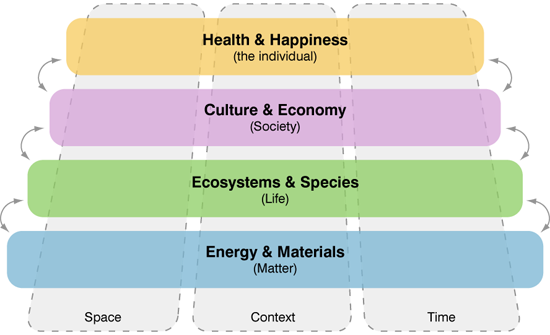
The Symbiosis in Development sustainability definition (v4): Sustainability is a state of a complex, dynamic system. In this state, a system can continue to flourish resiliently, in harmony, without requiring inputs from outside its system boundaries .
Applied to our civilization, this state is consistent with societies powered by renewable energy and closed loop material systems, living in thriving ecosystems, on a biodiverse planet, with healthy and happy individuals living in just, tolerant, and diverse cultures, supported by open and transparent economies. “When we try to pick out anything by itself, we find it hitched to everything else in the Universe”
- john muir
group exercise Practice understanding what sustainability means by thinking about how you would look at the below items in a systemic context. Remembering that only systems can be sustainable (or not), how would you rephrase the following items? A ‘sustainable’ soda can A ‘sustainable’ city A ‘sustainable’ house A ‘sustainable’ organization A ‘sustainable’ policy measure Group Exercise Format (20 minutes) Assign a term to each individual in the group.
Let each person think for about 5 minutes on the subject. Then, have a 10-15 minute reflection on the results afterwards, one by one.
Optionally, have a group discussion following. What you hope to see in the resulting discussion is that in each case, it is useful to ‘reverse’ the term, by making it reflect on society. EG, a ‘sustainable’ soda can is a soda can that maximally contributes to a sustainable society.
A ‘sustainable city’ is a city that contributes positively to the sustainability of the country, or of the global human society as a whole. And so on. 12 rules of complex systems Complex systems are numerous (uncountable) in their components in which all components influence each other.
They exhibit non-linear behavior emergent from their interactions beyond each component’s mechanical (linear) behavior. Complex systems can be understood but not predicted . Any action upon them may have unpredictable (side-)effects. Don’t make decisions based on prediction; instead, prepare for resilience, adaptability, flexibility and so forth. Complex systems grow like organisms , and, like them, perish like them. No complex system is meant to exist for eternity.
Understand and accept the natural cycle of things, and aim for self-reproductivity and longevity rather than eternality. Complex systems require an increasing number of resources per added unit of complexity . This means there are always limits to their growth.
Systems respond differently at different scales, but may exhibit similar patterns at different scales. Complex systems change rapidly in revolution-like jumps, as well as in slow evolutionary progression , and both together. These events can be triggered by anything. Patterns in details are just as important as large-scale variables.
Complex systems do not necessarily behave the same way given the same conditions , nor is historical behavior always an indication of future behavior. Complex systems are always dynamic, never sit still, and are never entirely in balance, even if they seem to be.
Complex systems are not aware or alive per se, but may exhibit survival or seemingly cognitive behavior . It makes sense to mentally construct a complex system as a biological entity with a character to increase your understanding of its dynamics. Complex systems require incubation periods for changes to be registered , processed, and acted upon. Be patient.
Measure in the full spectrum for any changes lest you miss a rebound effect or changed state somewhere. Complex systems, at the moment, can best be understood by human brains , as they’re also organic complex systems. Immersing oneself in a complex system and fully interacting with it is the best way to learn its behavior.
In other words, try to get out from behind your desk and connect. Complex systems interact beyond their chosen system boundary, which needs to be taken into account at all times. Maximize the beneficial properties of these externalizations and minimize the system’s dependency on them for increased sustainability.
Complex systems always offer hidden dynamic processes that can have beneficial as well as destructive effects. Find these patterns to boost capacity for change and prevent harmful externalities. harmonious autonomous flourishing Resilient examples: object over system Object-Oriented Sustainability Goes Wrong Why is system thinking and an integrated approach so important for sustainable development? Let’s imagine our society as a complex creature with various bits and pieces that keep it running.
These bits and pieces are our everyday technologies , cars, planes, light bulbs, computers, as well as us, nature, and all other ‘things’.
The technological bits move people from place to place, facilitate communication, allow us to read after dark, travel around the world, and perform many other amazing and useful functions. Ideally, we like to keep all of those, but without their negative impact.
Many current ‘sustainable’ projects and environmental policies are focused on these ‘negative’ objects. In other words, they are centered around finding bits within the organism of our society that could be running a bit more efficiently, and making an effort to replace them with “better” versions.
We’ve seen many examples of this type of ‘sustainable’ solution, often developed with the best of intentions, that resulted in worse scenarios than if they had not been conceived at all. Examples are solutions that save energy that at the same time pollute our environment with toxins, or eco-friendly devices that are produced under dismal human conditions.
We see many examples of ‘green’ solutions that are pushing the damage from one area to another, from one time frame to the next, and from one generation to another. As we see now, these are due to what we call an ‘object-oriented’ approach (see examples on this and the next page).
The system as a whole, its purpose, direction, and impact, will not change if we just switch out bits and pieces. It isn’t just the bits that need upgrading. It is the configuration of the overall system that is at fault. We need to redesign the organism itself.
We need to begin functioning differently within our societies, changing the patterns of our behavior, and reducing our impact by orders of magnitude, not just by tiny increments. The true nature of the problems that we face IS, per se, systemic, and requires an entirely different approach.
To cite Einstein: “We cannot solve problems with the same kind of thinking we used when we created them.”. If we don’t use a new systemic approach, we’re trying to cure the symptoms, but not the disease, and things will continue to go very wrong.
The Light Conundrum Artificial light has been essential for our development. It has extended our working day, providing increased productivity, safety, and quality of life. But these little fake suns come at a big energy cost. As society expands, so has their burden on our energy resources.
Thus, the European Commission banned the
Thus, the European Commission banned the tungsten filament light bulb in 2009, the trusty mini sun that has lighted our homes for over a century, because it emits most energy in the form of heat and is therefore not efficient for lighting purposes.
The only alternative at the time was the Compact Fluorescent Light (CFL), commonly known as a power saving bulb. Sounds good. But few of us knew that CFL’s use mercury vapor to do its thing, a highly neurotoxic substance. Even the most perfect recycling program won’t prevent some of the lamps breaking, impacting our health and the environment.
So for the sake of energy savings, we have introduced a toxic substance in our lives and nature, a substance we spend large amounts of effort on trying to get rid of. This is a typical example of ‘trading pain’; we save some energy, but at the expense of damage to our health and ecosystems.
CFL’s can be a beneficial addition, depending on how its energy is produced and how the lamps are used, but just substituting one for the other is not necessarily a sustainable act. Thankfully we have good LEDs now.
Takeaway: Where you draw system boundaries determines what you see and what you miss. Time boundaries matter equally: short-term fixes often create long-term problems. This unit continues in "System Boundaries and Time (Part 2)" with extended examples including bioplastics and leaded gasoline.
This knowledge is free because of our supporters. Join them.