Schiphol Catalyst Office
The Challenge
Amsterdam Airport Schiphol is one of Europe's busiest transport hubs. Its central business district was growing rapidly, and Schiphol Real Estate needed a new approach to office development, one that would set a global benchmark for sustainability while creating healthy, inspiring workplaces. The challenge: design a 20,000 m² multi-tenant office concept that functions not as an isolated building, but as a catalyst for circularity across the entire business precinct.
Applying SiD
Except partnered with Schiphol Real Estate and brought together over 70 stakeholders and experts. The team used the Symbiosis in Development (SiD) framework to co-develop actionable, measurable performance goals that surpassed existing benchmarks like BREEAM and WELL.
Central to the approach was the ELSI framework, which organized sustainability goals across six interconnected domains:
- Energy
- Materials
- Ecosystems and biodiversity
- Culture
- Economy and logistics
- Health and well-being

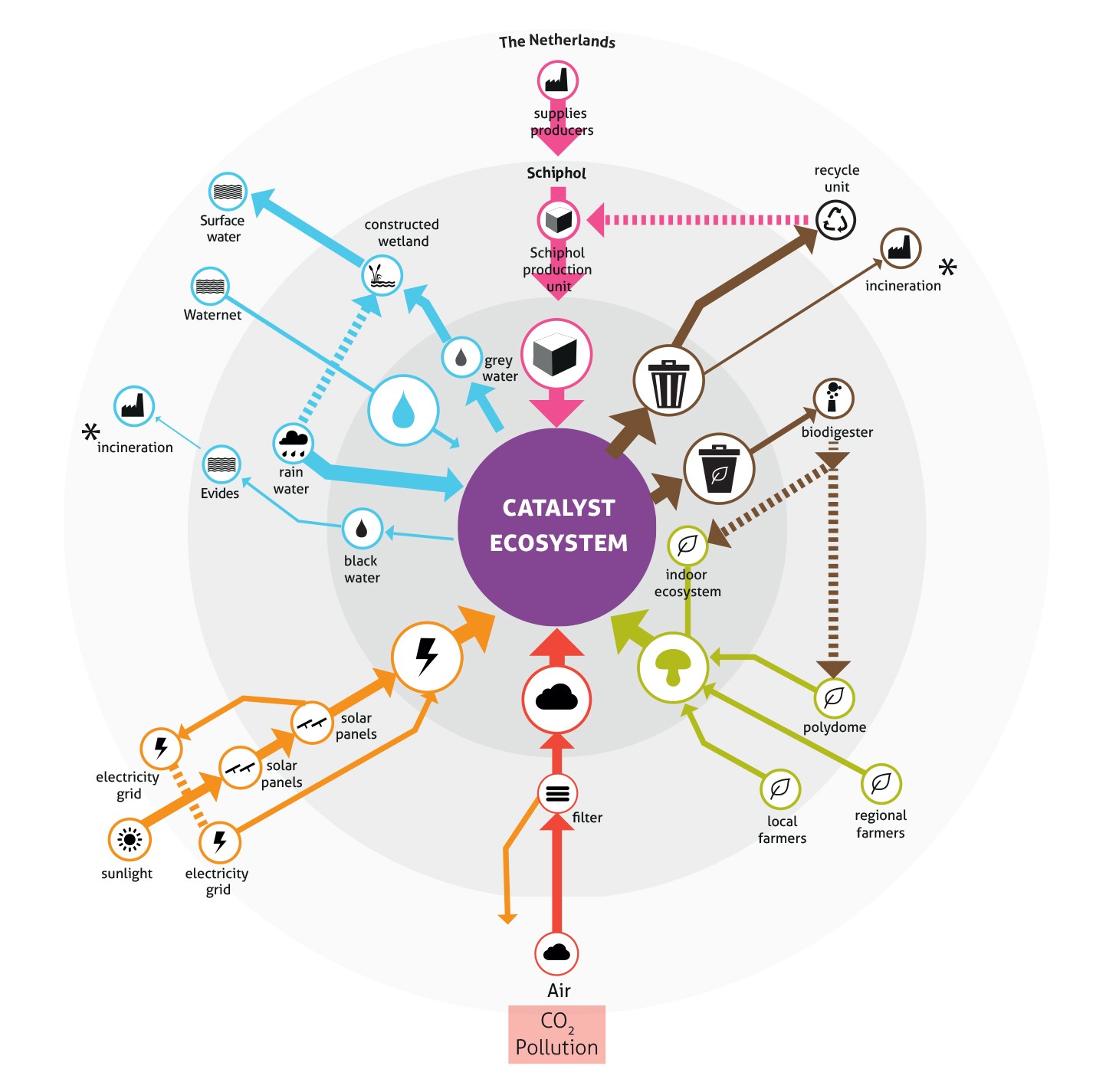
Rather than treating the building as a standalone structure, the team applied systems thinking to connect the Catalyst's resource flows with neighboring buildings. The concept established closed-loop systems for energy, water, and waste that extend beyond conventional solar panels and greywater treatment. By importing and processing waste streams from adjacent buildings, the Catalyst transforms its surroundings into a productive, circular district.
The Design
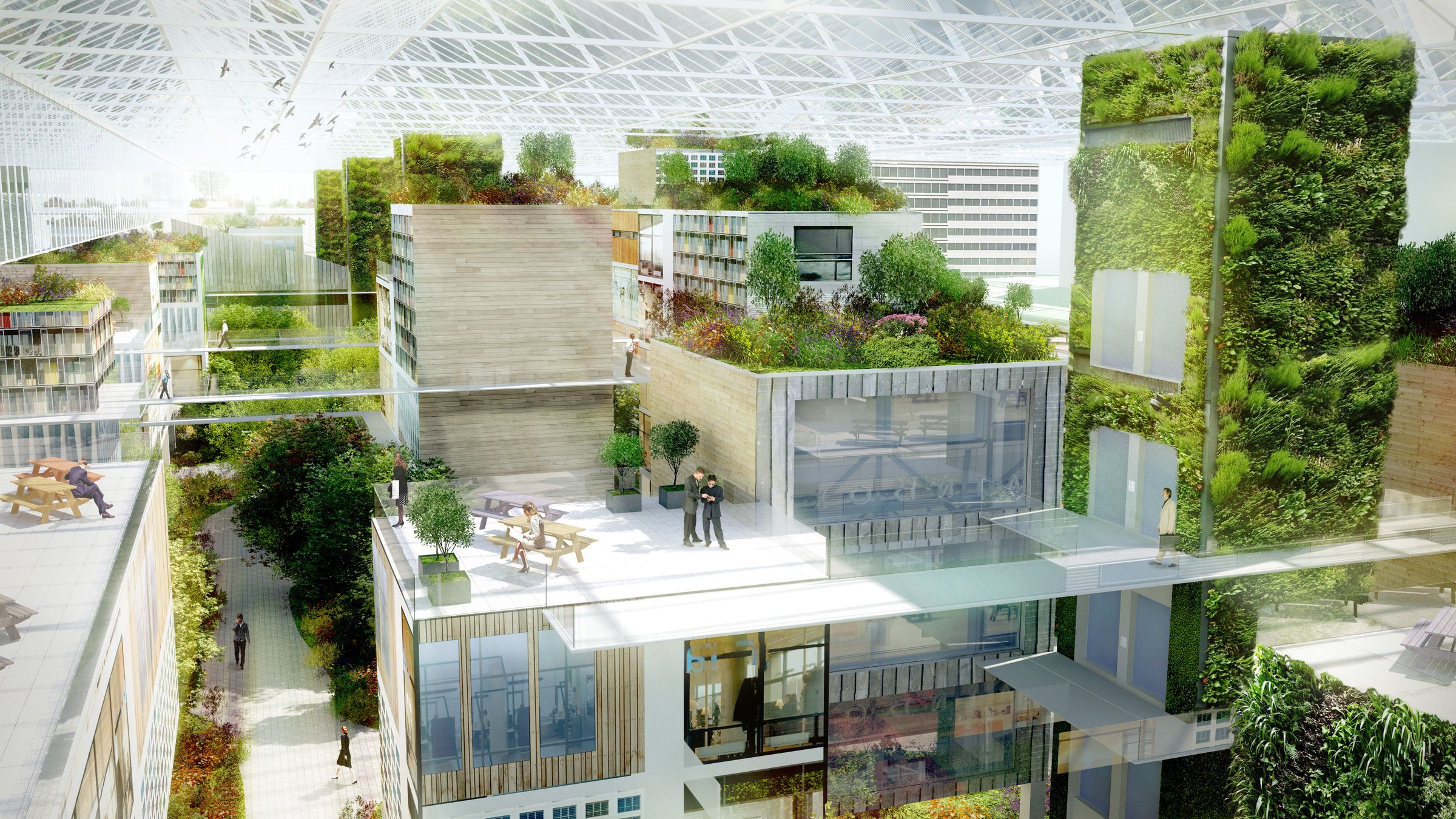
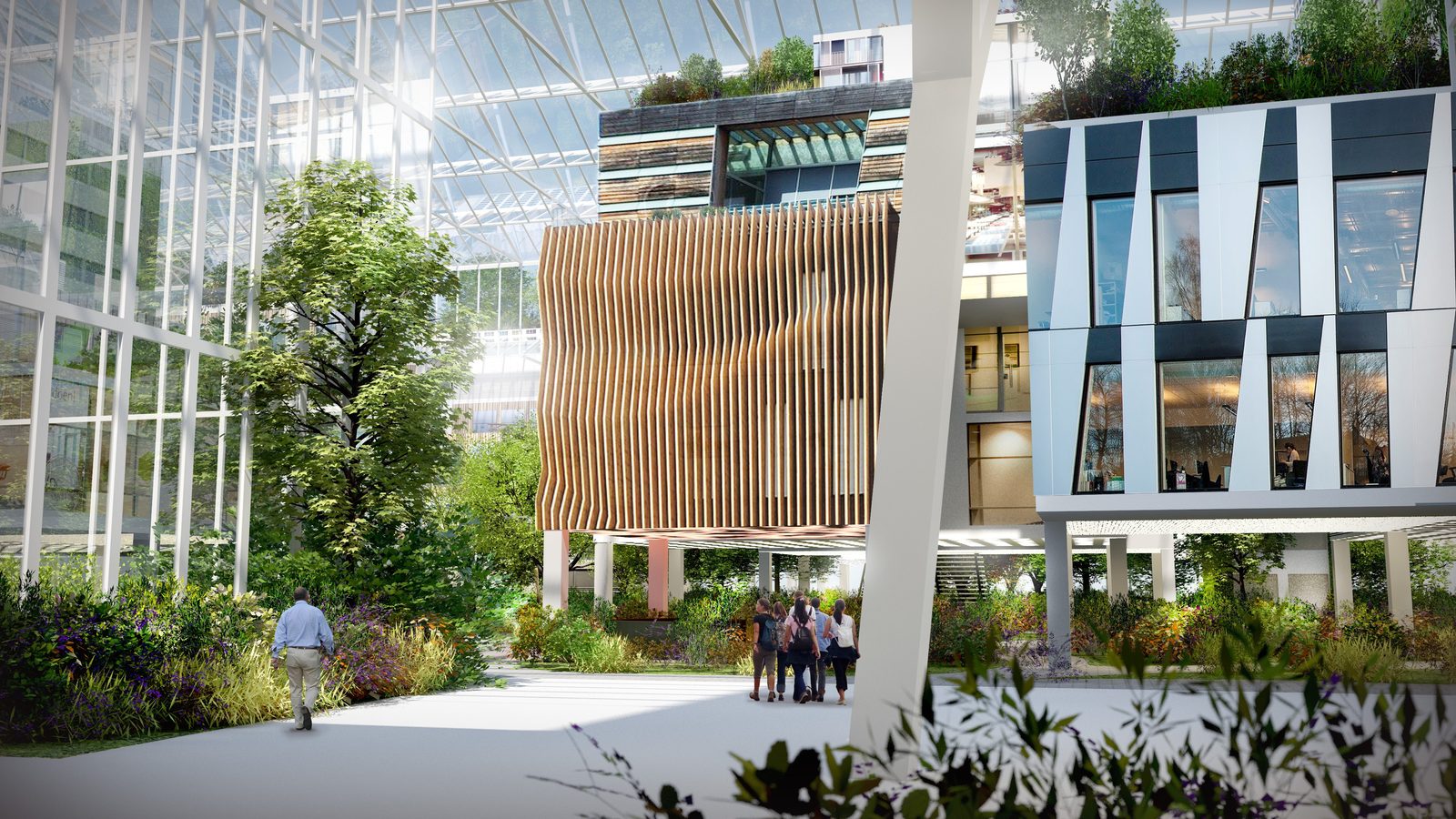
The resulting concept is architecturally distinctive. The lower layers handle parking and water storage. Above them, an elevated landscape and ecosystem serves as the building's metabolic core, enclosed in a transparent canopy that addresses airport safety restrictions while protecting a biodiverse indoor parkland with mature trees (otherwise restricted due to bird-strike concerns near runways).
Multiple stilted office pavilions sit within this landscape. Each tenant can customize their space while remaining connected to shared circular systems. The modular design enables cyclical renovation and relocation without disrupting the whole.
Outcomes
Modeling demonstrated that connecting the initial 10,000 m² building's energy, water, and waste systems to the surrounding 50,000 m² neighborhood substantially enhanced district-wide circularity and sustainability.
Research revealed a direct link between healthy building design and employee performance, with the concept demonstrating capacity to boost performance by over 10%, providing clear return-on-investment since employee costs represent the largest tenant expense.
As Tom Bosschaert noted: "The goals for the Catalyst building represent the most ground-breaking sustainability performance indicators for an office building to date, anywhere in the world."
Key SiD Methods Used
- ELSI framework for six-domain sustainability goal-setting
- System mapping of building and district resource flows
- Goals and indicators exceeding BREEAM/WELL benchmarks
- Circular economy integration at neighborhood scale
- Resilience thinking for adaptive, modular design