Tools: Green Chemistry and Spiral Dynamics
Where This Fits
This unit is part of the SiD Toolbox (Section 4). It covers two frameworks: Green Chemistry, which provides design principles for safer chemical processes at the object level, and Spiral Dynamics, which maps value-system evolution at the network and system levels. Both complement the SiD analytical approach.
Using Labels Wisely
Labels are tools, not answers. They standardize base quality levels and move the bottom of an industry upward. That has value. But they can also become a substitute for genuine systems thinking. The most useful practice is to know the landscape, understand what each label measures and what it ignores, and never mistake certification for sustainability.
What comes next: Chapter 4.6 presents the 12 Principles of Green Engineering, a practical design guide for physical systems.
Principles of Green Engineering
Where this fits: Part 4, Chapter 4.6. The 12 Principles of Green Engineering provide a practical design checklist for anyone working on physical systems. They complement SiD's systems-level approach with object-level design guidance.
Origin
Paul Anastas and Julie Zimmerman adapted the 12 Principles of Green Chemistry (conceived by Anastas and John Warner during their long career in sustainable industrial chemistry) into a generic set of engineering guidelines. These principles are useful for anyone designing and optimizing physical systems, from products to buildings to infrastructure.
A sister set, the 12 Principles of Green Chemistry, focuses on molecular-level design. Together they cover the full spectrum from chemistry to engineering.
The 12 Principles
1. Inherent Rather Than Circumstantial
Ensure that all material and energy inputs and outputs are as inherently nonhazardous as possible. Do not rely on circumstantial controls to manage hazardous substances. Design the hazard out at the source.
2. Prevention Instead of Treatment
Prevent waste rather than treat or clean up waste after it forms. The cheapest, safest waste is the waste that never exists.
3. Design for Separation
Design separation and purification operations to minimize energy consumption and material use. Every separation step consumes resources. Fewer steps, fewer losses.
4. Maximize Efficiency
Design products, processes, and systems to maximize mass, energy, space, and time efficiency. Waste in any of these dimensions is waste.
5. Output-Pulled vs. Input-Pushed
Design systems to be "output-pulled" rather than "input-pushed." Produce what is needed, when it is needed. Input-pushed systems overproduce and generate surplus, which becomes waste.
6. Conserve Complexity
Treat embedded entropy and complexity as an investment. When choosing between recycling, reuse, or disposal, recognize the energy and organization already invested in a material or product. Destroying complexity to rebuild it is wasteful.
7. Durability Rather Than Immortality
Design for targeted durability, not immortality. A product that outlasts its useful life by centuries (a plastic bag, a nuclear waste container) creates a different kind of problem. Match the lifespan of the product to its purpose.
8. Meet Need, Minimize Excess
Design for the actual need, not unnecessary capacity. "One size fits all" is a design flaw. Excess capability consumes excess resources.
9. Minimize Material Diversity
Minimize the variety of materials in multicomponent products. Fewer material types make disassembly easier and value retention higher at end of life.
10. Integrate Material and Energy Flows
Design products, processes, and systems to connect with available energy and material flows. Isolation is inefficiency. Integration creates symbiosis.
11. Design for Commercial Afterlife
Design products, processes, and systems for performance in a commercial "afterlife." What happens after the first use cycle is a design question, not an afterthought.
12. Renewable Rather Than Depleting
Choose renewable material and energy inputs over depleting ones. This is the simplest principle and the hardest to implement at scale.
Using These Principles with SiD
The Green Engineering principles operate primarily at the Object level of SiD's SNO framework (System, Network, Object). They are practical, concrete, and directly applicable to design decisions. SiD extends beyond these principles into Network-level dynamics (governance, relationships, flows) and System-level properties (Resilience, Autonomy, Harmony). The Green Engineering principles do not address these higher layers, but within their domain they are precise and useful.
Treat them as a design checklist. When working on the physical aspects of any SiD project, run the solution through these twelve questions. They will catch oversights that systems-level thinking alone may miss.
Source: ACS Green Engineering Principles
What comes next: Chapter 4.7 introduces Spiral Dynamics, a framework for understanding worldview conflicts and cultural evolution.
Spiral Dynamics
Where this fits: Part 4, Chapter 4.7. Spiral Dynamics helps explain why groups and individuals with different worldviews clash, and how to work with that friction. It operates in SiD's Culture domain (one of the ELSI-8 categories) and is particularly useful during stakeholder engagement and system understanding.
What It Is
Spiral Dynamics is a theory of human development created by Don Beck and Chris Cowan, introduced in 1996. It provides a structured way to understand and resolve friction between groups and individuals with opposing worldviews. As a practical tool, it offers a set of "glasses" for observing behavior, interests, and group dynamics.
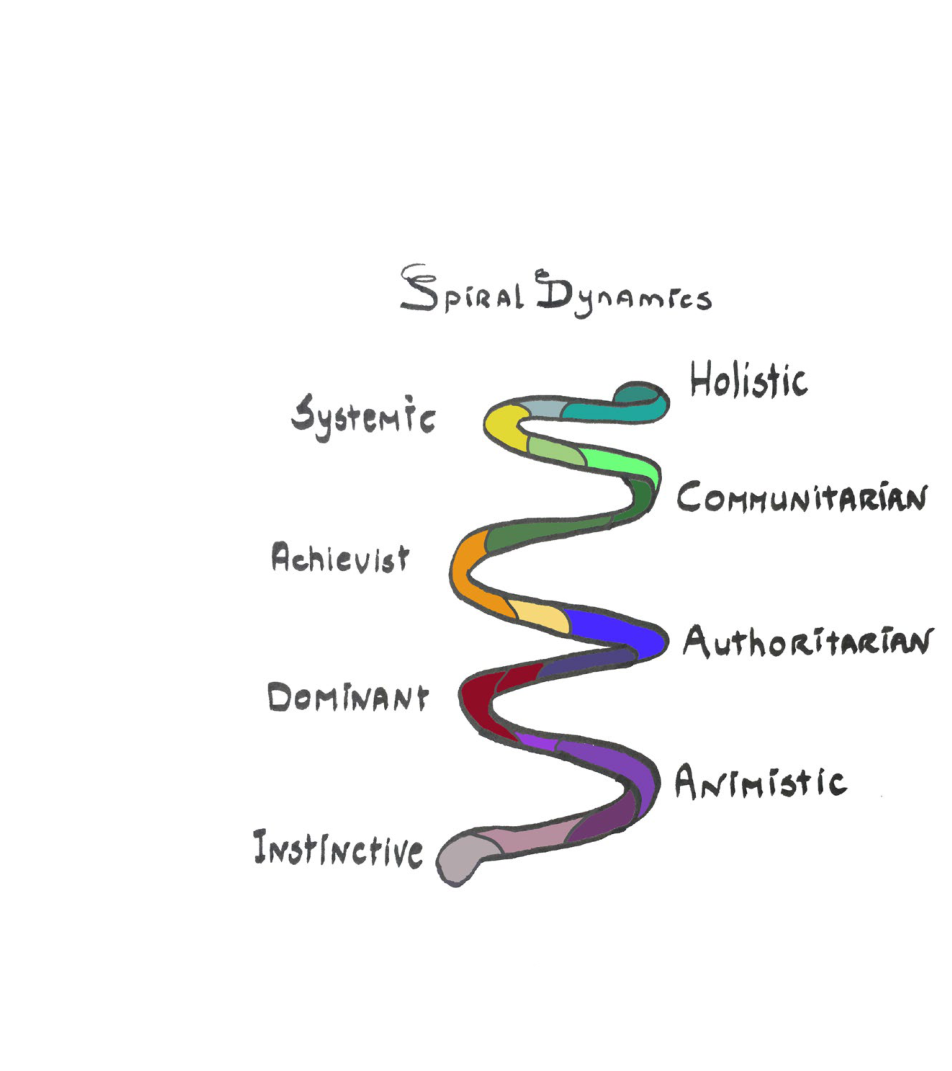
The theory organizes human value systems into a sequence of stages, each represented by a color. These stages are not random. They build on each other, each containing and transcending the ones before it.
Cultural Memes
The core concept is the "cultural meme," a cluster of values, perspectives, and behaviors that functions like a cultural gene, passed within and between groups. These memes include values, songs, fashion, and perspective, but at their core sits a dominant ideology.
Cultural memes live within people, sometimes across many generations, and evolve with their environment. Several memes coexist within any individual or group at any given time. One meme dominates. Under pressure, a person or group may fall back to an earlier, more foundational meme. This explains why behavior changes under stress: not erratically, but predictably, toward more basic survival-oriented patterns.
Each subsequent stage contains all the preceding ones, nesting like layers. Understanding this nesting is the key to the model's practical value: it explains not just what people believe, but why they believe it, and what they are likely to do when conditions change.
The Stages
Beige: Survival (c. 100,000 BC)
Express self to meet immediate physiological needs through instinct. This is pure biological survival. Think: early humans on the savanna, or any person in extreme crisis stripped down to basic needs.
Purple: Tribal (c. 50,000 BC)
Sacrifice self to the ways of the elders and customs. The individual is subsumed in the group. This is the level of traditional cultures, ancestral rituals, and deep kinship bonds. Sacred places, seasonal cycles, and oral traditions define reality.
Red: Power (c. 7,000 BC)
Express self impulsively for what self desires, without guilt. Dominance, conquest, immediate gratification. Expressed in the mentality of street gangs, warlords, and Viking raiders. Survival through force of will.
Blue: Order (c. 3,000 BC)
Sacrifice self for reward to come through obedience to rightful authority. Purpose, meaning, and moral code are paramount. Embodied by fundamentalist religions, rigid institutional hierarchies, and absolute moral systems. Right and wrong are fixed.
Orange: Achievement (c. 1,000 AD)
Express self strategically to reach goals without provoking the ire of important others. Rational, competitive, results-driven. This is the value system of the Scientific Revolution, the Industrial Revolution, and modern capitalism. Success is measured, optimized, and scaled.
Green: Community (c. 1850 onward)
Sacrifice self-interest for acceptance and group harmony. Egalitarian, pluralistic, sensitive to human feeling and ecological impact. Emerged in the 1960s counterculture and systems theory movements. Consensus, inclusion, and shared power are core values.
Yellow: Integrative (c. 1950s)
Express self not for personal desire, but to avoid harm to others so that all life benefits. This is the first stage that genuinely integrates all previous stages. Systems thinking becomes natural. Flexibility, competence, and functionality matter more than status or belonging.
Turquoise: Holistic (c. 1970s)
An integrative system combining necessary self-interest with the interests of all communities in which the organism participates. The theory at this level is still forming. Think of it as Yellow's systemic awareness extended to a global and ecological scale.
Why It Matters for Sustainability Work
Sustainability projects routinely fail because of worldview collisions. An Orange-dominant business executive and a Green-dominant environmental activist may share the same goal (less pollution) while being unable to collaborate because their underlying value systems are incompatible in their framing, language, and priorities.
Spiral Dynamics does not resolve these collisions by declaring one stage superior. It provides a diagnostic: where is each stakeholder operating from? What language and framing will reach them? What happens to their behavior under stress?
For SiD practitioners, this is relevant in at least three places. During stakeholder analysis, it explains why certain groups resist certain solutions. During co-creation sessions, it helps facilitators design processes that speak to multiple value systems. During roadmapping, it clarifies which communication strategies will gain traction with which audiences.
The model is a lens, not a label. Avoid the temptation to categorize individuals as "Orange" or "Green" and stop there. Most people carry multiple active memes. Context determines which one leads.
Source: spiraldynamics.org
What comes next: Chapter 4.9 covers Life Cycle Assessment (LCA), the standard method for evaluating environmental impacts across a product's life.
Blue Economy
Where this fits
This chapter is part of the SiD Toolbox (Section 4). The Blue Economy is a design philosophy and business model that aligns closely with SiD's core principles. It sits within the "Solutioning and Roadmapping" phase as an inspiration source for generating solutions that produce zero waste while creating jobs and social capital.
The core idea
The Blue Economy, developed by Gunter Pauli and presented in his 2010 book The Blue Economy: 10 Years, 100 Innovations, 100 Million Jobs, proposes a simple shift: instead of asking how to reduce environmental damage, ask how to eliminate the concept of waste entirely.
The logic comes from ecosystems. In a forest, there is no waste. A fallen leaf becomes food for fungi, which become food for insects, which become food for birds. Every output is an input somewhere else. The Blue Economy applies this principle to business: design systems where the waste product of one process becomes the raw material for another.
Takeaway
Green Chemistry provides 12 principles for designing safer chemical processes. Spiral Dynamics maps the evolution of value systems in societies and organizations. Both tools complement SiD: Green Chemistry at the object level, Spiral Dynamics at the network and system levels.
This knowledge is free because of our supporters. Join them.