Tools: GRI and Sustainability Labels
Where this fits: Part 4, Chapter 4.4. The GRI is an industry-standard reporting framework. Understanding its strengths and weaknesses helps sustainability professionals work within established systems while recognizing their limits.
What is the GRI?
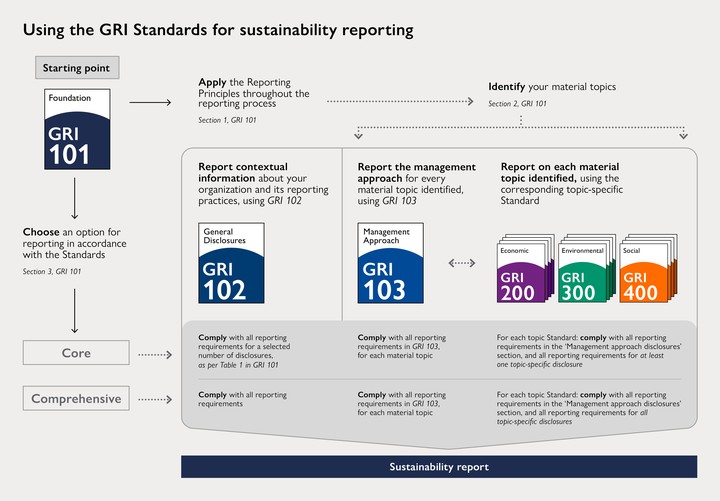
The GRI is an international standard that helps organizations report their sustainability-related impacts: climate change, human rights, corruption, and more. First released in 2000 by a non-profit of the same name, it provides a freely available set of guidelines for structuring, standardizing, and regulating sustainability and CSR reports.
The GRI is now widespread. By 2017, 75% of the Fortune Global 250 reported using its guidelines. It has become a near-mandatory standard among multinational corporations.
What It Does Well
The GRI gives organizations of all sizes a common language for sustainability reporting. It standardizes supplier relationship tiers and provides a graduated approach: organizations increase their sustainability intelligence by expanding the scope and depth of their data collection across tiers.
The standard draws on other established frameworks for specific domains. ISO standards cover environmental impact measurement. OHSAS standards cover health and safety.
What It Does Not Do
Two things are worth noting clearly.
The GRI does not improve impacts. It is a transparency framework, not a performance framework. Adopting the GRI gives an organization a standardized way to report, not a method for doing better. The standard focuses on reporting itself, not on making reports more useful, insightful, or likely to drive action.
The GRI is vulnerable to manipulation. As a largely voluntary standard, organizations choose which aspects to report, the scope of reporting, and the context against which impacts are measured (for example, whether to benchmark against planetary boundaries). For organizations wanting to obscure or inflate their performance, the current framework makes this easy to do. This makes the GRI, in its current form, a weak standard that requires disciplined application and independent third-party auditing to be effective.
The GRI Process
The GRI process consists of three phases:
- Identification of impacts.
- Prioritization of impacts.
- Validation of impact data.
Results are reported using standardized formats and guidelines. The GRI website contains extensive documentation on each phase.
How SiD Connects
SiD can support GRI reporting in several ways: helping identify impacts through ELSI-8 scanning, ensuring an integrated set of impact measurements, setting measurement standards, and providing systemic insight into the causes of impacts and potential solutions for improving them. Where the GRI tells you what to report, SiD helps you understand what drives those numbers.
Sustainability Labels and Certificates
The Uncomfortable Truth About Labels
Sustainability labels and certifications exist to raise the floor of an industry: to set minimum standards and give consumers a signal of responsible practice. In this, they serve a real purpose.
But no single label guarantees sustainable performance. Their quality, transparency, effectiveness, and rigor vary enormously. Some are strong, science-backed certifications with independent auditing. Others are little more than voluntary self-reporting. A few may actively detract from genuine sustainable impact by creating a false sense of progress.
The deeper problem is structural. Virtually no sustainability label operates at the systems level. A product may score well on a label's criteria while contributing to negative system-level outcomes: deforestation displaced to another region, labor exploitation shifted to a different tier of the supply chain, ecological damage moved from one ELSI-8 domain (Energy, Land use, Materials, Ecosystems, Species, Culture, Economy, Health and Happiness) to another.
When evaluating any label, ask: Is it voluntary or mandatory? What is its scope and focus? How is accreditation handled? Who audits, and how independently? An extended index of eco-labels is available at ecolabelindex.com.
For Company Impact Performance
Dow Jones Sustainability Index (DJSI). Since 1999, DJSI has scored more than 1,000 companies on their sustainability performance. It provides a useful barometer of corporate sustainability awareness, though being indexed is not the same as being sustainable.
ISO 14001 (1996). A voluntary international standard for organizations, primarily in industry, focused on environmental management systems.
B Corp. A voluntary standard for organizations wanting to pioneer sustainable business and operations. Covers governance, workers, community, environment, and customers.
Carbon Trust / Gold Standard. Two of many carbon certification labels and organizations. These focus primarily on carbon and are often connected to tradable carbon offset markets. The narrow focus on a single metric is both their strength (clarity) and their weakness (everything else is invisible).
For Products
Forest Stewardship Council (FSC) and Programme for the Endorsement of Forest Certification (PEFC). Two of the oldest and most respected sustainability labels, focused on sustainable forestry and forestry products such as paper and timber. FSC and PEFC work very differently but pursue the same goal. Comparing their approaches is a useful case study for anyone designing new certification systems.
Marine Stewardship Council (MSC) and Aquaculture Stewardship Council (ASC). Labels for responsibly sourced fish. MSC covers wild-caught; ASC covers farmed. Both are strong environmental certifications. ASC places limited focus on social aspects and animal welfare; MSC places none.
Fairtrade and Max Havelaar. Formed in the 1960s, focused on socially equitable supply chains. Max Havelaar was the first formal initiative and label (1988), originating in the Netherlands.
OEKO-TEX. A family of labels for the textile and leather industry, managed by the International Association for Research and Testing in the Field of Textile and Leather Ecology since 1992.
EU Ecolabel. A voluntary standard for products focused on ecological impact across their life cycle (1992). It has localized variants with country-specific requirements.
Energy Star. Established in 1992 by the US Environmental Protection Agency. Focused on promoting and labeling energy-efficient products.
For Real Estate
BREEAM (Building Research Establishment Environmental Assessment Method). Established in 1990 in the UK, one of the first voluntary green building standards. It has expanded into labels for neighborhoods, reconstruction, and other countries. Focuses almost exclusively on direct environmental impact.
LEED (Leadership in Energy and Environmental Design). A voluntary green building program from the United States (1992), similar to BREEAM but more centralized in its accreditation process. Also focuses primarily on direct environmental building performance through checklists.
Living Building Challenge (LBC). From 2006, a more rigorous, ambitious, and modern certification than BREEAM or LEED. It includes health, wellbeing, and social justice, making it closer to a systems-level standard.
WELL Standard. Launched in 2003, focused on the wellbeing and health of building occupants. Addresses a dimension (human experience of the built environment) that most other building certifications overlook.
Green Key. A voluntary self-reporting standard for hotels and the hospitality industry. Generally a weak standard within an industry that has been slow to respond to sustainability challenges.
Takeaway
The GRI and sustainability labels are useful reporting and communication tools, but they measure compliance, not systemic sustainability. Use them as inputs to a SiD process, not as substitutes for one.
This knowledge is free because of our supporters. Join them.