Tools: Permaculture Principles
- Where This Fits
- The Blue Economy
- Principles
- Connection to SiD
- Examples in practice
- The Borneo parable
- Resources
- Takeaway
- Where this fits
- The invisible foundation
- Why Natural Capital?
- How Natural Capital Accounting works
- How do we value nature?
- SiD as a structure for value
- Opportunities in policy
- Advantages for business
- Making it happen
- Resources
- Takeaway
- Where this fits
Where This Fits
This unit is part of the SiD Toolbox (Section 4). It covers the Blue Economy model, Permaculture design principles, and practical brainstorming techniques. These tools support the Solutioning phase of the SiD method by providing nature-inspired design strategies and structured ideation methods.
The Blue Economy
This differs from the "green economy" approach, which often asks consumers and businesses to pay more for less environmental harm. The Blue Economy aims to deliver more value, not less, while eliminating harm entirely. Pauli's argument: sustainability should not be a luxury that costs extra. It should be the smarter, cheaper, better option.
Principles
The Blue Economy operates on several core principles:
- Use what you have. Solutions should rely on locally available resources, physics, and biology rather than imported technologies or rare materials.
- Replace something with nothing. The best solution eliminates the need for a product or input entirely. If you can design a building that does not need air conditioning (through passive ventilation and thermal mass), you have replaced an energy-consuming system with nothing.
- Cascade nutrients and energy. Model industrial systems on food webs. Every output feeds another process. This creates multiple revenue streams from a single input.
- Seek multiple benefits. Nature never optimizes for one thing. A mangrove forest simultaneously filters water, protects coastlines, sequesters carbon, provides nursery habitat for fish, and supports livelihoods. Solutions should aim for this kind of multi-benefit integration.
Connection to SiD
The Blue Economy resonates strongly with SiD's framework. In SNO terms (System, Network, Object layers):
- At the Object layer, Blue Economy solutions redesign physical products and processes to eliminate waste.
- At the Network layer, they create industrial ecosystems where businesses are linked through material and energy flows, much like organisms in an ecosystem.
- At the System layer, they shift the governing logic from "minimize harm" to "generate value through integration."
The RAH goals (Resilience, Autonomy, Harmony) map naturally: cascading resource flows build resilience through redundancy, local sourcing builds autonomy, and waste elimination moves toward harmony with living systems.
Examples in practice
Pauli's book catalogs over 100 case studies. A few illustrate the principles:
Coffee grounds to mushrooms. Spent coffee grounds, normally waste, become substrate for growing mushrooms. The mushroom harvest generates revenue. The spent substrate then becomes animal feed or compost. Three value streams from one waste product.
Stone paper. Paper made from calcium carbonate (limestone waste from mining) requires no water, no bleach, no acids, and no trees. It is waterproof and fully recyclable. It replaces a resource-intensive product with one made from an abundant waste material.
Windbreaks to biogas. Trees planted as windbreaks on farms simultaneously prevent soil erosion, create habitat, produce biomass for biogas, and generate timber. A single intervention with cascading benefits across multiple ELSI-8 domains (Energy, Land use, Ecosystems, Economy).
The Borneo parable
One of the most vivid illustrations of why systemic thinking matters comes from Borneo. In the 1950s, the World Health Organization sprayed large amounts of DDT in a remote village to combat malaria. The DDT killed the mosquitoes. But geckos ate the poisoned insects and accumulated DDT in their bodies.
Cats ate the geckos and died. Without cats, the rat population exploded, bringing new disease risks far worse than the original problem. The Royal Air Force eventually airdropped crates of cats by parachute into the village to restore balance: Operation Cat Drop.
This true story illustrates what happens when you apply object-level solutions (DDT) without understanding network and system-level consequences. It is the kind of failure the Blue Economy, and SiD more broadly, exist to prevent. Every intervention cascades through the system. Design with that cascade in mind, and you create value. Ignore it, and you create new problems.
Resources
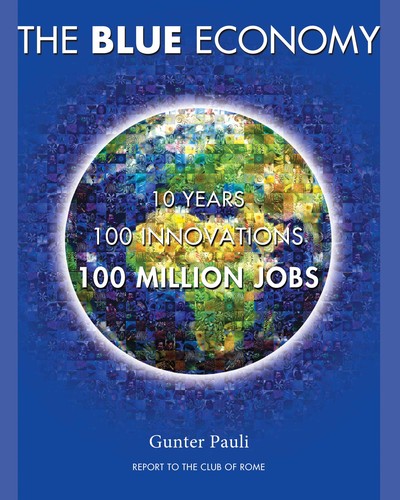
- Gunter Pauli, The Blue Economy: 10 Years, 100 Innovations, 100 Million Jobs (2010)
- The Blue Economy website: theblueeconomy.org
- Search "Cats in Borneo" on YouTube for the full Operation Cat Drop story
Takeaway
The Blue Economy shows that sustainability does not have to mean sacrifice. By modeling business systems on ecosystems, where every output becomes an input, you can eliminate waste, create jobs, and generate value simultaneously. The key is designing at the system level, not just the object level.
Next: Circular Economy, which extends these principles into a comprehensive framework for eliminating waste across entire economic systems.
Natural Capital
Where this fits
This chapter is part of the SiD Toolbox (Section 4). Natural Capital connects to nearly every ELSI-8 domain (Energy, Land use, Materials, Ecosystems, Species, Culture, Economy, Health and Happiness) and operates across all three SNO layers. It addresses a fundamental flaw in conventional economics: the value of nature is set to zero.
The invisible foundation
The land we grow our food on. Water that flows through it. Animals and plants living in this environment. The oceans, birthplace of life. This, and more, is our natural capital: the value represented by our ecosystems, species, and everything in between that we rely on to persist on this planet.
All of our natural systems are declining fast. This threatens our future. It puts at risk any business with a complex supply chain, and jeopardizes the resource availability of any nation.
The Natural Capital (NC) movement attempts to halt and reverse this trend by embedding the value of natural systems into economic systems as a financial value.
Why Natural Capital?
The concept has been around for more than a century, and it is not without controversy. Can we value nature in financial terms at all? The ethical debate has been going on for decades, raising questions without clear answers.
But the global decline of nature pressures us for action. Nature currently is given limited economic value, causing it to be regularly sacrificed. This "tragedy of the commons" plagues conservation efforts, and the debate itself has delayed solutions, resulting in preventable losses.
At the 2013 World Forum on Natural Capital in Edinburgh, organized by the Scottish Wildlife Trust, most policy and business representatives agreed it was time to put the ethical discussion to the background and take action. Barry Gardiner, UK shadow minister for the environment, stated it plainly:
"We use nature because it gives us value, and we destroy it because it's free. Nature should be given the rightful value it deserves. It's the only real way we can safeguard our natural resources for the future."
NC is one of the few tools that allows direct action. The challenge can be summarized: what mechanisms make natural capital work, how do we value nature in all its facets, and how do we create advantage for policy and business to drive rapid implementation?
How Natural Capital Accounting works
The solution supported by the largest NGOs introduces national NC profit and loss balance sheets (EPL) in each country and company, tracking this balance as is done with finance. These balance sheets express Natural Capital both in terms of quantity and quality of resources (amounts of forests, water, biodiversity) and, where possible, as currency. For every asset that disappears from the balance sheet, something else needs to be brought back.
This functions to increase awareness and transparency about the state of our natural resources and improve their management. When successful, Natural Capital Accounting (NCA) injects a balancing system for our planet's physical limits to growth into an economy currently aimed at capitalizing on limitless growth.
Implementation carries risk. The carbon credit scheme demonstrates how incomplete valuation creates perverse incentives, shifting damage from one place to another. To prevent this, NCA needs to account for the full spectrum of value we recognize today and leave room for values that appear in the future. Values that cannot be expressed in monetary equivalents need to appear on balance sheets in their qualitative form.
Professor Dieter Helm explained at the Edinburgh forum:
"We do not need to be entirely correct in our assessment of Natural Capital. Even if we're only 80% or even 50% in the ballpark, that's at least better than the value of zero we have currently. We need to act, now, to prevent further losses to an already marginalized system."
How do we value nature?
This is the greatest challenge. What value does a tree have? Ask a hundred scientists and economists and you will get a hundred different answers.
A tree is worth more than the price of its wood. It provides a home to animals. It acts as shade in summer. It buffers and filters rainwater. It cleans the air. It supplies ecosystem services. It may be culturally valuable, and it plays a role in the ecosystem as a whole. The value of a tree in its entirety is not the same as the price for its wood in the store.
Studies have attempted to quantify these values. Johnson and Wardle gave the Canadian Boreal forest a value of US$3.7 trillion for its ecosystem services and carbon sequestration. Costanza et al. (1997) put a price tag of US$33 trillion on the world's biosphere ecosystem services. These studies provide starting points, but large gaps remain. A more inclusive framework to assess value is necessary.
SiD as a structure for value
The SiD systems analysis framework provides such a tool. It can assess the full spectrum of value for any given subject, including the relational values of the system as a whole. Its flexible structure allows room for future discovery while providing clarity to start valuing with limited insight today.
Using SiD's SNO framework, the value of a tree can be seen on three scales:
- Object layer: Direct physical value. The wood, fruit, shade, and air filtration the tree provides.
- Network layer: Service and relational value. The tree's role in water cycling, habitat provision, soil stabilization, and its connections to other organisms.
- System layer: Whole-system value. The tree's contribution to climate regulation, biodiversity, ecosystem resilience, and cultural meaning.
The first scale is the easiest to assess. The last is the hardest but has the most impact. Combining all three produces a comprehensive estimation of the tree's Natural Capital value.
SiD also reserves room for values like transparency, diversity, health, and wellbeing to be integrated once research makes them available. Because it is a universal framework, it can be inclusive of other movements such as social justice or poverty alleviation. This flexibility prevents the system from becoming rigid after adoption, avoiding the perverse incentives that occur when real value and measured value diverge (an issue that plagues carbon trading).
Opportunities in policy
Progress in policy is slow, hampered by lack of oversight, valuation tools, accessible knowledge databases, and stakeholder awareness. These challenges can be solved more effectively with systems thinking than traditional approaches.
One way to accelerate: apply distributed innovation mechanisms such as crowd-solutioning and serious gaming. These approaches have resolved highly complex problems (like unraveling the secrets of protein folding) in weeks, where teams of scientists previously took years. Applied to the obstacles holding back Natural Capital, solutions could be implemented at a much faster rate.
Advantages for business
At first sight, business may not seem to have an interest in Natural Capital. But there are several reasons why NCA is not only advantageous but critical:
Supply chain resilience. Most companies rely on natural resources somewhere in their supply chain, yet may not know where or how. Tracking NC is essential to ensure continued business in both the short and long term. If a sizeable business is not tracking this, it is not conducting proper risk management.
Cost savings through ecosystem services. Companies have found bio-based alternatives to artificial or fossil resources that save money and provide long-term sourcing security.
First-mover advantage. Being ahead of the curve on issues that governments will eventually mandate avoids costly forced compliance later. Puma started publishing the first Environmental Profit and Loss Account (EPLA) under direction of their holding company Kering, tracking 145 million in environmental impacts in 2010. This resulted in positive press globally, several companies following suit, and creating a catch-up game for everyone else.
Financial sector pressure. Insurance companies are becoming interested in NCA, since threats to a company's resource base are threats to the company itself. Standards and Poor's, one of the Big Three credit rating firms, is investigating Natural Capital Accounting as a new input, directly affecting credit ratings.
Making it happen
A structured and systemic approach is critical to make NC succeed. This is why solutions like SiD exist. The front runners in policy, business, and NGOs should be brought together to collectively accelerate the process and support each other. We have the tools, expertise, and capacity. The task is implementation.
Resources
- OpenNESS: Translating NC and Ecosystem Services into operational frameworks. openness-project.eu
- Natural Capital Toolkit (WBCSD): shift.tools/contributors/551
- Natural Capital Plant Database: permacultureplantdata.com
Takeaway
Natural Capital addresses the most dangerous flaw in conventional economics: treating nature as free. By embedding nature's value into balance sheets, using frameworks like SiD's SNO layers to capture the full spectrum from physical resources to systemic contributions, we create the conditions for an economy that works within planetary limits. The tools exist. The data, while imperfect, is good enough to start. What remains is the will to act.
Next: Brainstorm Rules, practical guidelines for generating ideas effectively in team settings.
Brainstorm Rules
Where this fits
This chapter is part of the SiD Toolbox (Section 4). Brainstorming is a core technique used throughout SiD's five-step method, particularly during System Understanding (step 3) and Solutioning and Roadmapping (step 4). Done well, it generates the raw material from which systemic solutions emerge. Done poorly, it wastes everyone's time.
This knowledge is free because of our supporters. Join them.