In 1999, the Dutch designer and engineer Tom Bosschaert set out to find systemic solutions for the critical challenges facing our society. After evaluating existing frameworks and finding them incomplete, he began building what would become Symbiosis in Development: an open, integrated approach to sustainability grounded in systems science and refined across more than 700 projects on six continents.
This is the story of why SiD exists, what it stands for, and why it matters now more than ever.
The problem SiD was made to solve
Our world is becoming increasingly complex. The impact of a growing population on a finite planet is multiplied by the need for better living standards for all, and by escalating challenges in climate, resources, and social justice. Seven of nine planetary boundaries have been breached. The systems that sustain human civilization are under pressure in ways we have never experienced before.
Yet most approaches to sustainability focus on isolated symptoms: energy here, circularity there, social equity somewhere else. They optimize for single metrics while ignoring the interconnected systems that produce those metrics. The result is well-intentioned efforts that miss the mark, or worse, create new problems while solving old ones.
"The systems we have built are extraordinary; the ones we have failed to build are even more extraordinary. Both testify to the difficulty of seeing the whole."
Jay Forrester, founder of system dynamics
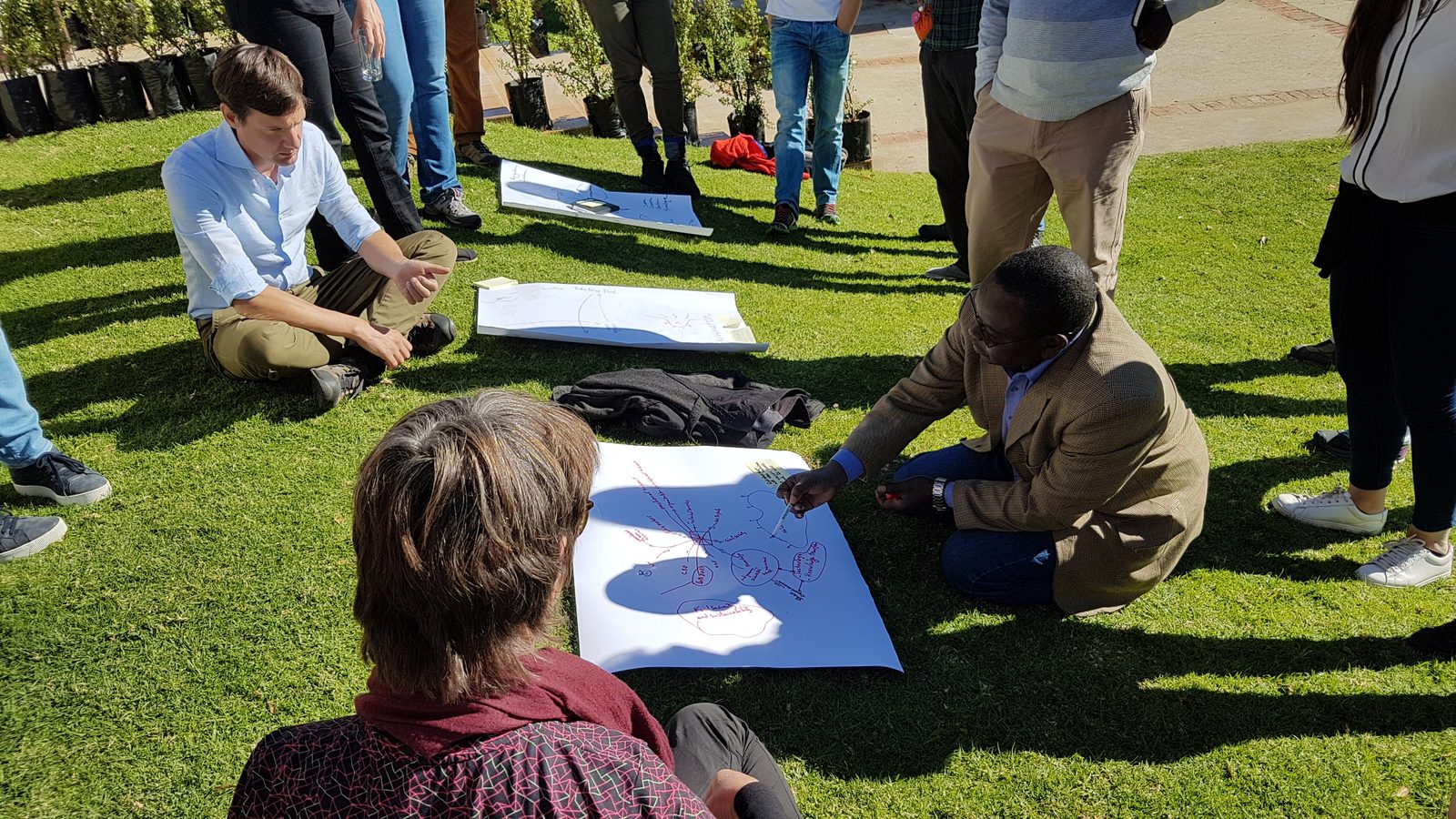
SiD was built to see the whole. Not as an abstract exercise, but as a practical necessity. To meet the challenges of our time, we need an approach that works from idea to execution, that connects causes to consequences across scales and time horizons, and that allows teams to distribute tasks and work towards a common goal. This is what SiD was made to do.
Systems, not symptoms
The word "complex" has been diluted by management literature to mean simply "difficult." That is not what it means in the sense that matters. A system is complex when its behavior emerges from the interaction of its components rather than being the sum of them, when feedback loops cause effects to circle back and change the conditions that produced them, and when time delays separate causes from consequences in ways that make intuition unreliable.
"A system is a set of things interconnected in such a way that they produce their own pattern of behavior over time. The system, to a large extent, causes its own behavior."
Donella Meadows, systems analyst
Supply chains, ecosystems, cities, economies, public health, food systems: all of them are complex in this precise sense. They contain feedback, non-linearity, and time delay. The standard tools of strategy and planning treat these systems as static backdrops. SiD treats them as the subject of analysis.
This changes everything about how you design interventions. Non-linearity means that leverage exists in specific places, and finding those places matters more than applying uniform pressure everywhere. Time delays mean that early indicators of future conditions are more valuable than current performance metrics. Emergence means that coordinated portfolios of action outperform isolated initiatives. And adaptivity means that building learning into the design is a prerequisite for durable results.
Beyond fragmented sustainability
SiD covers the full spectrum of sustainability: from circular energy, materials, ecosystems and biodiversity to culture, economy, health and happiness. It does this not by adding more categories to a checklist, but by mapping the causal relationships between them.
"If we are to use the world wisely, we need to understand how it actually works, not how we assume it works, and the gap between those two things is where most strategic error lives."
E.O. Wilson, biologist and naturalist
The SiD framework uses four nested dimensions to structure this analysis. Environment encompasses the physical and ecological systems that all others depend on. Liveability addresses the conditions that make human life healthy, safe, and dignified. Social describes the relationships, institutions, and cultural patterns that bind communities. And Institutional covers the governance structures, rules, and decision-making processes that shape how systems are managed.
These dimensions are not independent categories. They are causally nested: institutional decisions shape social dynamics, which determine liveability conditions, which depend on environmental integrity. Understanding this nesting is what makes SiD different from frameworks that treat sustainability as a balanced scorecard of unrelated metrics.
From understanding to action
Analysis without action is academic. SiD was built as a practical tool, not a theoretical construct. It supports the entire lifecycle of a project: from team building through co-creation sessions, from systemic analysis through concept development, to the implementation of concrete action plans.
"The only way to understand a complex system is to get into it. You cannot stand outside and observe. You must change your relationship to it."
Russell Ackoff, systems theorist
The backcasting method central to SiD begins with the desired future state and works backward to identify the decisions that make it achievable. This is different from forecasting, which extrapolates from current trends. Backcasting asks: given where we need to be, what must be true at each earlier point, and what decisions now constrain or enable what is possible later? The result is a transition roadmap with explicit milestones, decision points, and learning loops.
SiD's modular setup allows inclusion of custom tools and methods. Any tool that helps analysis, development, or design plugs directly into the process. It is flexible enough to apply at any scale, from a single product to a city, from a company to an entire sector.
Open by design
Since 2014, SiD has been open-source and free to use, supported by the Except Integrated Sustainability Foundation. This was a deliberate choice. The challenges we face are too large and too urgent to restrict the tools that address them. SiD is licensed under Creative Commons BY-SA 4.0, which means anyone can use, adapt, and share it, provided they give credit and share their improvements under the same terms.
"A thing is right when it tends to preserve the integrity, stability, and beauty of the biotic community. It is wrong when it tends otherwise."
Aldo Leopold, conservationist
Hundreds of professionals use SiD daily. It has been taught at universities, applied by multinational companies and governments, and used in communities across the globe. The framework continues to evolve through practice: every project that uses SiD contributes to its refinement.
Why it matters now
We are living through a period of converging disruptions: climate change, biodiversity loss, resource depletion, social inequality, institutional erosion. These are not separate crises. They are interconnected expressions of the same underlying dynamic: systems designed for extraction operating beyond their boundaries.
"We cannot predict what we will discover, but we can design systems that help us discover and respond. The capacity to learn from a transition is itself a strategic asset."
Fritjof Capra, physicist and systems thinker
Responding to this requires more than incremental improvements to existing approaches. It requires the capacity to see systems whole, to identify where intervention is most effective, and to design coordinated responses that create lasting positive change. This is exactly what SiD was built to do, and what it has been doing for over 25 years.
The framework is ready. The community is growing. The question is not whether we can afford to think systemically. It is whether we can afford not to.