Biomimicry & DesignLens
Learning from Nature
Biomimicry emulates nature's strategies to solve human design challenges. Nature has 3.8 billion years of R&D: organisms that did not solve their challenges effectively are no longer with us. Within SiD, biomimicry is a solutioning tool used primarily in Step 4: Solutioning & Roadmapping.
Three Levels of Biomimicry
Form: Mimicking natural shapes and structures. Example: the Shinkansen bullet train nose modeled on a kingfisher's beak to reduce sonic booms.
Process: Mimicking natural processes. Example: manufacturing at ambient temperatures and pressures, as organisms do, instead of using extreme heat and toxic chemicals.
Ecosystem: Mimicking how natural ecosystems organize themselves. Example: industrial symbiosis where waste from one process becomes input for another, mimicking nutrient cycling.
The DesignLens
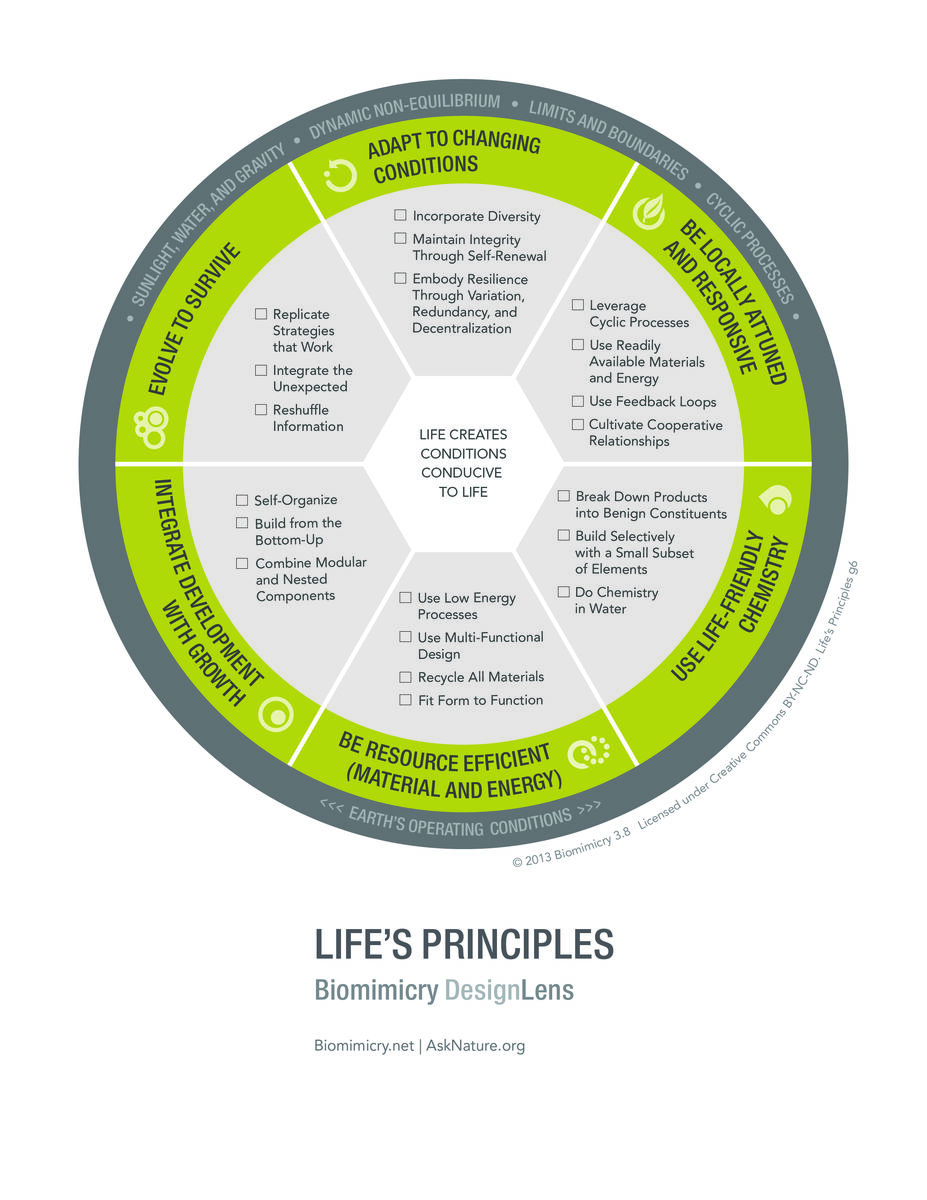
The Biomimicry DesignLens provides "Life's Principles" — strategies shared by all surviving organisms — as a checklist for sustainable design: adapt to changing conditions, be locally attuned and responsive, use life-friendly chemistry, be resource efficient, integrate development with growth, evolve to survive.
Biomimicry in SiD
The ecosystem level of biomimicry connects directly to SiD's system-level thinking. Natural ecosystems demonstrate the properties SiD values most: resilience through diversity and redundancy, autonomy through closed material loops, and harmony through balanced relationships. These map directly onto the RAH system indicators. Nature's strategies often suggest network and system-level solutions that conventional engineering approaches miss.