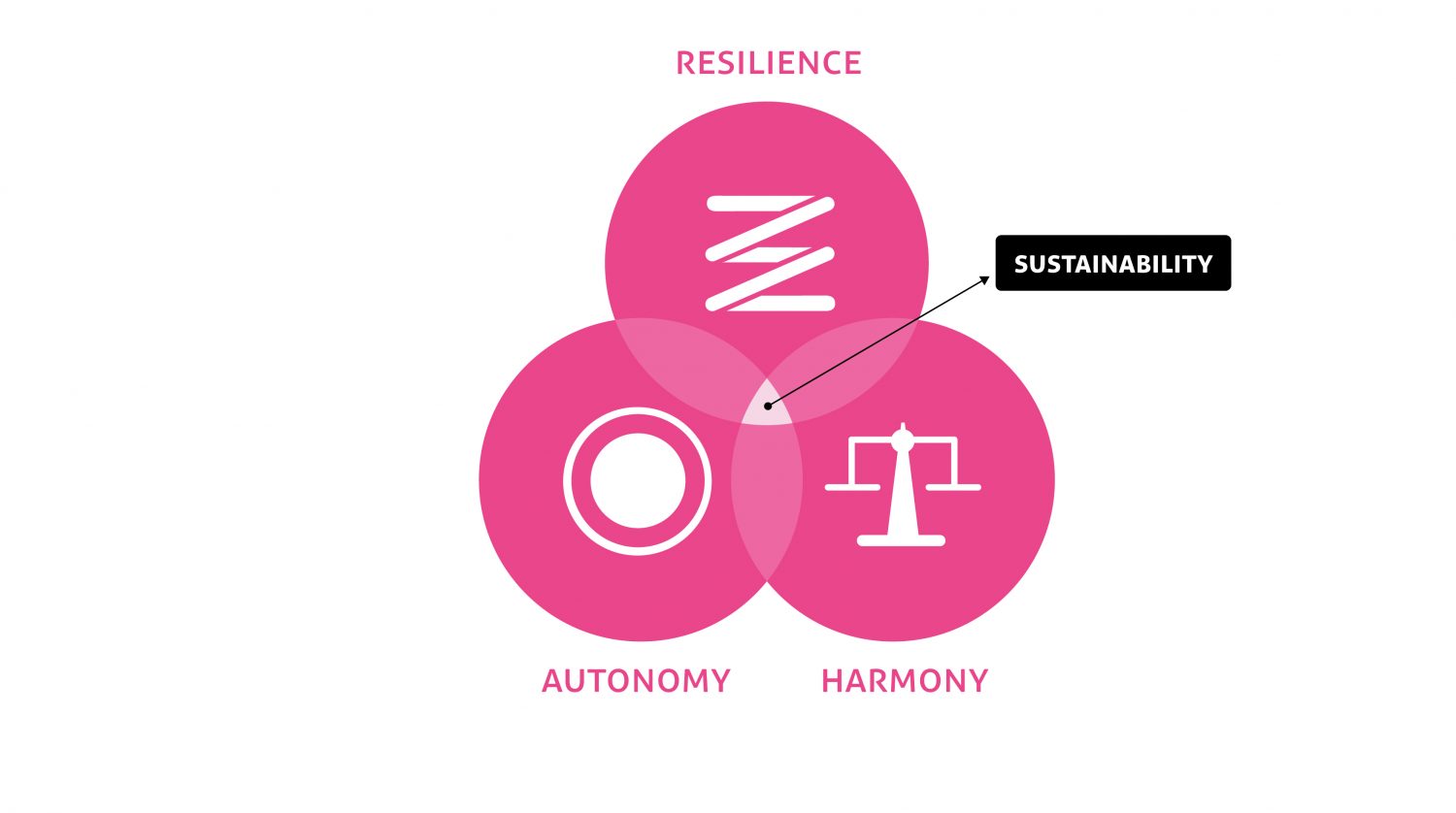
Goals & Indicators
Step 1: Where Do We Go?
This step sets goals, determines vision, establishes indicators, and defines system boundaries. Stakeholder demands, time, and budget constraints find their home here. Outputs from Step 1 feed directly into Step 2: System Mapping.
Setting Good Goals
Goals are set with the full team including the client, then revisited with stakeholders. Good goals are expressed at a system level and performatively: they describe intended outcomes and system performance, not specific solutions. This preserves the widest possible solution space.
Bad goal: "All buildings should use solar panels to provide electricity." This locks in a specific technology and closes off alternatives.
Better goal: "The neighborhood provides its own renewable energy." This allows solar panels and other approaches.
System-level goal: "The neighborhood's energy system contributes to the resilience of the wider community." This opens the widest solution space and connects the object to its context.
Sub-Goals
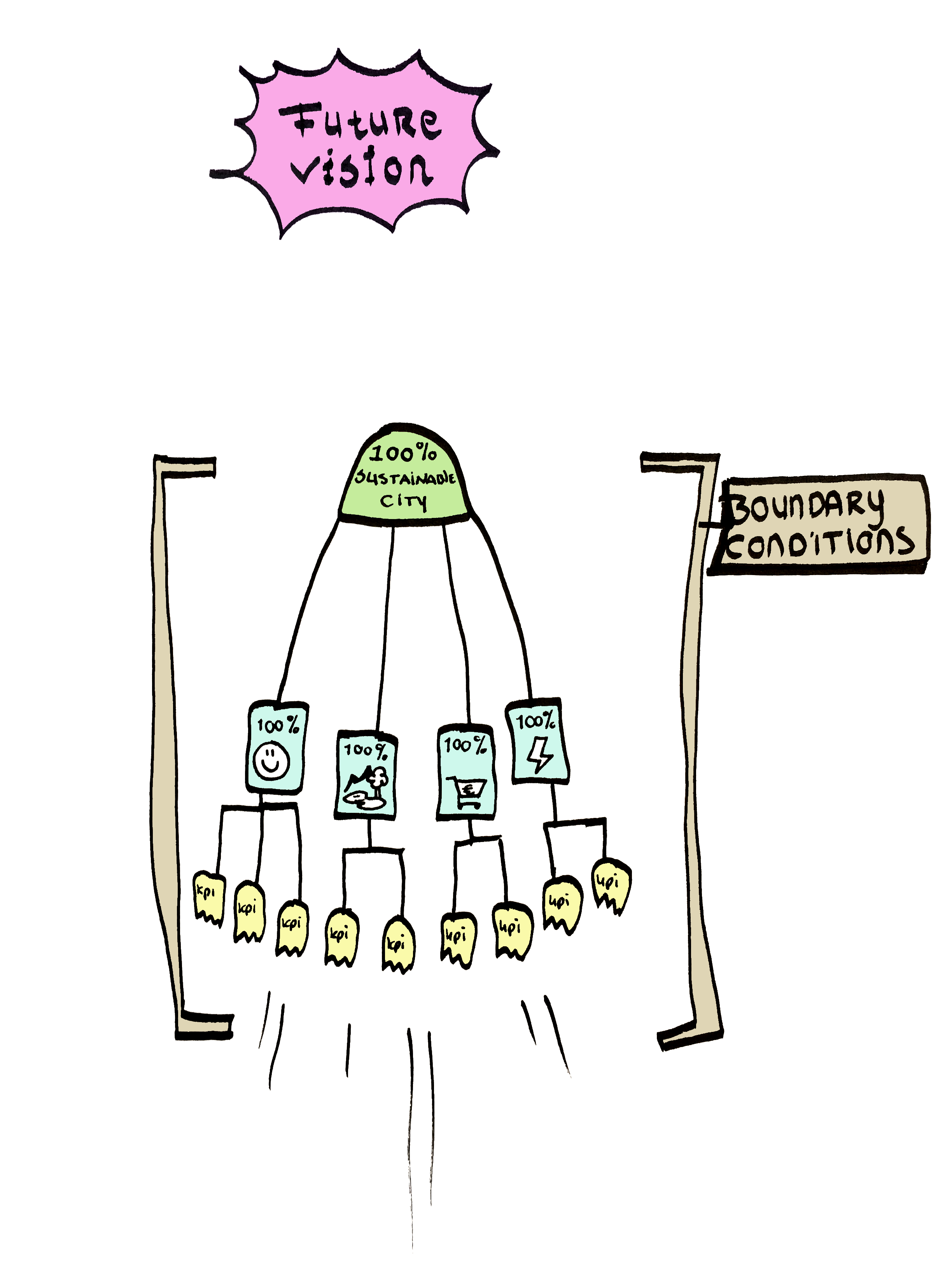
After the main goal is set, break it into performance-based network and object sub-goals. ELSI and the Network Parameters are good tools for formulating sub-goals and ensuring comprehensive coverage. A neighborhood project, for instance, might have sub-goals organized by ELSI4: Energy and Materials (close cycles, generate own energy, export surplus), Life (restore local biodiversity, connect ecological corridors), Society (strengthen community governance, create local employment), Individual (improve air quality, increase access to green space).
System Boundaries
The system boundary determines the solution space. A larger boundary provides more levers for intervention but also more complexity. Factors outside the boundary must still be represented as external influences. Choosing the boundary is a strategic decision: too narrow and you miss systemic opportunities; too wide and analysis becomes unmanageable.
A powerful technique is to shift the goal from object-level to system-level. For the Rotterdam public transportation system, the original brief was to "make PT more sustainable." Reframing to "increase the sustainability of the city region of Rotterdam by means of the Public Transportation system" shifted the boundary from a transport network to an entire city region, revealing far more reaching interventions.
Visioning
For longer-term projects involving large groups, a strong vision energizes people and grounds goals in a tangible future. Teams formulate dreams through movies, drawings, and written stories; specific goals and indicators are then extracted from this material. With a vision in hand, backcasting works backward from the desired future to identify steps needed today.
Indicators
Indicators translate goals into measurable quantities. They should cover the full ELSI spectrum, operate at multiple scales (object, network, system), and be sensitive enough to detect both progress and regression. The RAH indicators (Resilience, Autonomy, Harmony) provide system-level measurement, while ELSI-based indicators capture object-level performance.