
SiD System Indicators (RAH)
System indicators define the performance of a system as a whole — the highest order of evaluation. They incorporate all network and object indicators below them and are most strongly influenced by system dynamics.
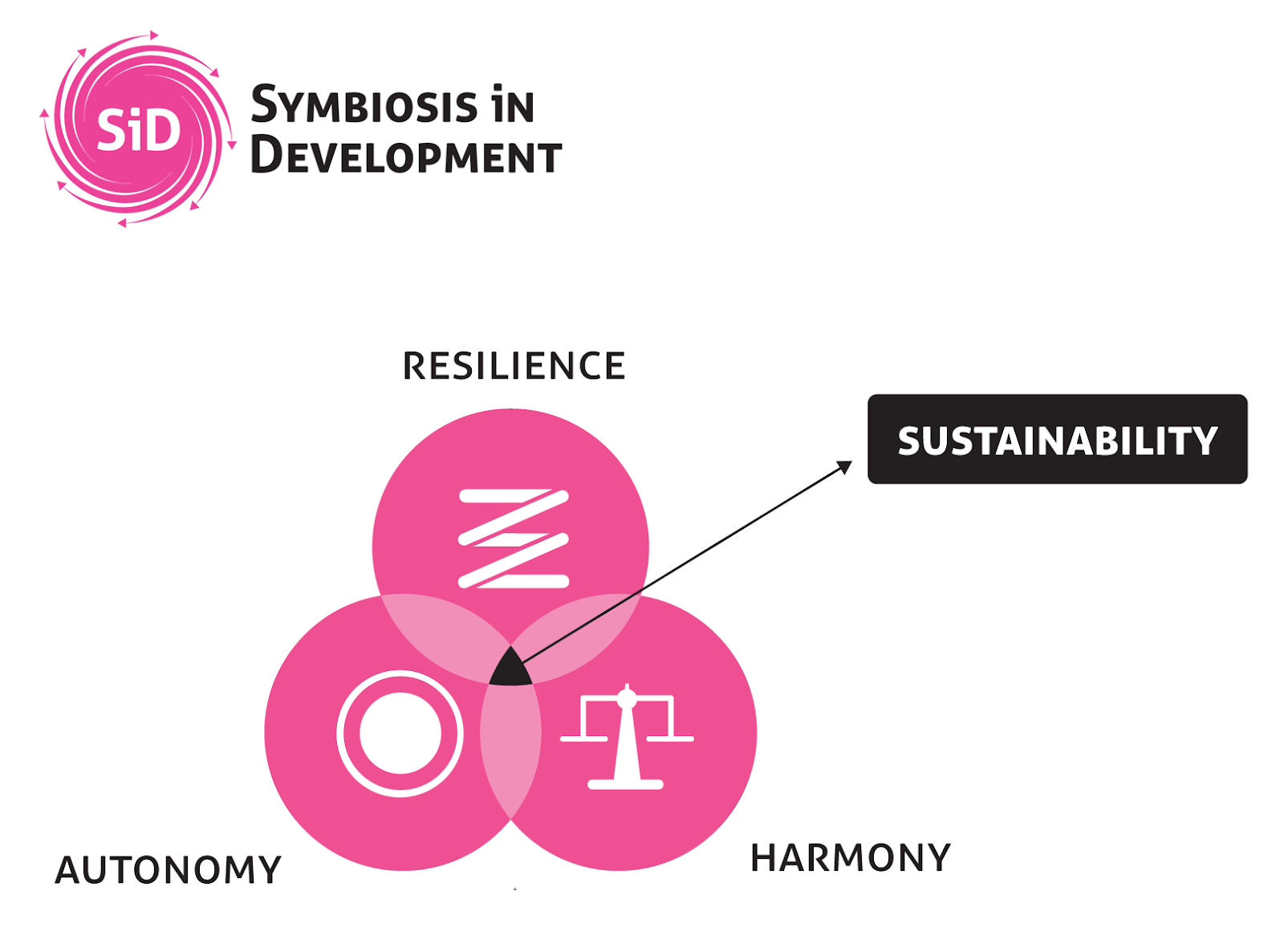
Derived from the SiD sustainability definition, the three system indicators are Resilience, Autonomy, and Harmony — abbreviated as RAH. Each is fed by the network and object indicators below, and responds to the others. In every complex system the relationships between these indicators differ, so for each project these relationships should be mapped at an appropriate level of detail.
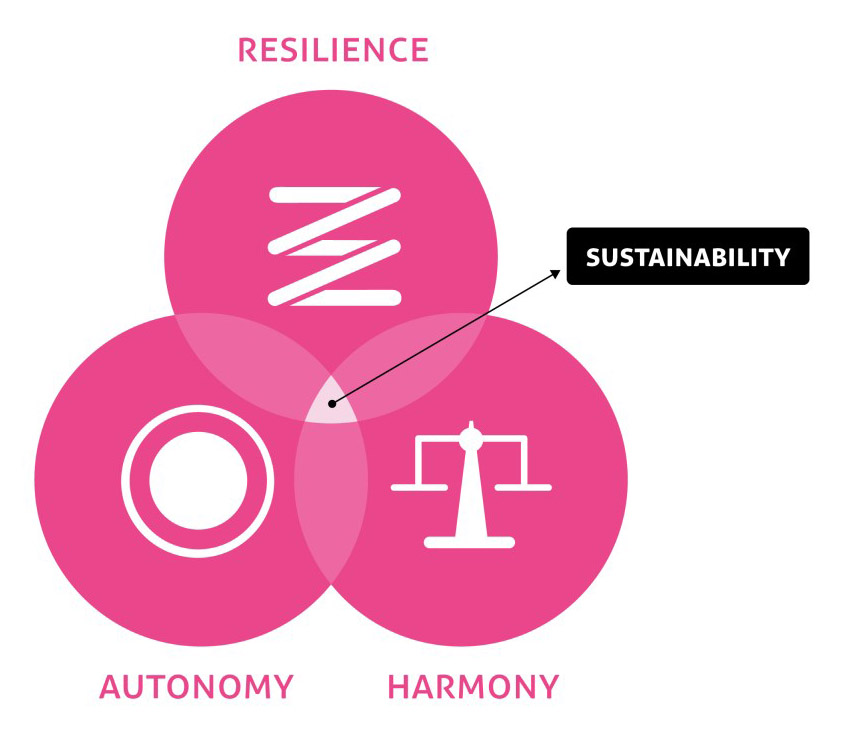
Resilience
"Resilience is a system's capacity to withstand (unexpected) disturbances and its ability to return to a healthy state after suffering a blow (not necessarily the same state as before)."
Focusing on resilience reveals that goals such as growth and profit lead down fragile pathways that ultimately serve no one. Placing resilience at the top of decision-making creates clarity for all stakeholders and should be considered a goal in itself.
Resilience is influenced by a wide variety of network and object parameters that change with circumstance. It is highly susceptible to system dynamics — often more so than Autonomy or Harmony.
Autonomy
"Autonomy, or self-reliance, is the level of independence of the system from other systems on any level, including material resources, decision making, trade balances, etc."
All systems depend on others to some degree, and maximizing autonomy is rarely the goal. But for vital resource flows and network functions, high autonomy increases sustainability. Investigating autonomy surfaces local strengths and context-specific solutions, leading toward closed resource loops and reduced waste.
The key is discerning between critical resources and luxuries. For critical resources — food, shelter, clean water, power — keep them close, decentralized, and locally adapted. For non-critical or rarely used resources, pooling at larger scales improves efficiency. The right scale of autonomy differs per resource: small villages can feasibly manage their own water supply; not every village needs its own car factory.
The same principle applies to policy. Universal decisions with slow change rates (such as human rights declarations) suit centralized structures. Local conditions and rapid decisions suit decentralized governance.
Autonomy is most directly influenced by object parameters: resource cycles, decision-making structures, and the balance of interchange between neighboring systems.
Harmony
Harmony, or social justice, is about fairness: to each other, to future generations, and to all other living things. It measures internal tension in the system — when low, there is risk of collapse through conflict. Harmony provides the base conditions for people to want to be part of a system and make it succeed.
Evaluating Harmony begins with basic human rights, still challenged in global supply chains today. For more complex social evaluations, fields such as ethics, deontology, and consequentialism provide tools. History shows that sustainable systems must protect themselves from concentrations of power that benefit few at the expense of many.
Harmony is primarily fed by the upper ELSI layers — cultural rules, laws, economic balances, and individual health and happiness — together with network parameters such as transparency and awareness. Strengthening these through policy typically increases harmony over time.