SiD Overview
What is SiD?
SiD is a framework for developing symbiotic, sustainable solutions. It covers the full process from idea to implementation, aimed at teams of cooperating experts and individuals alike. It combines a holistic systems approach, interdisciplinary collaboration, design thinking, and iterative development cycles.
The results are top-down systemic strategies activated by bottom-up interventions, pushed towards implementation using short-term action plans that follow long-term roadmaps towards systemic change. The outcomes are resilient, harmonious, and autonomous organizations, cities, nations, and industries.
Why Use SiD?
No matter where in the world you act, you have to consider long-term consequences. Focusing only on sub-aspects such as energy or food is insufficient — they are all related and eventually affect each other.
SiD enables you to take the full system into account at all times, using this as a strength to find the most effective solutions for the least effort and resources. SiD does not tell you what to do or what is right and wrong. It helps you figure out what the right questions are in any given situation.
A Practical Framework
SiD combines complex systems thinking with design thinking into a practical, actionable framework. Where systems thinking reveals the interconnected nature of real-world challenges, design thinking provides structured creativity to develop solutions. SiD bridges these disciplines so that teams can move from analysis to action.
Multidisciplinary collaboration is central to SiD. No single discipline can grasp the full complexity of a sustainability challenge. SiD is designed to bring together architects, engineers, ecologists, economists, social scientists, policymakers, and community members into a shared process where each perspective strengthens the whole. The framework provides a common language and structure that enables experts from different fields to contribute meaningfully and build on each other's insights.
SiD's Four Components
SiD consists of four main components, nested inside one another:
SiD Theory covers fundamental concepts: the sustainability definition, the anatomy of systems, SNO hierarchy, system dynamics, transitions, and roadmaps.
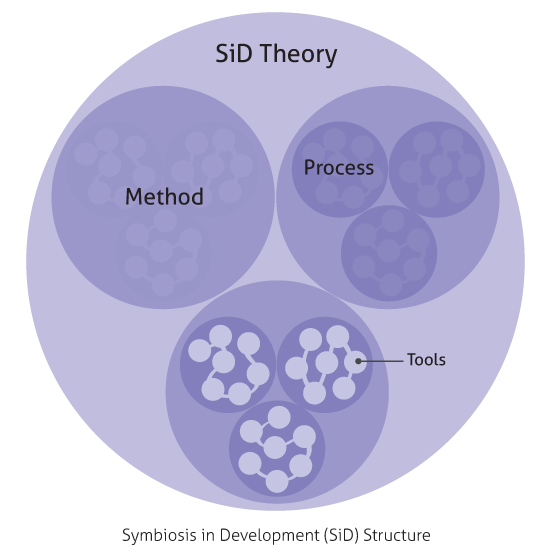
SiD Method describes how the theory is applied step-by-step: goal setting, system analysis and understanding, solutioning and roadmapping, and evaluation. The method is iterative — during a single project it is cycled through several times.
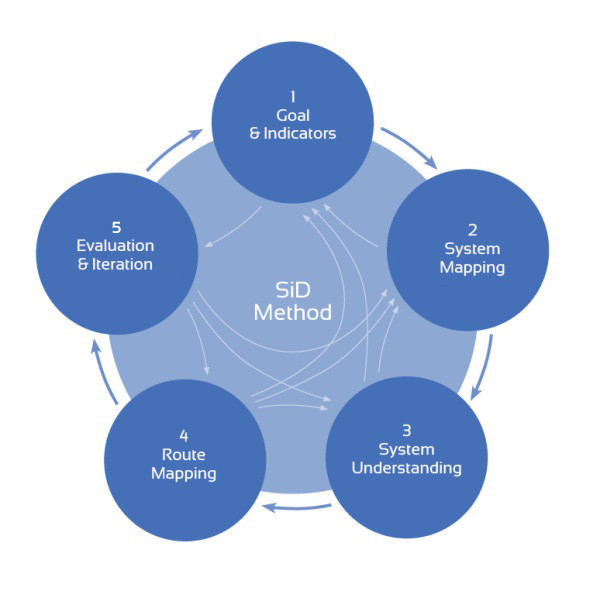
SiD Process focuses on day-to-day practice: how to build a working process from A to Z, build a team, involve stakeholders, and manage a project.
SiD Tools lists useful aids for various stages of a SiD process, from biomimicry to backcasting and circular economy.
SiD Takes Time
Mastering SiD takes time and effort. Sustainability is inherently complex. SiD helps streamline and accelerate this, but cannot make the challenges simpler in their essence.
In our experience, a few years of full-time engagement are needed to master SiD end to end. Thankfully, many tools and approaches work well on their own — you can learn step by step and start implementing immediately.
Once you have done a few SiD projects and allowed yourself to become familiar with the theory, it becomes useful even in a day-to-day context. Once you have reached that stage of systems insight, practicing SiD can be a straightforward affair — almost like an invisible intuitive process in the background.
The A-ha Machine
SiD's method uploads available information about the system to your mind, where it is processed to recognize patterns. Patterns in complex systems are often the key to great solutions, but your brain needs to marinate in the challenge to find them.
In this mental process — largely subconscious — allow yourself room for creativity and relaxation. Just as Archimedes needed to take a bath before his "Eureka" moment, your brain needs mental rest to process in the background.
Modular and Open Source
SiD is a modular framework. It is not a belief, dogma, or certification system. It is flexible, adjustable, and open for you to add your own techniques. Feel free to apply tools you already know at any point in the process.
SiD stands on the shoulders of giants, learning from ideas and frameworks developed by others. To support this, SiD is made open source under a Creative Commons license. If you make or improve tools, please share them back with the community.
SiD and the UN Sustainable Development Goals
The UN's Sustainable Development Goals (SDGs), published in 2015, emphasize a holistic approach with 17 global challenges. SiD can be used to analyze SDG impacts, organize processes to develop solutions, and as a reporting framework.
The SDGs are systemic in their origins as a whole, but each individual goal is object-oriented. SiD bridges this gap: it can explore the SDGs for a given challenge, map their impacts, detect system-level interrelations, show system dynamics, and find powerful systemic solutions that positively affect multiple SDG areas at once.