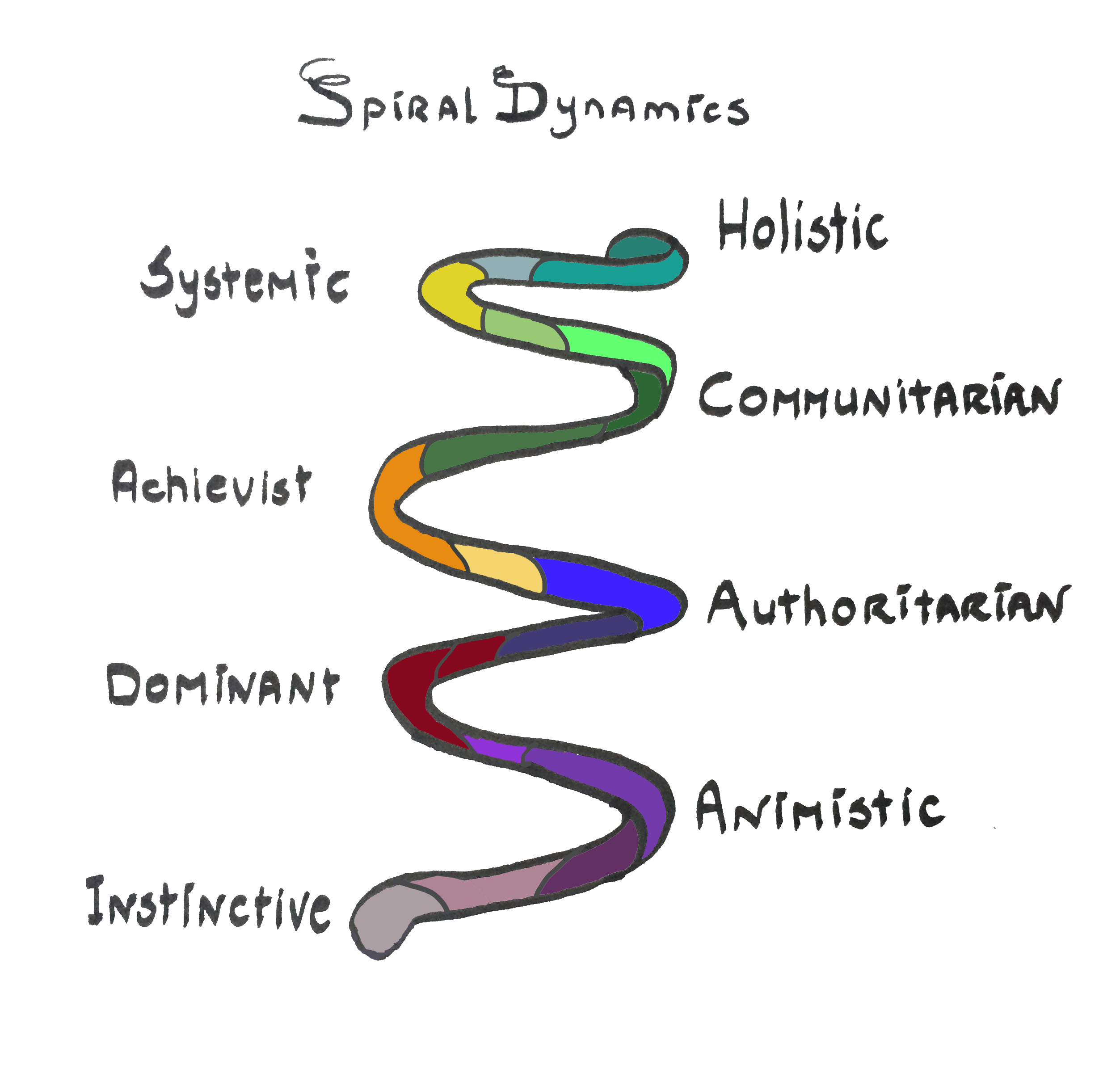
Spiral Dynamics
Understanding Worldviews
Spiral Dynamics, developed by Don Beck and Chris Cowan (1996) building on the work of Clare Graves, maps the development of human value systems as a nested hierarchy of worldviews, or "memes." It is a powerful tool for understanding and resolving friction between groups and individuals who hold differing or opposing perspectives on sustainability challenges.
The Spiral of Value Systems
Each level of the spiral represents a worldview that emerged in response to specific life conditions. They are nested: higher levels include and transcend lower ones, but under stress, groups and individuals fall back to underlying levels. The color-coded levels from base to apex:
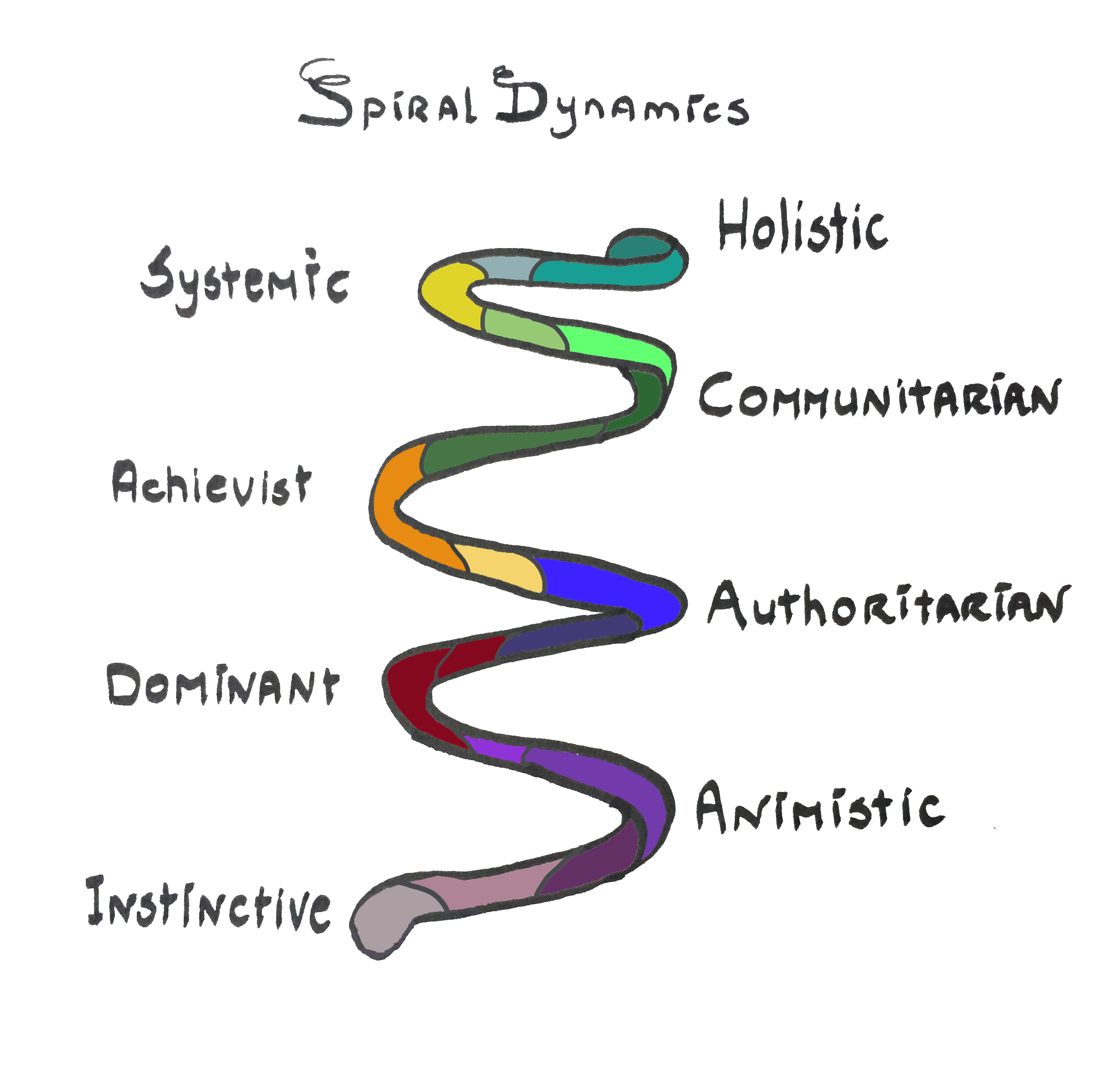
Beige (Survival, ~100,000 BC): Basic survival instincts. Food, water, shelter, reproduction. Operates in small bands. Relevant when communities face existential resource crises.
Purple (Tribal, ~50,000 BC): Animistic, clan-based, sacrifice to ancestors and elders. Trust within the group; suspicion of outsiders. Strong in indigenous communities and family businesses.
Red (Power, ~7000 BC): Egocentric, impulsive, dominance-oriented. Exploits without guilt. Visible in authoritarian leadership and frontier economies.
Blue (Order, ~3000 BC): Absolutist, obedient to authority, purpose-driven by higher cause. Fundamentalist in both religious and secular forms. Strong in bureaucratic institutions and rule-based governance.
Orange (Achievement, ~1000 AD): Strategic, scientific, competitive. Calculated self-expression and material success. Dominant in modern business, technology, and market economies.
Green (Communitarian, ~1850): Egalitarian, consensus-seeking, environmentally aware. Values group harmony and social justice. Strong in sustainability movements, NGOs, and progressive organizations.
Yellow (Systemic, ~1950s): Integrative, sees the value in all previous levels. Benefits all life, not just one group. Comfortable with complexity and paradox. Naturally aligned with systems thinking.
Turquoise (Holistic, ~1970s): Global-holistic, combines self-interest with community interest. Sees all life as interconnected. Rarest level; represents the systemic awareness SiD aims to cultivate.
Application in SiD
Spiral Dynamics is most useful during Step 3: System Understanding and Process Design. When stakeholder groups clash, the conflict often reflects different spiral levels rather than factual disagreements. A Blue-level institution (rule-following, hierarchical) will resist Green-level proposals (participatory, consensus-based) not because the proposals are wrong but because they violate the institution's value system.
Understanding this allows the SiD facilitator to frame solutions in language and structures that resonate with each stakeholder's level, rather than trying to convince everyone to adopt a single perspective. A Yellow or Turquoise facilitator can work across all levels because they understand and respect each one's contribution to the whole.
Caution
Spiral Dynamics is a model, not reality. People and organizations do not sit neatly at single levels. The framework is useful for understanding patterns of resistance and alignment in stakeholder processes, but should not be used to categorize or judge individuals. Its value in SiD is diagnostic, not prescriptive.