Skip to content
What is Sustainability?
Home / Documentation / What is Sustainability?

What is Sustainability?

The Problem with a Vague Definition

Ask ten people what they think sustainability is, and you get ten different answers. As one of the most important words of the last few decades, sustainability as a concept is the driver of many programs and initiatives in society. Yet there is little solid ground to find when investigating what it exactly is. And this is a problem.

Since the start of this century, the realities of our impoverished environment, social inequality, fragile economy, and unstable climate have brought "sustainability" to the forefront of debate. Inevitably, the word has eroded. It is used in virtually every marketing strategy, political speech, and product label. Many "sustainable" developments are not sustainable at all, often due to a lack of understanding rather than any nefarious purpose.

If few people know what something exactly is, how could you hope to achieve it? Imagine two people trying to build a house together, but with a different understanding of what the house should be. It would be a disaster. Having a good definition of sustainability is fundamental to any attempt at doing something "sustainable."

The Brundtland Commission Definition

The most used definition of sustainable development comes from the 1987 United Nations report Our Common Future:

"Sustainable development is development that meets the needs of the present without compromising the ability of future generations to meet their own needs." -- Brundtland Commission (1987)

This definition has been instrumental in achieving the realization that sustainability relates to time and to people. However, it has significant limitations for practical use:

First, it describes what sustainable development should result in, not what it actually is. Meeting the needs of current and future generations is an outcome, not a process or definition. It is like trying to explain the rules of soccer by stating the scores of a match.

Second, future generations do not have a voice. We cannot call up the future to ask whether we did something right or wrong, making evaluation difficult.

SiD's Sustainability Definition

"Sustainability is a state of a complex, dynamic system. In this state, a system can continue to flourish resiliently, in harmony, without requiring inputs from outside its system boundaries."

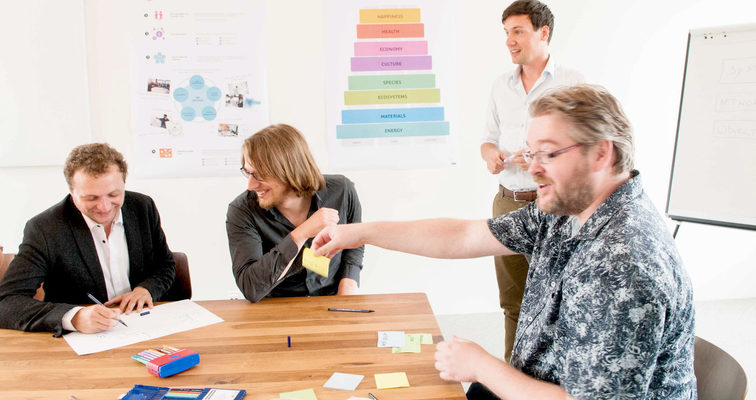
Applied to our civilization, this state is consistent with societies powered by renewable energy and closed-loop material systems, living in thriving ecosystems, on a biodiverse planet, with healthy and happy individuals living in just, tolerant, and diverse cultures, supported by open and transparent economies.

Why "a state of a system"?

Consider a toothbrush that says it is sustainable on the package. What does this mean? Does it mean the material is environmentally friendly? That it was made without slave labor? That it promotes a sustainable lifestyle?

The "sustainability" of the toothbrush depends on factors outside the toothbrush itself -- its production cycle, social impact, how it will be discarded. An object cannot really be called sustainable without knowing these answers. In SiD's perspective, sustainability is not a physical property of material objects. It is expressed on the system level.

This means it does not make much sense to talk about a "sustainable toothbrush," but rather about to what degree a toothbrush affects the sustainability of society. Saying that an object is in itself "sustainable" is simply nonsensical -- it is like saying a person is love. Love is a relational quality, something that describes a relation between things. Just so with sustainability.

What is a "system"?

A system is a dynamic set of actors, relations, objects, and all their interconnections -- such as a city, company, community, or society as a whole. What is and is not a system is defined by us. It is a theoretical device we use to think about the world in a specific way. We "create" a system by defining its boundaries, which determine where the system stops and the rest of the universe begins.

What is a "state"?

A state can be seen as a position that the system is in, regardless of its containing objects. A light switch is in the "on" state or "off" state -- the same materials, nothing added or removed, just a changed configuration.

Understanding that sustainability is a "state" means we can reach a sustainable society with everything we have already. We do not need any extra "stuff." We need to reconfigure the relationship between us, our stuff, and each other.

Why "complex" and "dynamic"?

The word "complex" underlines that we are talking about non-linear, infinitely complex entities -- almost like biological organisms -- not predictable, finite, mechanistic systems. Complex systems exhibit behavior that cannot be predicted using normal mechanical analysis. An easy example is the weather: nobody can accurately predict it more than a week out.

"Dynamic" means sustainability is an edge condition of something that always moves, changes, grows, and shrinks. A system can move and change while still remaining in the "state" of sustainability, as long as it does not cross the border of its state. Without dynamism there is no capacity for adaptability, no resilience. A system without resilience is hard-pressed to be sustainable.

Resilience, Autonomy, and Harmony

The SiD definition identifies three main system indicators for sustainability:

Resilience determines the degree to which a system can survive unexpected occurrences -- a critical part of continuing to exist.

Autonomy determines to what degree a system can take care of its own needs, and its ability to continue doing so, without requiring critical inputs from outside its boundaries.

Harmony addresses the management of internal tensions. Inharmonious systems -- unjust, inequitable, with large divisions of resource control -- give rise to internal strife and even war. A system can be resilient and autonomous, but without harmony it will still collapse due to internal tension.

The word "flourish" is also present in the definition. This gives us a way to positively regard difficult-to-quantify values such as quality of life, cultural and artistic value, and excitement.

12 Rules of Complex Systems

Complex systems are numerous in their components, with all components influencing each other. They exhibit non-linear behavior emergent from their interactions.

They can be understood but not predicted. Any action upon them may have unpredictable side-effects. Prepare for resilience, not prediction.

They grow like organisms and perish like them. No complex system exists for eternity.

They require increasing resources per added unit of complexity. There are always limits to growth.

They change rapidly in revolution-like jumps as well as in slow evolutionary progression.

They do not necessarily behave the same way given the same conditions.

They are always dynamic, never sit still, and are never entirely in balance.

They may exhibit survival or seemingly cognitive behavior.

They require incubation periods for changes to be registered and acted upon.

They can best be understood by human brains, as they are also organic complex systems.

They interact beyond their chosen system boundary.

They always offer hidden dynamic processes that can have beneficial or destructive effects.

Object-Oriented Sustainability Goes Wrong

Why is systems thinking so important? Consider the European Commission's 2009 ban on tungsten filament light bulbs. The only alternative at the time was the Compact Fluorescent Light (CFL), which uses mercury vapor -- a highly neurotoxic substance. For the sake of energy savings, we introduced a toxic substance into our lives and nature. This is "trading pain": saving energy at the expense of health and ecosystems.

Bioplastics offer another example. When mixed into normal plastic recycling streams, they degrade the quality of the batch. They do not dissolve in nature but require industrial composting. And some bioplastic feedstock comes from land that could otherwise grow food.
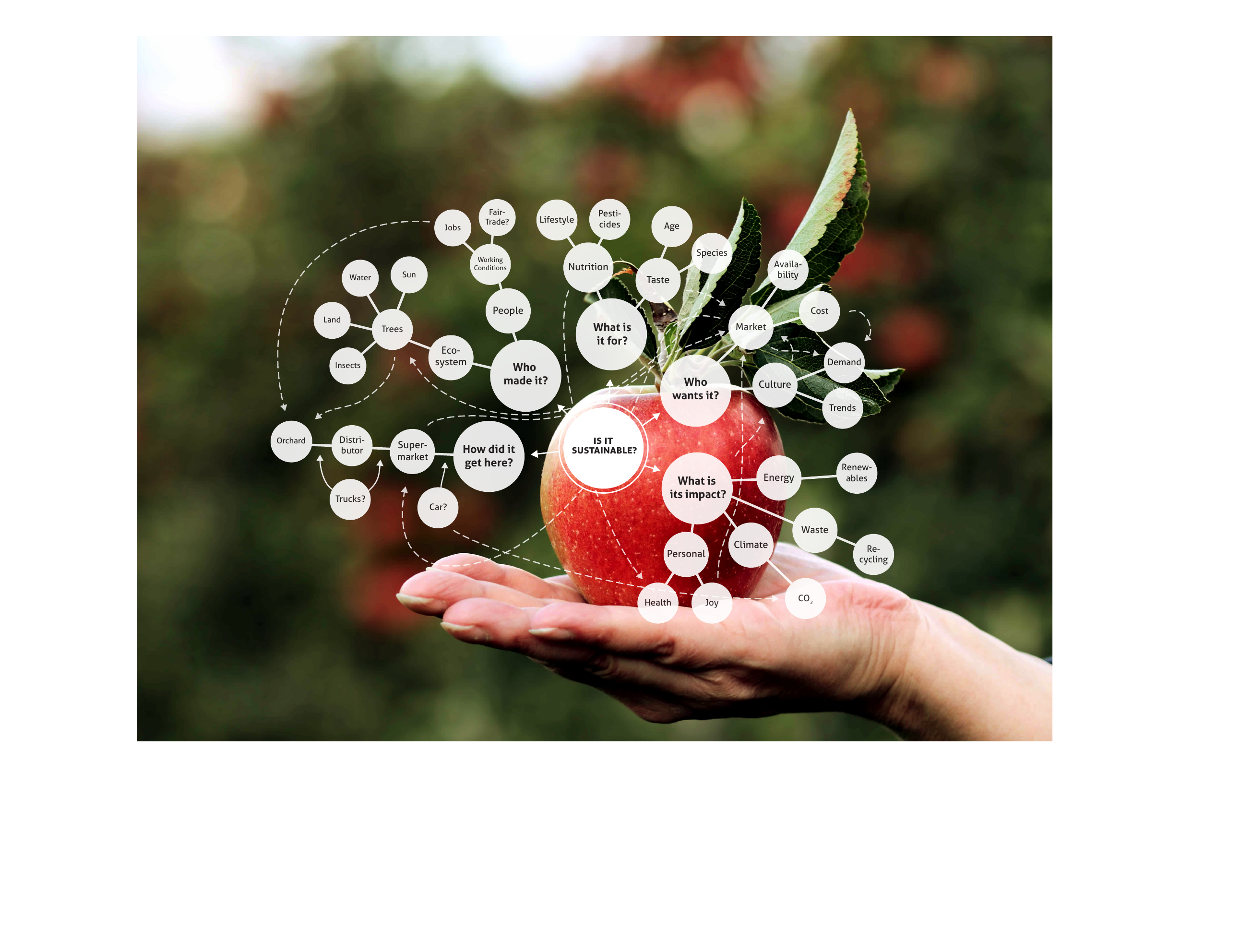
The system as a whole will not change if we just switch out bits and pieces. It is the configuration of the overall system that is at fault. We need to redesign the organism itself.

"We cannot solve problems with the same kind of thinking we used when we created them." -- Albert Einstein
"When we try to pick out anything by itself, we find it hitched to everything else in the Universe." -- John Muir
Learn this interactively
What is Sustainability
Video lessons, exercises, and progress tracking. Free, self-paced.
Start Learning
SiD Tutor
Your learning guide
Welcome to SiD Learning. I am here to help you explore and understand the material. What would you like to discuss?