SiD for Business Strategy
Beyond Corporate Sustainability Reports
Traditional business strategy optimizes individual metrics: revenue, market share, cost reduction. SiD provides a framework for systemic business transformation, where the organization becomes a catalyst for positive change across its entire value chain.
The Catalyst Principle
A catalyst changes the conditions around it, enabling transformations that would not otherwise occur. SiD's business application centers on this idea: rather than minimizing a company's negative footprint, design the business to multiply positive impacts across its network of relationships.

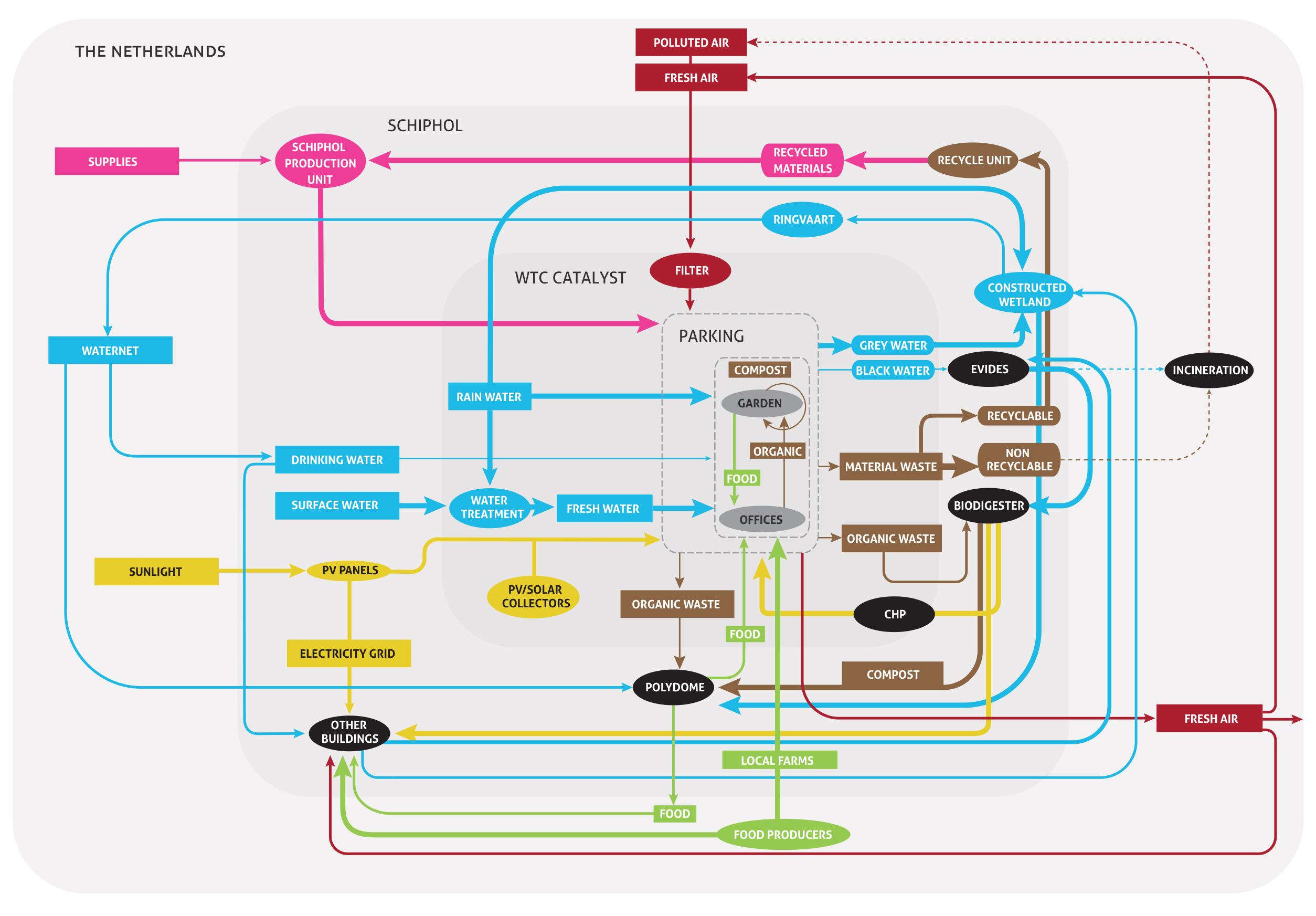
The Schiphol Catalyst project demonstrated this at building scale. Through three SiD sessions of increasing scope (five days with the core team, four days with 15 stakeholders, four days with 40 stakeholders), the team designed an office building standard where the building itself catalyzed sustainable development across the airport's entire ecosystem. The building was not just less harmful; it actively improved its surroundings.
The IKEA Supply Chain Transformation
IKEA asked Except to make their catalogue more sustainable without changing any physical property of the catalogue itself. This constraint forced systemic thinking. The team spent a full year analyzing everything around the catalogue: supply chains, printers, paper suppliers, marketing agencies, distribution networks.
They discovered that the object itself was not what needed to change. The quality of the sustainability around the object was. By building a visual analysis tool for over 500 data parameters and creating automated, transparent sustainability reports, they turned the annual supplier competition into a continuous improvement system. Sales departments became sustainability advocates because the data directly tied sustainability performance to contract retention.
The result: suppliers across the printing industry invested billions of euros into sustainable practices. The catalogue's positive footprint exceeded its negative footprint by a factor of 1,000. When the catalogue eventually transitioned to online, it had already catalyzed industry-wide transformation during the transition decade.
Systemic Lock-In Avoidance
Conventional business strategy often creates systemic lock-in: investments in infrastructure, supply chains, or technology that constrain future options. SiD's roadmapping approach explicitly identifies lock-in risks and designs transition pathways that preserve flexibility. Each intervention is classified as Change, Start, Stop, or Replace, and sequenced to avoid creating dependencies that make future adaptation impossible.
SiD Sessions in Corporate Settings
Corporate SiD processes typically adapt the standard process design to business constraints. Sessions may be shorter (two to three days rather than five) but more frequent. The core team includes business leadership alongside sustainability specialists, ensuring that systemic insights translate directly into business decisions. Key adaptations:
- System boundary: Define the business within its full value chain, not just its own operations.
- Goal setting: Express goals in terms of system performance ("our supply chain strengthens the communities it operates in") rather than object-level metrics ("reduce our carbon emissions by 30%").
- ELSI scanning: Ensure business analysis covers all eight domains, not just the ones with regulatory requirements.
- Roadmap construction: Build transformation pathways that align business growth with systemic improvement, so profitability and sustainability reinforce each other rather than competing.
Positive Footprint Multiplication
The ultimate goal of SiD-informed business strategy is not net-zero impact but net-positive: a business whose existence improves the sustainability of the systems around it. This is achievable when the business is designed as a catalyst rather than optimized as an isolated entity. The IKEA case, the Schiphol Catalyst, and Orchid City all demonstrate that positive footprint multiplication is practical, commercially viable, and scalable.