
What is Sustainability?
The Problem with a Vague Definition
Ask ten people what sustainability is, and you get ten different answers. As one of the most important words of the last few decades, sustainability drives many programs and initiatives in society, yet there is little solid ground when investigating what it actually means. And this is a problem.
Since the start of this century, the realities of environmental degradation, social inequality, and unstable climate have brought "sustainability" to the forefront of debate. Inevitably, the word has eroded. It is used in virtually every marketing strategy, political speech, and product label. Many "sustainable" developments are not sustainable at all, often due to a lack of understanding rather than nefarious purpose.
If few people know what something is, how could you hope to achieve it? Having a good definition of sustainability is fundamental to any attempt at doing something sustainable.
The Brundtland Commission Definition
The most used definition comes from the 1987 UN report Our Common Future:
"Sustainable development is development that meets the needs of the present without compromising the ability of future generations to meet their own needs." — Brundtland Commission (1987)
This definition was instrumental in establishing that sustainability relates to time and to people. However, it has significant limitations for practical use:
First, it describes what sustainable development should result in, not what it actually is. Meeting the needs of current and future generations is an outcome, not a definition: like explaining the rules of soccer by stating match scores.
Second, future generations do not have a voice. We cannot call up the future to ask whether we did something right, making evaluation difficult.
Object-Oriented Sustainability Goes Wrong
Most sustainability tools treat objects in isolation. Consider the European Commission's 2009 ban on tungsten filament light bulbs. The only alternative was the Compact Fluorescent Light (CFL), which uses mercury vapor, a highly neurotoxic substance. For the sake of energy savings, we introduced a toxic substance into our lives and nature. This is "trading pain": saving energy at the expense of health and ecosystems.
Bioplastics offer another example. When mixed into normal plastic recycling streams, they degrade batch quality. They do not dissolve in nature but require industrial composting. And some bioplastic feedstock comes from land that could otherwise grow food.
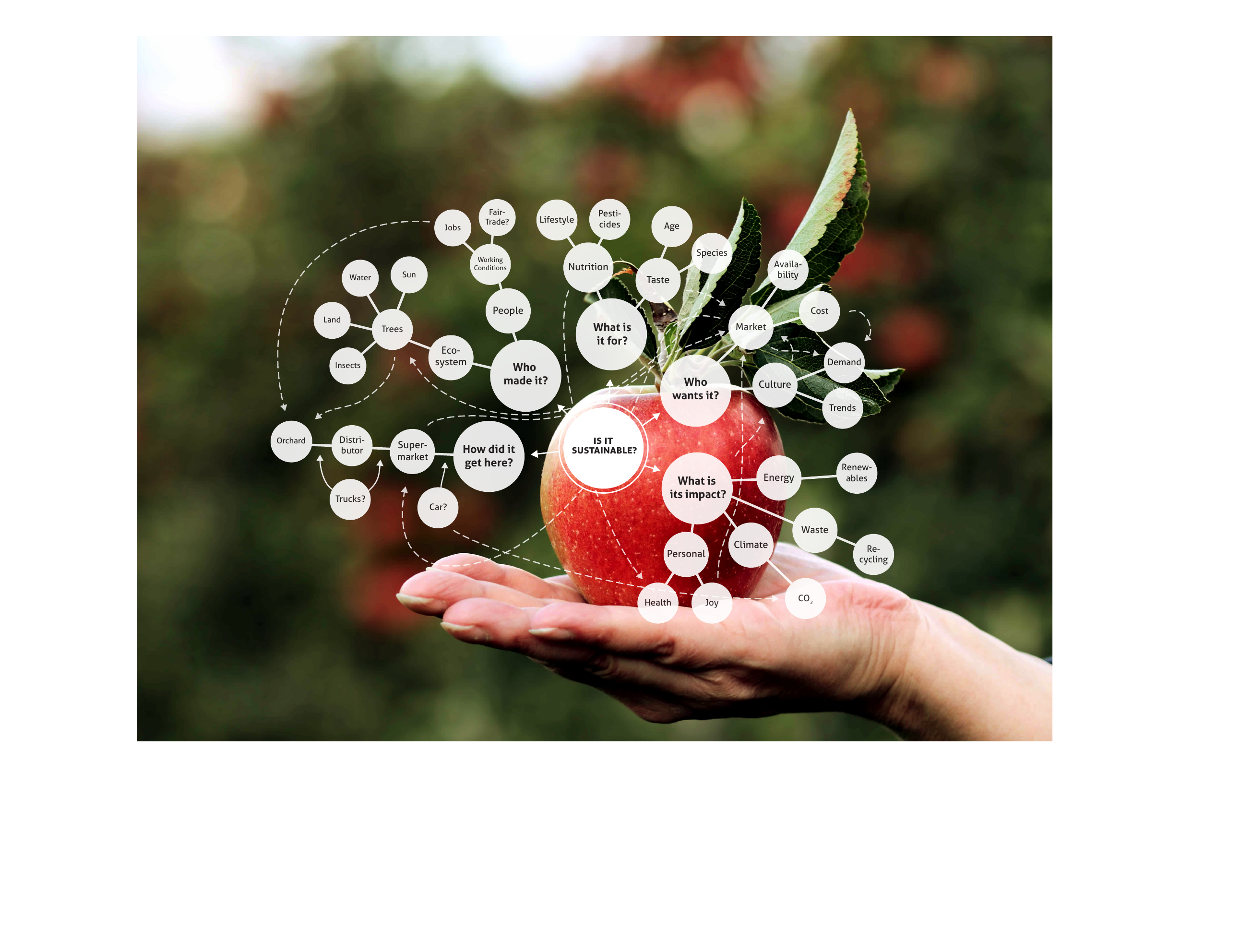
The system as a whole will not change if we just switch out bits and pieces. It is the configuration of the overall system that is at fault. We need to redesign the organism itself. Even a simple apple, when traced through its full system of production, distribution, consumption, and waste, reveals dozens of interconnected domains and impacts.
Why Systems Thinking?
A product, building, or policy cannot be "sustainable" in itself. Sustainability is not a property of objects; it is a state of a system. This means any serious attempt at sustainability requires thinking and acting at the system level.
SiD's answer to this challenge is a precise, actionable definition of sustainability rooted in complex systems science. It treats sustainability as a measurable state of a dynamic system, opening up pathways for analysis, evaluation, and improvement that object-focused definitions cannot provide.
"We cannot solve problems with the same kind of thinking we used when we created them." — Albert Einstein
"When we try to pick out anything by itself, we find it hitched to everything else in the Universe." — John Muir
The full SiD sustainability definition and its analytical breakdown are presented in 1.2 SiD Sustainability Definition.