
The Anatomy of a System
Systems in SiD
A system in SiD is a set of objects and relations between individual components (agents) that operate together, exchanging information, energy, materials, value, and other resources. Systems are a mental and analytical model to understand the world — not "real," but a framework for understanding.
A system may take many forms: a city, a pond, an entire civilization, a company, or a government. Systems are defined and separated by their system boundary.
Three Levels: System, Network, Object
In SiD, a system consists of three levels (SNO):
The Object Level is the collection of physical elements in the system. For a city: buildings, park furniture, pipes, cars, money, books, people, animals, trees. This is where you encounter topics commonly found in sustainable development: energy use, materials, ecosystems, land use, economic impact.
The Network Level is where all objects exchange things with one another — flows of people and information, resource flows, laws, regulation, trade, economy. Unlike the object level, network connections are intangible and often transient or dynamic.
The System Level is where the underlying levels come together. It determines the edges of the system and evaluates performance as a whole. On this level, sustainability is evaluated through RAH: Resilience, Autonomy, and Harmony.
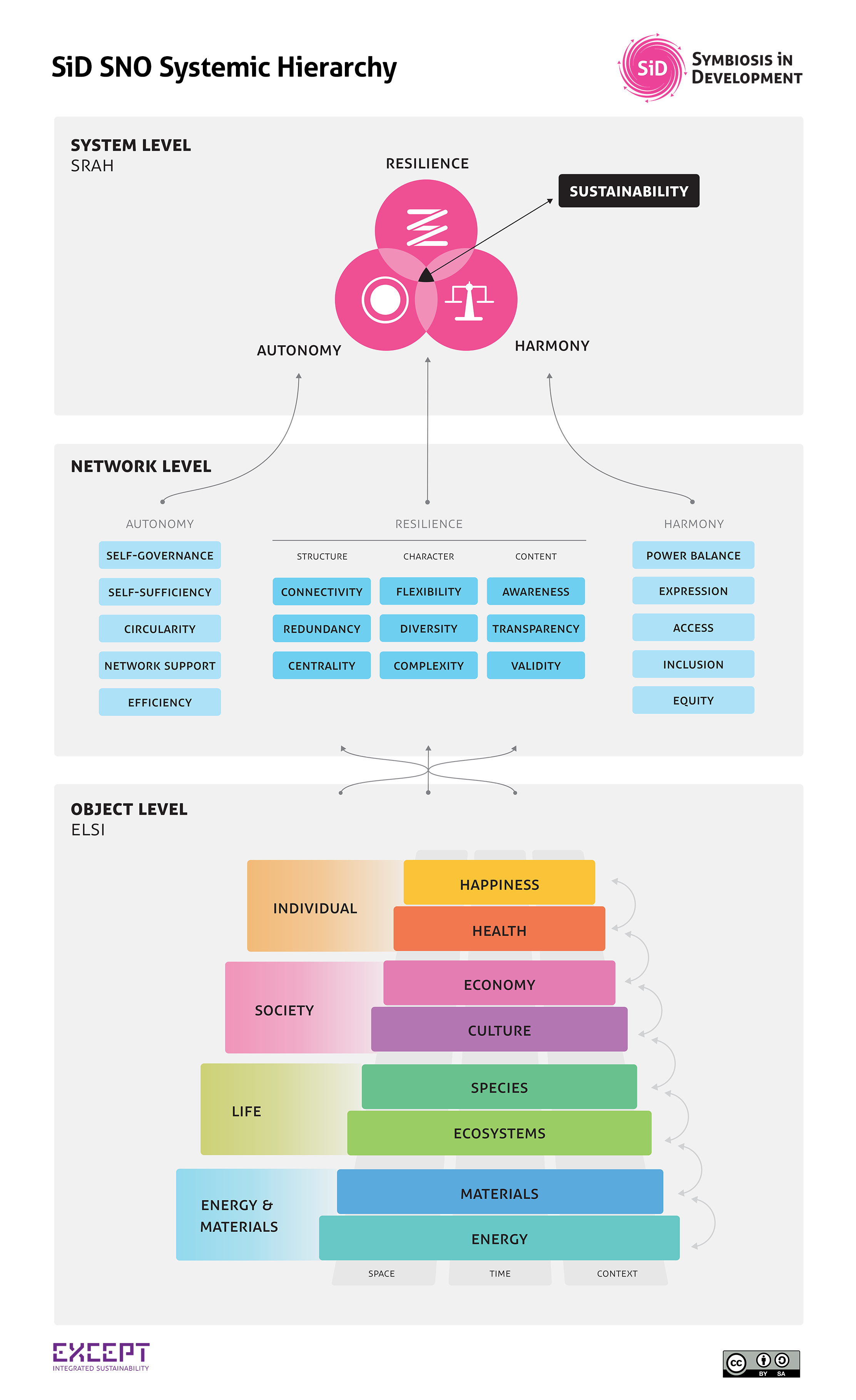
The SNO Hierarchy
Together, these three levels make the fundamental building blocks of SiD's system-based thinking. We set goals on the system level and operate on the object level to make them happen. Network parameters connect them, revealing hidden opportunities to use system dynamics to advantage.
System Boundaries
Systems consist of the collection of objects and networks contained within them. The boundary defines what is and what is not part of the system — without a boundary, everything is part of everything else, making work impossible. A system boundary can be defined by geographical area, time period, and context degree.
Relations that interact with the system from beyond its boundaries are called "externalizations" — these always need to be accounted for. For most cases, having exact boundaries is not critical at the start.
Integrated Analysis
For sustainable development to succeed, we need to take into account all critical areas of interest a system consists of — "thinking in the full spectrum." SiD offers the complete SNO hierarchy framework for exploring, indexing, evaluating, and finding solutions for all aspects of complex systems.
The ELSI Categorization System
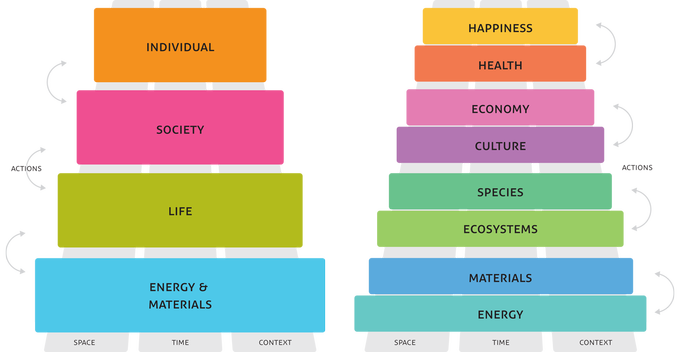
At the object level, SiD uses the ELSI categorization system to map indicators across the full spectrum — four dimensions that cover all physical aspects of the world around us. This allows you to quickly develop areas of interest and indicator sets for each challenge while being sure to work in the full spectrum.
Network Parameters
The network level parameters are a powerful interface between the top-down system view and the bottom-up object view. They help unravel complexities, reveal system interactions, and find the best intervention points.
SiD's standardized network parameters are split into three sets aligned with the RAH system indicators:
CRAFTDCCV (Resilience): Connectivity, Redundancy, Awareness, Flexibility, Transparency, Diversity, Centrality, Complexity, Validity
SSCNE (Autonomy): Self-Governance, Self-Sufficiency, Circularity, Network Support, Efficiency
PEAIE (Harmony): Power Balance, Expression, Access, Inclusion, Equity
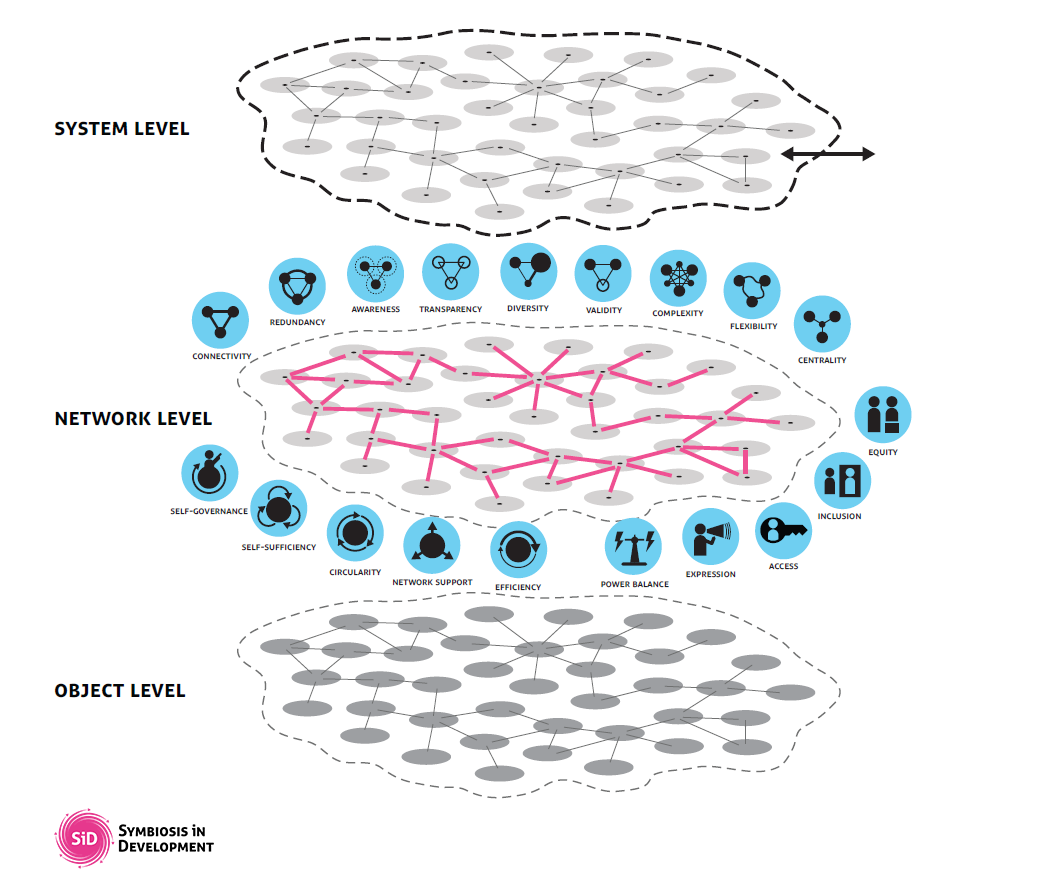
The Playground of System Dynamics
On the network level we find powerful systemic behaviors that remain hidden at the object level. The network is about "how" rather than "what" — it matters more that people can communicate instantly over long distances than what is being said or what device they use.
Network parameters can be observed from both top-down (how they contribute to RAH) and bottom-up (constructed from connections between objects). This flexibility makes the network level a playground for creativity.
System Indicators: RAH
The three main SiD system indicators inform us about the performance of the system as a whole:
Resilience — the capacity of a system to absorb disturbance and reorganize while undergoing change, retaining essentially the same function, structure, and identity.
Autonomy — the degree to which a system can sustain itself without critical external inputs, and its capacity for self-governance.
Harmony — the balance of internal tensions within the system, encompassing equity, justice, inclusion, and the fair distribution of resources and power.
SiD analyzes systems across three dimensions (Space, Time, and Context), each at multiple scales. The full framework for dimensional analysis is covered in 1.6 Analyzing Systems.