Method Overview
The SiD Method in Five Steps
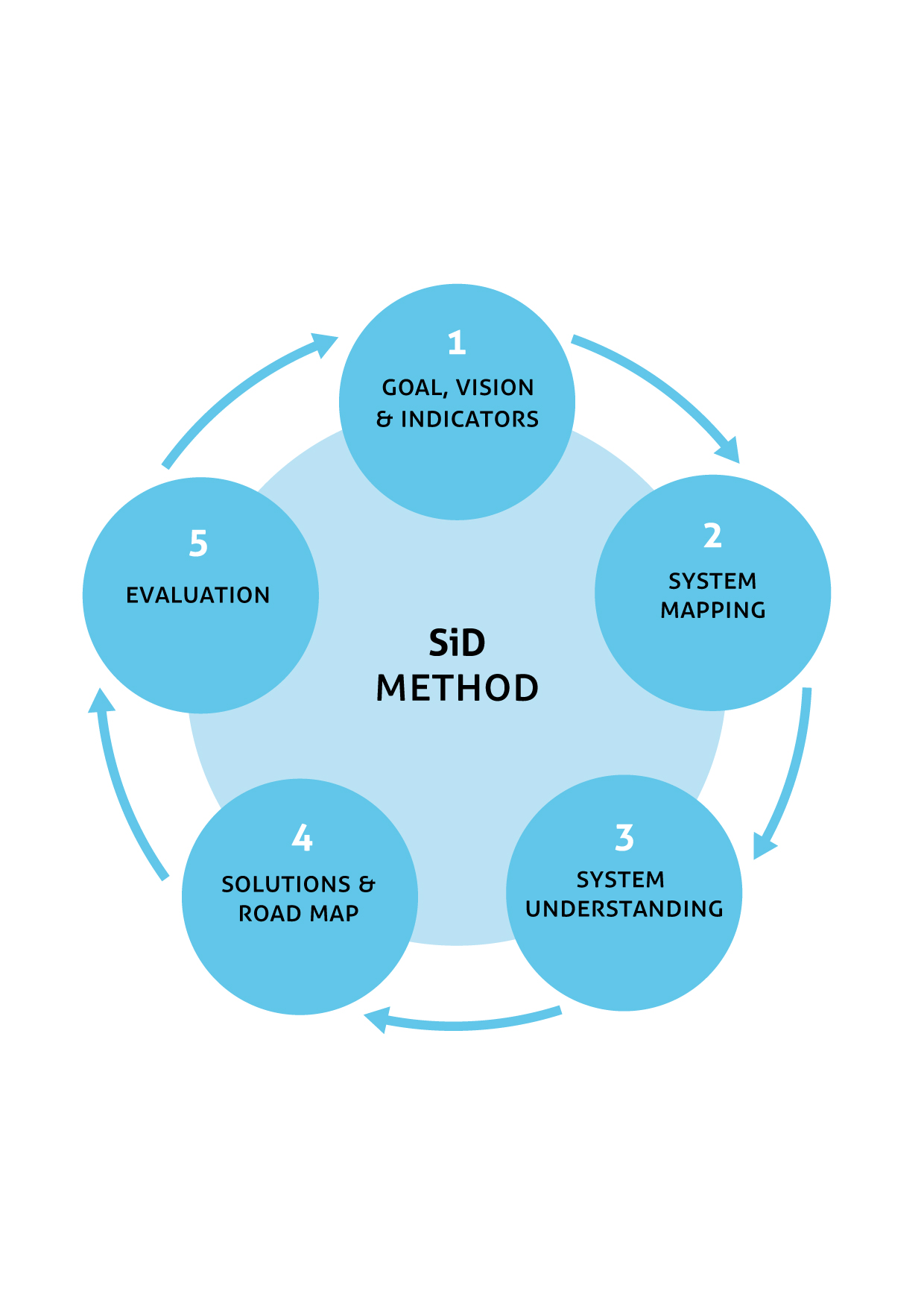
The SiD method finds pathways toward sustainable systems through five iterative steps. It is usually practiced within a larger SiD Process but can also be executed independently.
Imagine you are planning a journey to an ideal place. In step one, you think about what "ideal" means. In step two, you investigate the environment and draw a map. In step three, you study the map and figure out where you actually are. In step four, you plot routes to your destination. In step five, you check whether you are actually heading where you said you wanted to go. Then you repeat.
- Goals & Indicators: Set system-level goals, define project and system boundaries, and establish the indicators that will measure success.
- System Mapping: Collect and represent information across all three dimensions (space, time, context) and multiple scales to build an integrated picture of the current system.
- System Understanding: Immerse in the maps, identify patterns and dynamics, and develop intuitive grasp of where the system is and where leverage points lie.
- Solutioning & Roadmapping: Design interventions at network and system level, sequence them along a timeline, and build a roadmap from current state to desired future.
- Evaluate & Iterate: Check that solutions address system-level goals, indicators show improvement across the full ELSI spectrum, and decide whether to proceed or run another cycle.
Iterative by Design
The method is cyclical. We recommend at least three cycles, moving from rough reconnaissance to refined analysis. Do the first cycle quickly, almost as fast as you can, with the entire team. This rapid pass captures the most obvious elements and builds shared orientation. Each subsequent cycle deepens the analysis.
A useful pacing rule follows the Fibonacci Sequence: if the first cycle takes 1 day, the next also takes 1 day, the third takes 2 days, the fourth 3, the fifth 5, the sixth 8, and the seventh 13 days. This progression naturally allocates more time to deeper analysis as understanding grows.
Why Iteration Matters
Complex systems cannot be fully understood in a single pass. The first cycle reveals what you do not know. The second cycle fills major gaps. The third cycle refines understanding to the point where robust solutions emerge. Skipping cycles creates blind spots; running too many produces diminishing returns. The evaluation step (Step 5) determines when understanding is sufficient to act.
The method works at any scale, from a single product to an entire city region, and for any time horizon. What changes is the depth of each step and the number of cycles required.