SiD Sustainability Definition
The SiD Definition
Since 1999, Except worked on developing an integrated approach to sustainability covering the full spectrum: energy, ecosystems, economy, social justice, and systemic resilience. That system, called Symbiosis in Development (SiD), required a precise, actionable definition as its foundation. Version 4.0 (September 2019):
"Sustainability is a state of a complex, dynamic system. In this state, a system can continue to flourish resiliently, in harmony, without requiring inputs from outside its system boundaries.
Applied to our civilization, this state is consistent with societies powered by renewable energy and closed-loop material systems, living in thriving ecosystems, on a biodiverse planet, with healthy and happy individuals living in just, tolerant, and diverse cultures, supported by open and transparent economies."
The first sentence defines what sustainability is: actionable and testable. The second sentence applies that to our civilization. It is not strictly necessary in a definition, but lends it color and inspires direction.
What Does the Definition Tell Us?
A defining feature is that sustainability is not a physical constant but a state of a dynamic system: an edge condition of something that always moves, changes, grows, and shrinks. Defining it as such allows us to evaluate and work towards sustainability without locking into static, rigid structures.
It places sustainability squarely in the realm of systems science, including network and complexity theory, opening up a wide range of new perspectives and innovative pathways that a static, object-focused definition cannot.
Another key aspect is the system boundary: a dynamic set of actors, relations, and things, defined by a spatial, temporal, and contextual edge. Sustainability for a planet is something fundamentally different from sustainability for a company or a city. Defining the boundary is the first step in any SiD analysis.
Objects Versus Systems
On close reading, the definition tells us that an object, a house, a car, a product, cannot in itself be called sustainable. Sustainability is the state of a system, of a set of relations.
It is like the word "love." A car does not love, nor does a house or a single person. Love is an expression of a bond between things, a relation. So is sustainability: the state of a whole set of dynamic relations, not a property of any single element.
This shifts the frame from "is this product sustainable?" to "how does this product affect the sustainability of the system it exists within?", a fundamentally more useful question.
Ethics
The definition's second part, with words like "just," "tolerant," and "diverse," anchors sustainability in the field of ethics. Where physical measures are ambivalent, we are dealing with the complexities of human relations: fairness, rights, and dignity. Environmental ethics, deontology, and consequentialism all become relevant tools for evaluation.
By including "flourishing," the definition ensures that difficult-to-quantify values, quality of life, cultural richness, artistic endeavor, happiness, are carried forward as explicit goals, not afterthoughts.
Understanding complex systems is essential to applying this definition. Their key properties, including non-linearity, unpredictability, and emergent behavior, are explored in 1.7 System Behavior & Dynamics.
The Evaluation Foundation
The SiD definition lays the foundation for a complete evaluation framework. At the system level, three core indicators measure sustainability: Resilience, Autonomy, and Harmony (RAH).
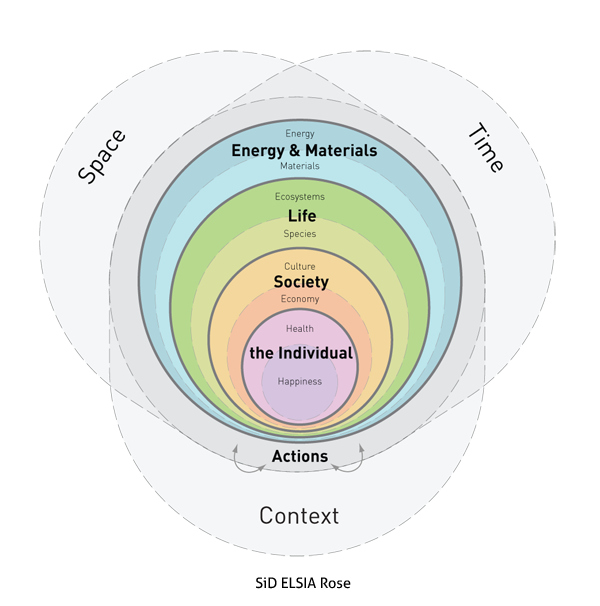
These system indicators are fed by network parameters (connectivity, diversity, transparency, redundancy) and object-level measures across the eight ELSI domains: Energy, Land, Species, Infrastructure, Materials, Economy, Culture, and Health.
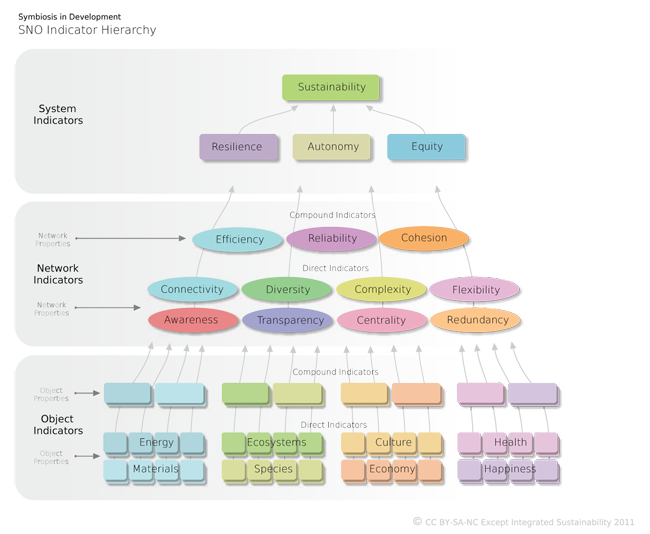
Together, the definition, the ELSI framework, and the RAH system indicators form a comprehensive and practical system for understanding what sustainability is, how to evaluate it, and how to work towards it. These are explored in detail in 1.3 ELSI in Detail and 1.4 System Indicators (RAH).