Backcasting
Where this fits
This chapter is part of the SiD Toolbox (Section 4). Backcasting is a core planning method used in SiD's fourth step, "Solutioning and Roadmapping," within the five-step method (Goals and Indicators, System Mapping, System Understanding, Solutioning and Roadmapping, Evaluate and Iterate). It complements forecasting by working in the opposite direction: from a defined future back to the present.
The problem with forecasting
Most planning works forward. You look at where you are, project current trends into the future, and try to steer. This is forecasting, and it dominates business strategy, policy planning, and personal goal-setting alike.
Forecasting is useful for stable systems with predictable trajectories. It fails when the system is complex, when multiple interacting forces create nonlinear outcomes, or when the goal is fundamentally different from the current trajectory. In those cases, projecting forward from the present tends to produce incremental adjustments to a path that may be heading in the wrong direction entirely.
Climate policy is a good example. Forecasting from current emissions trends produces projections of warming. These projections inform targets. But the targets themselves are constrained by what seems "realistic" given current trends, which means they rarely challenge the underlying systems that produce the emissions. The result is a planning process that optimizes within a failing paradigm rather than charting a path to a different one.
Working backward from the future
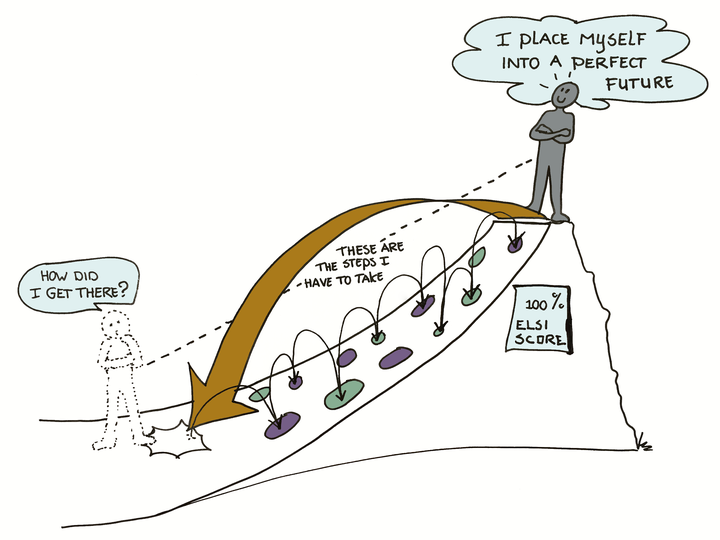
Backcasting inverts the process. You start by defining the desired future state in concrete terms. Then you work backward, step by step, to determine what conditions, decisions, and actions would need to be in place at each stage to arrive there.
The method was developed in the 1970s by John B. Robinson at the University of Waterloo. It gained prominence in sustainability planning through the work of Karl-Henrik Robert and The Natural Step framework. In SiD, backcasting is a standard tool used during the solutioning phase.
The logic is straightforward:
- Define the desired end state. Be specific. Not "a sustainable city" but "a city where 90% of trips are made by foot, bike, or public transit; where all buildings produce more energy than they consume; where every resident has access to green space within 300 meters of their home." The SiD framework's RAH goals (Resilience, Autonomy, Harmony) and ELSI-8 domains (Energy, Land use, Materials, Ecosystems, Species, Culture, Economy, Health and Happiness) provide structure for defining this end state comprehensively.
- Identify the gap. Compare the desired future with the current state. What is different? What systems, structures, behaviors, and conditions would need to change?
- Work backward in stages. From the end state, ask: what needs to be true five years before this is achieved? Ten years before? What decisions, investments, policies, and cultural shifts precede the desired outcome? Each stage reveals prerequisites for the next.
- Identify actions for today. The final step produces a set of actions, decisions, and investments that need to happen now, or soon, to set the chain in motion. These actions are grounded in a clear logic connecting them to the desired outcome.
Why backcasting works
Backcasting succeeds where forecasting fails for three reasons:
It liberates from path dependency. When you plan forward, you are anchored to the present. Every option is evaluated against "what seems feasible from here." Backcasting breaks this anchor. By starting from the future, you discover pathways that would never appear in a forward-looking analysis because they require early decisions that look impractical in isolation.
It reveals hidden prerequisites. Many transformations fail not because the final vision is wrong, but because critical enabling conditions were never put in place. Backcasting surfaces these conditions systematically. If the goal requires a skilled workforce in 2040, the training programs need to start in 2030, which means the curriculum needs to be developed by 2028, which means research needs to begin now.
It creates alignment. A well-defined end state gives all stakeholders a shared reference point. Disagreements shift from "what should we do?" (which invites endless debate) to "what does our agreed future require?" (which focuses discussion on practical steps).
Backcasting in SiD practice
In SiD, backcasting works in concert with other tools. The system mapping and understanding phases (steps 2 and 3) reveal the dynamics, leverage points, and constraints of the current system. Backcasting then uses that understanding to chart a viable path from desired future to present action.
The SNO framework (System, Network, Object layers) is particularly useful here. When working backward from a desired future, you can ask at each stage:
- System layer: What vision, strategy, and governance structures need to be in place?
- Network layer: What relationships, information flows, and resource exchanges need to exist?
- Object layer: What physical infrastructure, technologies, and material systems are required?
This prevents the common failure of backcasting exercises that focus only on physical infrastructure (Object layer) while ignoring the governance (System) and relational (Network) conditions that make infrastructure function.
A practical example
Consider a neighborhood that wants to become energy-positive by 2040.
End state (2040): All buildings produce surplus renewable energy. The neighborhood exports clean energy to the grid. No fossil fuels are used for heating, cooling, or transport within the area.
Working backward:
- 2037: All remaining buildings have completed retrofits. Local energy storage and smart grid systems are operational.
- 2034: Retrofit programs are at full scale. Financing mechanisms are proven and widely adopted. New construction standards require net-positive energy performance.
- 2030: Pilot retrofits on diverse building types are complete and documented. Community energy cooperative is established with strong participation. Grid infrastructure upgrades are underway.
- 2027: Building assessments are complete. Financing models are designed and tested. Regulatory barriers have been identified and addressed. Workforce training programs are producing qualified installers.
- Today: Commission building energy assessments. Research financing models from successful projects elsewhere. Begin stakeholder engagement. Identify regulatory barriers. Launch workforce training partnerships.
Each step backward reveals actions that would not emerge from a conventional forward-looking plan. The workforce training, for instance, often gets overlooked until it becomes a bottleneck years later.
Common pitfalls
Vague end states. "Sustainable" is not specific enough. Backcasting requires concrete, measurable descriptions of the desired future. The ELSI-8 domains help ensure nothing important is left out.
Skipping the system understanding. Backcasting without a thorough understanding of the current system produces fantasy roadmaps. The first three steps of the SiD process exist for a reason.
Single-path thinking. Good backcasting identifies multiple possible pathways and keeps options open. The future is uncertain; the roadmap needs to be adaptive.
Ignoring feedback loops. Actions taken today will change the system, which changes the conditions for future actions. Backcasting should be iterative, revisited as the system evolves. This connects directly to SiD's fifth step: Evaluate and Iterate.
Takeaway
Backcasting starts from a well-defined future and works backward to the present, revealing the decisions, conditions, and actions needed at each stage. It breaks free of path dependency, surfaces hidden prerequisites, and aligns stakeholders around a shared destination. In SiD, it transforms system understanding into actionable roadmaps.
Next: Blue Economy, an approach to innovation that generates zero waste by modeling business systems on ecosystems.
This knowledge is free because of our supporters. Join them.