Biomimicry and DesignLens
Where this fits
This chapter is part of the SiD Toolbox (Section 4), which provides practical instruments for sustainability practitioners. Biomimicry and the DesignLens sit within the "Solutioning and Roadmapping" phase of SiD's five-step method (Goals and Indicators, System Mapping, System Understanding, Solutioning and Roadmapping, Evaluate and Iterate). They help you generate solutions by learning from nature's 3.8 billion years of R&D.
Nature as engineer
Every organism alive today is a success story. It has survived billions of years of prototyping, testing, and iteration under the harshest quality control system imaginable: extinction. The materials, structures, forms, and strategies that remain are the ones that work.
Biomimicry takes this insight seriously. Rather than treating nature as a warehouse of raw materials to extract, it treats nature as a library of solutions to consult. The term was popularized by biologist Janine Benyus in her 1997 book Biomimicry: Innovation Inspired by Nature. The core question is simple: how does nature solve this problem?
Three levels of learning from nature
Biomimicry operates at three levels, each more powerful than the last:
1. Form. Copying a shape or structure. The bullet train's nose is modeled on a kingfisher's beak, which lets the bird dive from air into water with minimal resistance. The train enters tunnels the same way: smoothly, quietly, and with less energy.
2. Process. Mimicking how nature makes things. Spider silk is stronger than steel by weight, yet produced at room temperature from simple ingredients. Industrial manufacturing typically requires high heat, toxic chemicals, and enormous energy inputs. Learning from how organisms manufacture opens a path to radically cleaner production.
3. System. Learning from how ecosystems organize. A forest has no waste. Every output becomes an input for another process. Water is filtered, nutrients are cycled, energy is captured and redistributed. At the system level, biomimicry converges with the principles of SiD itself, particularly the SNO framework (System, Network, Object layers). Nature's system-level patterns, such as closed-loop cycling, distributed networks, and nested hierarchies, map directly onto the kind of systemic solutions SiD aims to generate.
The DesignLens
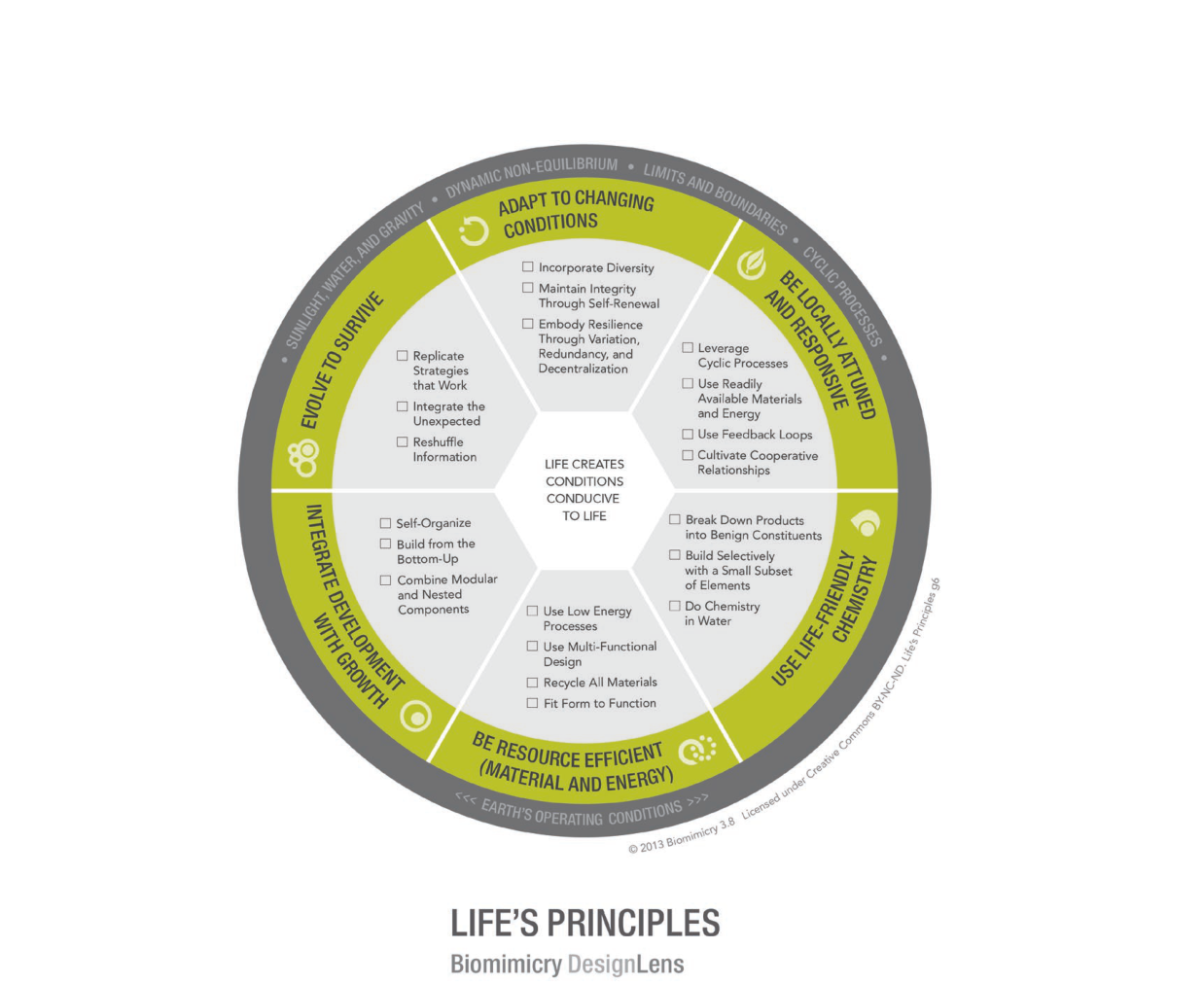
The Biomimicry Institute developed the DesignLens as a practical translation tool. It distills nature's operating principles into a set of design guidelines organized around what they call "Life's Principles." These include:
- Evolve to survive. Incorporate diversity, replicate strategies that work, integrate the unexpected.
- Adapt to changing conditions. Maintain integrity through self-renewal. Embody resilience through variation, redundancy, and decentralization.
- Be locally attuned and responsive. Use readily available materials and energy. Cultivate cooperative relationships. Leverage cyclic processes.
- Integrate development with growth. Combine modular and nested components. Build from the bottom up. Self-organize.
- Be resource efficient. Use low-energy processes. Recycle all materials. Fit form to function.
- Use life-friendly chemistry. Build selectively with a small subset of elements. Break down products into benign constituents. Do chemistry in water.
These principles function as a checklist during the solutioning phase. When designing a building, a supply chain, or a policy, you can hold your solution against Life's Principles and ask: does this design adapt? Is it resource-efficient? Does it use life-friendly chemistry?
How this connects to SiD
In SiD's framework, biomimicry fits naturally within the RAH goals (Resilience, Autonomy, Harmony). Nature's solutions are inherently resilient; they are tested against disruption over geological timescales. They tend toward autonomy; organisms and ecosystems maintain themselves without external management. And they embody harmony; every successful organism exists in dynamic balance with its environment.
The DesignLens also maps onto the ELSI-8 domains (Energy, Land use, Materials, Ecosystems, Species, Culture, Economy, Health and Happiness). Nature-inspired solutions tend to perform well across multiple domains simultaneously, because natural systems have been optimized across all of them by evolution.
This is the key advantage of biomimicry over conventional design: it does not optimize for a single variable. A leaf is simultaneously a solar collector, a gas exchange surface, a water management device, and a structural element. Learning from this kind of multi-functional integration is one of the fastest paths to genuinely sustainable solutions.
Applying biomimicry in practice
At Except, biomimicry principles have been applied across projects ranging from building design to industrial ecology. The most common entry point is asking: what organism or ecosystem has already solved the problem we face?
A few practical pointers:
- Start with function, not form. "How does nature cool a space?" is a better question than "What animal looks like a building?" The answer might lead you to termite mounds (passive ventilation), elephant ears (radiative cooling), or forest canopy layers (shade stratification).
- Use the AskNature database. The Biomimicry Institute maintains AskNature (asknature.org), a searchable database of biological strategies organized by function. It is a practical starting point for any design challenge.
- Move toward system-level mimicry. Form-level biomimicry is the easiest to apply but delivers the smallest impact. System-level biomimicry, designing entire processes and organizations to function like ecosystems, is harder but transforms outcomes.
Resources
- Janine Benyus, Biomimicry: Innovation Inspired by Nature (1997)
- The Biomimicry Institute: biomimicryinstitute.org
- AskNature database: asknature.org
- Biomimicry DesignLens: biomimicry.net/the-buzz/resources/designlens
Takeaway
Nature has already solved most of the problems we face, and done so elegantly, efficiently, and without waste. Biomimicry and the DesignLens provide structured ways to access that library of solutions. The deeper you go, from copying forms to mimicking processes to learning from whole ecosystems, the more powerful the results become.
Next: Backcasting, a method for working backward from a desired future to determine what actions to take today.
This knowledge is free because of our supporters. Join them.