The Alien Colony
Where This Fits
You know why SiD exists (from "Why Now?") and have seen its four components (from "The Essence of SiD"). This unit uses a thought experiment to make the three core sustainability indicators, Resilience, Autonomy, and Harmony (RAH), feel intuitive before the Theory layer defines them formally.
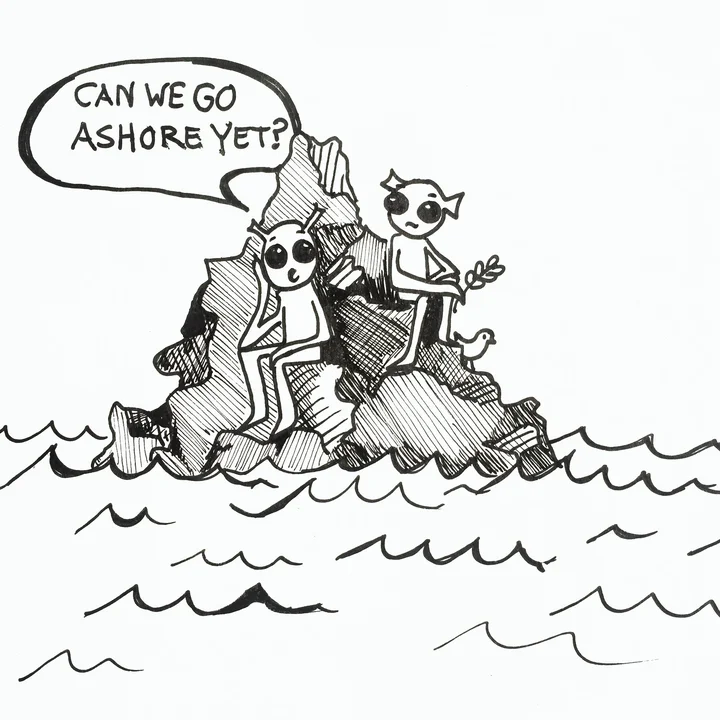
A Happy Colony of Aliens in Space
The objective of sustainability is, put shortly, for mankind to continue to survive on this planet. Preferably, flourishing and happy, but that requires survival in the first place, and absence of critical hardship in the second. What does it take for us to survive like this? In order to figure this out and get a feeling for its base principles, it helps to use the following thought experiment.
Imagine an alien colony floating around in space. What does it take for it to survive? Imagining this clarifies some of the base theoretical principles of SiD, which is helpful to have in mind before diving deeper into the theory chapter.
Preventing Collapse
In order to understand how our alien colony floating around in space can continue to survive, it helps to think about its reverse: preventing it from collapse. Collapse doesn't have to be complete annihilation; it is more often the degradation of a civilization to a more primitive state. In either case, collapse goes hand in hand with death and destruction of all kinds of values we hold dearly, such as cultural sophistication, economic value, and human rights.
Here we have our alien colony. Floating in space. They are lovely aliens who merely hope to survive and flourish. Let's look at what they will need to achieve this, and not collapse.
The Colony Needs Autonomy
To begin with, the colony will need their basics in order. All life needs some input of resources. They may need to consume sustenance to stay alive, which they need to make. They may also need heat to keep warm in space. Basically, they will need some material resources, including things like medicine to stay alive in the most basic form.
In order to stay that way, they need an indefinite supply of these resources to keep the colony alive, and an infrastructure of extraction, production, and distribution. This may include recycling everything to reduce reliance on outside sources, and so on. In SiD, these requirements are covered under the word "autonomy." Autonomy is about the colony's self-sufficiency, and making the decisions to remain that way.
The Colony Needs Harmony
In order to survive further, the colony should maintain some level of peace. It is all fine and well to have enough food and medicine and shelter, but if there is so much tension that they keep killing each other, that will threaten their existence. Things that may cause tension can include how resources are shared, power structures, participation, and so on.
All things related to this are called "Harmony" in SiD, which points to the need for the management of internal tensions of the colony.
The Colony Needs Resilience
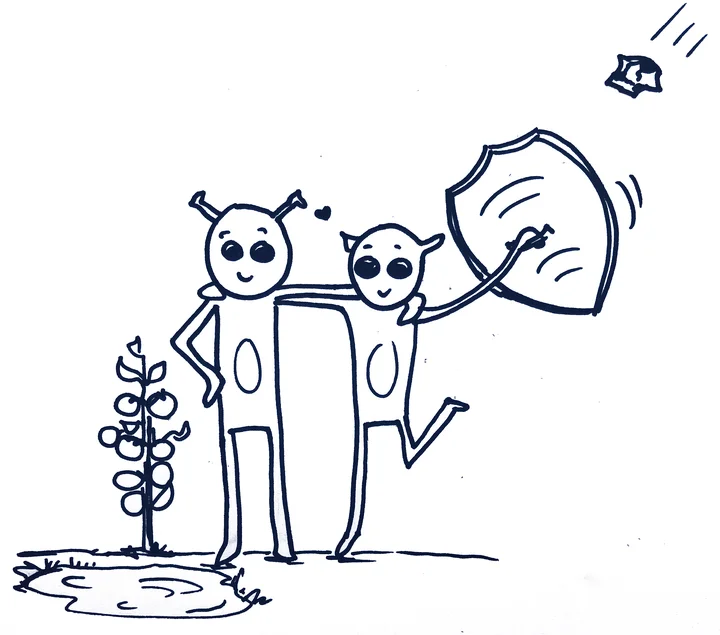
With autonomy and harmony in place, they are doing pretty well floating around. But then there are outside influences. They are floating in space, so at any time a meteor or other unidentified thing can cross their path. A moon's shadow may take away the light of a star needed to survive.
In order to deal with this and survive, they need specific properties. For example, they need to be able to detect things coming their way (awareness). If they understand that some giant space rock is hurtling their way, they need the capacity to get out of its way (flexibility).
In the event of being struck anyway, it would help if there is not just one alien but many, so that at least some will survive (redundancy). There are many such aspects that help the colony survive unexpected and sudden changes in their environment. These we call "Resilience" in SiD.
So, in order for a colony not to collapse, it needs to be autonomous, in harmony, and resilient. If it has these properties, it can survive. If these get up to a certain level of comfort, they also set the preconditions for the colony to flourish and be happy.
The Colony Needs Healthy System Dynamics
These three aspects, autonomy, harmony, and resilience, form the foundation of a sustainable society. If all three are in the "green," the colony has a good chance to survive. But it is never that simple. These three aspects influence one another.
For example, increasing the colony's resource intake, and thus their autonomy, may make them heavier. This reduces their agility of movement, which reduces their resilience. There is hardly ever an ideal move; there is always a trade-off.
Some of these interactions can get rather complex, much more than a simple trade-off. Some may develop slowly over time, or are so subtle on an individual basis that we cannot see their massive effects on a grand scale, like climate change. We call the patterns in these interactions "system dynamics" or "system behaviors."
As a human civilization, we are pretty good at understanding that we need to secure water, food, power, and some other resources to survive, the autonomy part. We mostly understand the importance of the harmony part but we are not particularly good at arranging that (yet).
The resilience part is where we still struggle the most. This causes us to miss important system dynamics between all of them. We make many decisions that make us less resilient in the long run for short-term autonomy or harmony gain.
Diminishing Marginal Returns
Joseph Tainter (1949-) is an anthropological scholar and historian, and one of the world's most interesting experts on societal dynamics. Tainter was fascinated by one central question: why did old civilizations cease to exist, even sophisticated ones?
He was not happy with the usual answers. For example, the Mayans collapsed because of a famine, and the Roman Empire because they were overrun by Barbarian tribes. He figured the Mayans had dealt with famine before, and the Romans dealt with Barbarians before, so he wondered: what was it that made them collapse this time around? What made their societies so fragile that they could not overcome that adversity?
So he studied many old civilizations, including Mayans, Chacoan, and the Romans, using network and complexity theory, and found a pattern. He wrote a magnificent book about it called The Collapse of Complex Societies (1988). In his work, he shows that societies become "brittle" over time due to the law of decreasing marginal returns, an over-arching system dynamic.
As a society grows and develops, it increasingly needs more of everything. A developed society has a larger footprint per capita than a more simple society, and this is an irreversible process (until collapse).
More of everything means not just more energy and food, but also less tangible things such as capacity to handle trade transactions, cultural diversity, and management overhead. Once resources become scarce, it puts pressure on everything, making the system "brittle." At that point, pretty much anything can set off the process of collapse.
So, applied to our colony of aliens: when it grows, it will need to fundamentally change its operations, infrastructures, and even base resource usage patterns to prevent becoming brittle and collapsing. Even out in space, where there is infinite room to grow, there are limits to growth, and a necessity to tune systems to their changing dynamics over time.
Takeaway
A sustainable system needs three things: Autonomy (self-sufficiency in resources), Harmony (internal peace and fair distribution), and Resilience (the capacity to survive external shocks). These three interact through system dynamics: trade-offs that can strengthen or weaken the whole. History shows that growing societies become brittle when they ignore these dynamics. SiD provides the tools to detect and navigate them.
Learning from Aliens and Collapse
Looking at our world, we can see the cracks in the system of our increasingly brittle society appearing. One can even deduce large societal movements such as the Arab Spring or the rise of nationalism in the western world as early systemic warning signs.
We also have some hopeful unique properties. Our society is unique in comparison to older civilizations in that we are globally connected. For the first time in history, we have a world economy and resource system that can help to balance resource needs. We also have unprecedented technological advances that may allow us to tap into more concentrated or abundantly available resources, such as renewable energy and nuclear fusion.
But besides battling the symptoms, even better is for us to learn, understand, and apply the solutions that systemic insight brings us. We can develop some eyes and awareness of them, and develop ways to ride the wave of change out of the danger zone.
Like the alien colony setting up control rooms to check for system dynamics in their colony, there is no reason to think that our society does not comply to the law of diminishing marginal returns, and there is plenty of proof to indicate that we have become increasingly "brittle."
In that, it helps to allow ourselves to start looking at our society as an alien colony floating in space. What systems would we put in place to detect these system dynamics? Where in the system that has become brittle can we intervene to increase resilience? What measures can increase autonomy and resilience at once? How can we better embed harmony in the world? What part can we play in this? Questions I hope using SiD will help you answer.
This knowledge is free because of our supporters. Join them.
Found a problem? Log in to report an issue.