Tools: Brainstorming
Where This Fits
This unit covers two practical tools: Natural Capital valuation for making ecosystem value visible in economic terms, and structured brainstorming techniques for generating systemic solutions. Both are commonly used in Steps 2-4 of the SiD method.
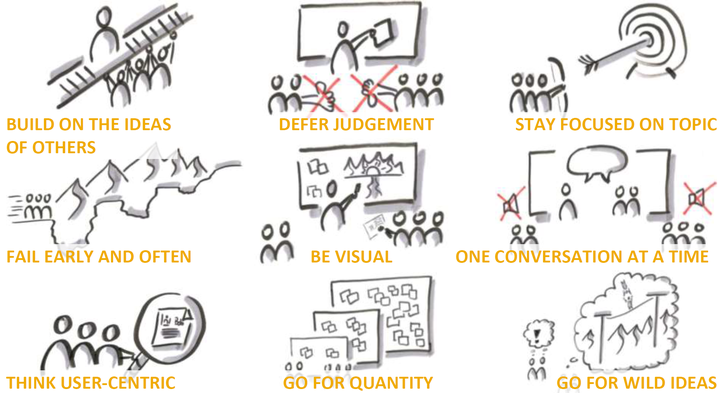
Why rules matter
Brainstorming can be a powerful exercise, if done well. The difference between a productive session and a frustrating one almost always comes down to whether participants follow a small set of ground rules.
For those not used to creative thinking, it can be hard at first, especially the "defer judgment" part. Remind each other of the rules when they are broken. There is nothing more devastating to a brainstorm session than naysayers, even when they are right. Brainstorming is about expanding your vision, diverging in your search for possibilities. The best ideas may come through an impossible other idea.
The rules
1. Defer judgment
Allow anyone to say anything, and build on each other's ideas. Do not say "no" to someone's idea. Instead, provide an alternative, or build on what they said. The moment someone's contribution is shot down, the entire group becomes cautious. Creativity requires psychological safety.
2. Encourage wild ideas
Bad ideas may lead to great ideas. Welcome even the most outlandish suggestions. An "impossible" idea often contains the seed of a genuinely innovative one. In SiD practice, some of the most effective systemic solutions started as ideas that seemed absurd on first hearing.
3. Go for quantity
Do not get stuck. Keep riffing. Quantity over quality. The filtering comes later. During a brainstorm, every idea is equally valid. Trying to evaluate each one as it appears slows the process to a crawl and activates the wrong kind of thinking.
4. Leave your phone off
Be fully engaged. Close your laptop. Put it away. Listen to one another. Creative ideation requires presence. Half-attention produces half-ideas.
5. Be creative with the space
Use the space, paper, materials. Walk around. Stand up. Sketch. Use sticky notes, whiteboards, large sheets of paper. Physical engagement activates different cognitive processes than sitting still and talking.
6. Stay focused
Keep it on the topic and in one discussion. Side conversations fragment the group's collective attention. If a tangent is interesting, note it for later.
7. Keep it short
Twenty minutes is the maximum for a single brainstorming round. After that, take a break, reflect on what emerged, cluster ideas, or switch to a different exercise. Energy and creativity drop sharply after twenty minutes of intense ideation. Multiple short rounds produce better results than one long slog.
Brainstorm variations
Brainstorming is a collection of ways to develop new ideas. Several variations can be more effective than traditional open-floor brainstorming, depending on the group and the challenge:
Brain-dumping
After the assignment is given, let everyone write down their initial ideas on a single piece of paper before sharing. People form an initial idea that may block new ideas from forming. Doing a brain-dump clears this initial impulse, making room for fresh thinking. It also ensures quieter participants contribute before dominant voices take over the room.
Brain-writing
Write down a sentence or an idea, then pass your paper to the left. Build further on the ideas you receive from others. This technique combines individual reflection with collaborative building. It produces a richer set of ideas than pure verbal brainstorming because it removes the pressure of speaking in front of the group.
Word associations
Call out single associated words related to the topic, no matter how far-fetched, and write all of them on a flip chart. Useful for finding names, discovering new directions, and as an ice-breaker. The speed of word association bypasses the analytical filters that can block creative thinking.
Brainstorming in a SiD context
In SiD work, brainstorming sessions typically focus on one of several tasks:
- Identifying stakeholders and system elements during the System Mapping phase.
- Exploring leverage points during System Understanding.
- Generating solution ideas during Solutioning, often using the ELSI-8 domains as prompts (what solutions address Energy? Land use? Health?).
- Imagining desired futures as input for backcasting exercises.
The rules above apply in all these cases. The specific constraint or prompt varies, but the principles of deferred judgment, quantity, and creative engagement remain constant.
One additional SiD-specific guideline: when brainstorming solutions, encourage ideas that span multiple ELSI-8 domains and SNO layers (System, Network, Object). The most powerful systemic solutions are those that address several domains simultaneously. A brainstorm that generates only object-level solutions has not gone deep enough.
Takeaway
Brainstorming works when the rules are followed: defer judgment, go for quantity, stay present, keep it short. Variations like brain-dumping and brain-writing help different kinds of thinkers contribute. In SiD practice, the most productive brainstorms are those that push beyond object-level ideas into network and system-level thinking.
Next: Twelve System Intervention Points, a framework for identifying where in a system your actions will have the most leverage.
This knowledge is free because of our supporters. Join them.