Circular Economy
From Linear to Circular
The circular economy replaces the linear "take-make-waste" model with one that keeps materials and products in use as long as possible, extracts maximum value, and regenerates natural systems. It is primarily an object-level and network-level tool in SiD, used most intensively during Step 4: Solutioning & Roadmapping.
Core Principles
Design out waste and pollution: Products and systems are designed from the start so materials can be safely returned to the biosphere or cycled indefinitely in technical systems.
Keep products and materials in use: Through reuse, repair, refurbishment, remanufacturing, and recycling, embedded value is preserved as long as possible.
Regenerate natural systems: Rather than minimizing harm, circular approaches actively improve natural capital by returning nutrients and materials to the biosphere.
Circularity Is Not Sustainability
SiD takes a specific position on circular economy: circularity is a necessary but not sufficient condition for sustainability. A perfectly circular system can still degrade ecosystems, increase inequality, or undermine community resilience if it operates without systemic awareness. The conventional separation of materials into "techno-cycles" and "bio-cycles" is scientifically questionable, as many materials do not fit neatly into either category, and the boundary between biological and technical systems is more permeable than the model suggests.
Without addressing system-level dynamics, including the RAH indicators (Resilience, Autonomy, Harmony) and the full ELSI spectrum, circular interventions can still generate unintended consequences. A circular supply chain that concentrates economic power, for instance, may be materially efficient but socially extractive.
Circular Economy in SiD
Within the SiD framework, circular economy primarily addresses the Materials and Energy categories of ELSI and connects strongly to the Autonomy system indicator through Circularity and Self-Sufficiency network parameters. It is most powerful when combined with other SiD tools:
- Biomimicry provides design principles for closed-loop systems inspired by natural processes.
- Intervention Points identify where in the system circular interventions will have the greatest leverage.
- System Mapping reveals material and energy flows that circular design must address.
Industrial Symbiosis
Industrial symbiosis is circular economy at network scale: one company or sector utilizing the waste resources of another (heat, energy, water, by-products, logistics, expertise, equipment, materials). The Kalundborg Eco-Industrial Park in Denmark is the classic example: an oil refinery, pharmaceutical plant, gypsum board manufacturer, recycling facility, and water/heat supplier form a network where each participant's waste becomes another's input. The system was originally designed for economic efficiency; environmental and social benefits emerged as side effects of closing resource loops.
Practical Application
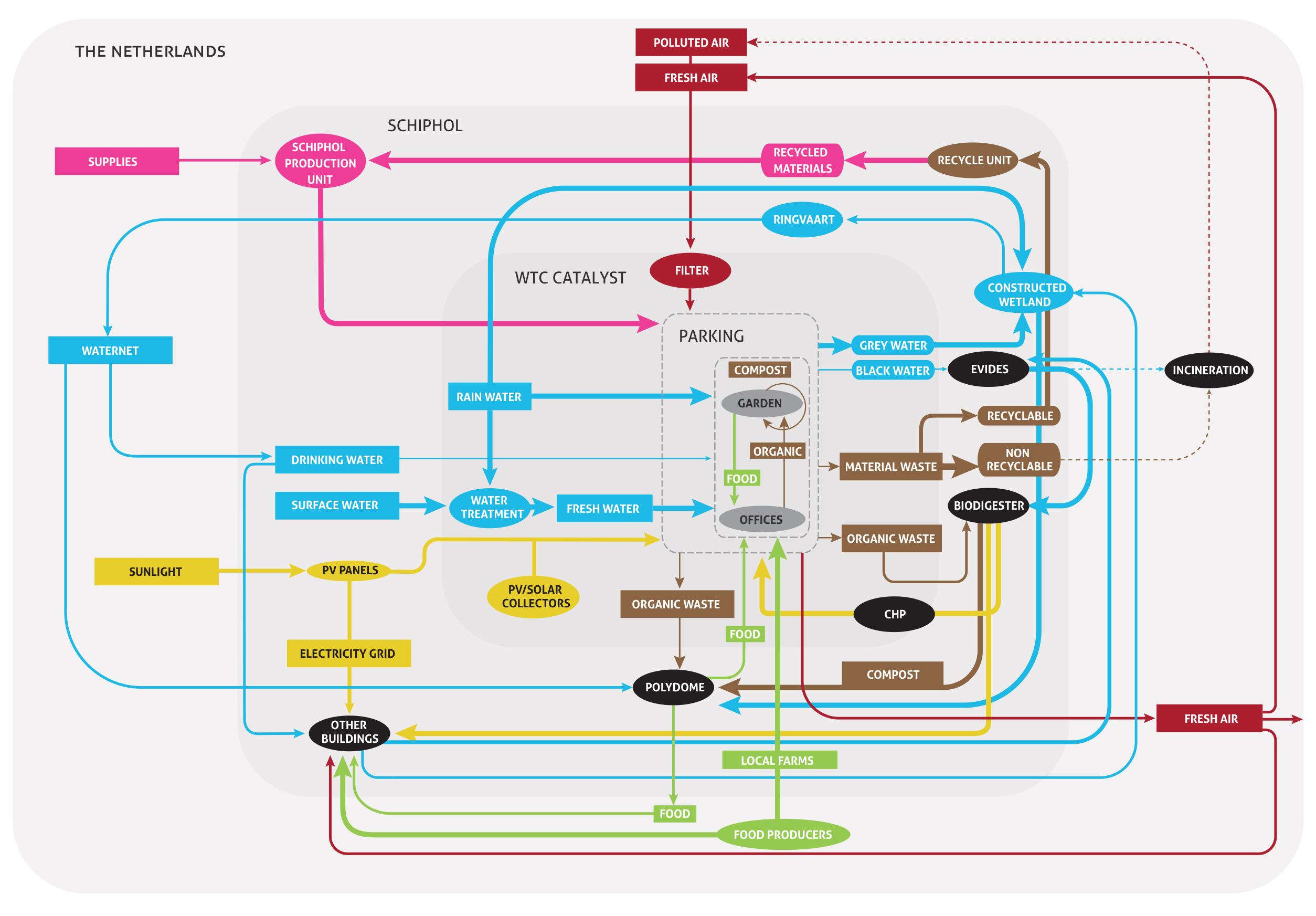
When integrating circular economy thinking into a SiD process, map all material and energy flows in the system (Step 2), identify where loops can be closed or waste streams redirected (Step 3-4), and evaluate whether circular interventions improve or degrade performance across the full ELSI spectrum (Step 5). The Schiphol Airport circular flows analysis shown above illustrates this approach: water, energy, waste, and composting loops mapped as an integrated system rather than separate waste management challenges.