Circular Economy
Where this fits
This chapter is part of the SiD Toolbox (Section 4). The Circular Economy is one of the most widely adopted sustainability frameworks in business and policy. It connects directly to SiD's ELSI-8 domain of Materials and to the Network layer of the SNO framework, where resource flows between actors define system behavior.
From linear to circular
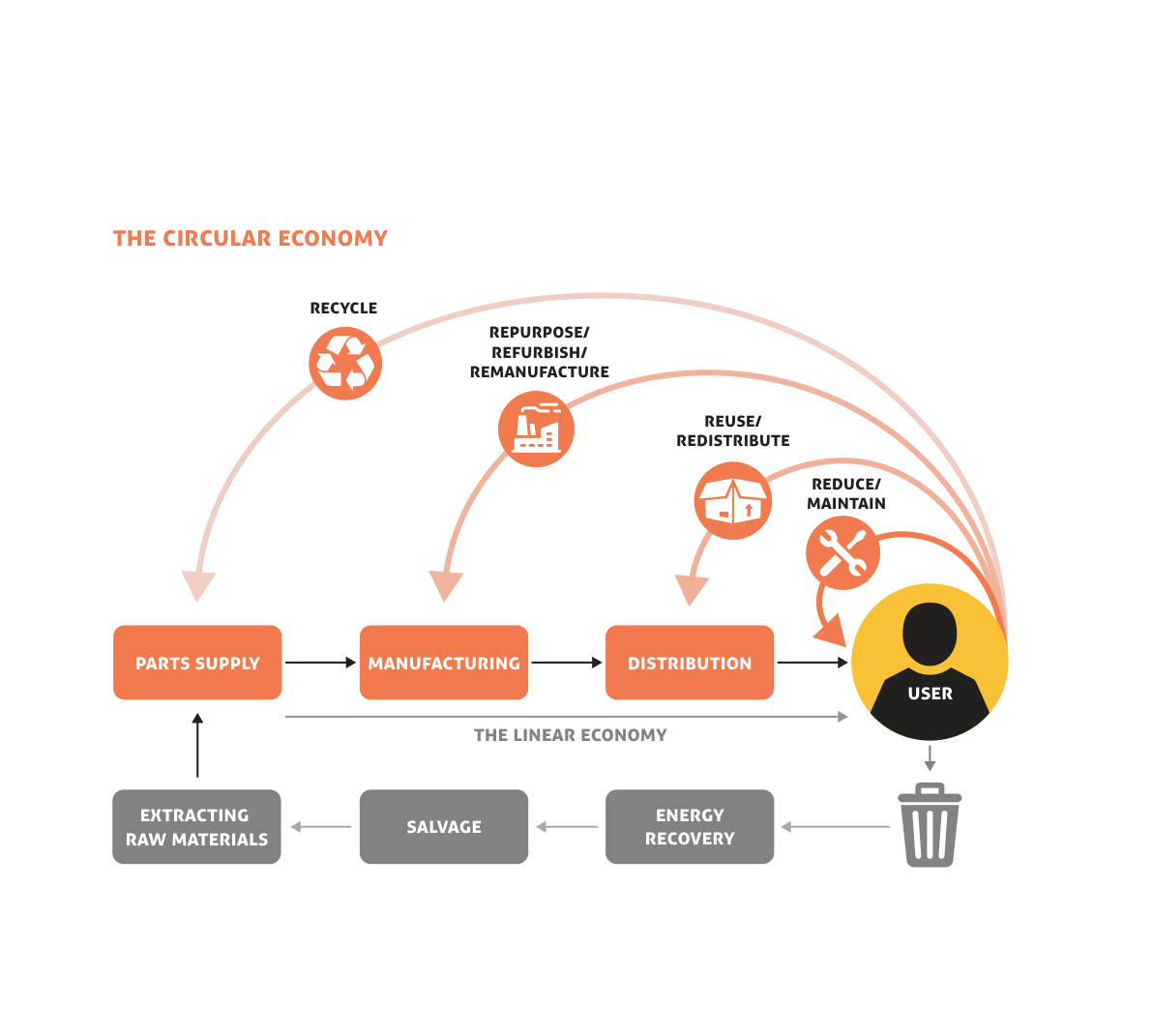
The conventional economy is linear: extract resources, manufacture products, use them, discard them. Take, make, waste. This model worked when resources seemed infinite and sinks seemed bottomless. Neither is true.
The Circular Economy (CE) replaces this linear flow with closed loops. Products and materials are designed to circulate at their highest value for as long as possible. When a product reaches the end of its useful life, its components and materials re-enter the system as inputs for new products or biological cycles.
The concept draws on several intellectual traditions: cradle-to-cradle design (McDonough and Braungart), industrial ecology, biomimicry, and the Blue Economy. The Ellen MacArthur Foundation has become the leading advocate, building a global network of businesses, governments, and universities working to accelerate the transition.
Three principles
The Ellen MacArthur Foundation distills the Circular Economy into three design principles:
- Eliminate waste and pollution. Waste is a design flaw. If a product cannot be reused, repaired, remanufactured, or recycled, it was designed wrong.
- Circulate products and materials at their highest value. Keep products in use through maintenance, repair, reuse, refurbishment, and remanufacturing. When a product truly cannot be used further, recycle its materials. Biological materials return to the earth through composting or anaerobic digestion.
- Regenerate nature. Move beyond "doing less harm" to actively rebuilding natural systems. Return biological nutrients to the soil. Support biodiversity. Restore ecosystem function.
Two material cycles
The CE distinguishes between two types of material flow:
Technical cycle. Products made from synthetic or mineral materials (metals, plastics, glass) circulate through sharing, maintenance, reuse, refurbishment, remanufacturing, and recycling. The goal is to keep these materials in productive use indefinitely, never losing them to landfill or dispersive uses.
Biological cycle. Products made from biological materials (food, wood, natural fibers, bio-based chemicals) return to living systems through composting, anaerobic digestion, or cascading use. A cotton shirt might be reused, then shredded for insulation, then composted to return nutrients to soil.
Connection to SiD
In SiD terms, the Circular Economy operates primarily at the Network and Object layers of the SNO framework:
- Object layer: Product design for disassembly, repair, and material recovery.
- Network layer: Business models based on access rather than ownership (leasing, sharing, product-as-service). Supply chains designed as closed loops. Industrial symbiosis, where the waste of one factory feeds another.
- System layer: The deeper shift that CE requires but does not always address. Changing the economic logic from throughput maximization to value preservation requires governance, cultural, and institutional change.
SiD adds depth to the CE by insisting on system-level analysis across all ELSI-8 domains. A circular product that solves the Materials domain but creates problems in Ecosystems or Health is not truly circular in a systemic sense.
Systems thinking and related theories
The Circular Economy is one node in a larger web of systems-oriented fields. Practitioners benefit from familiarity with related theories and approaches:
- Systems thinking (overarching, practical)
- Systems theory (overarching, theoretical)
- Network science (overarching, scientific)
- Complex adaptive systems (sociological)
- Chaos theory (mathematics, patterns in complexity)
- Cybernetics (organized complexity, systems modeling)
- Soft systems methodology (societal transitions)
- Permaculture (agriculture, ecosystems)
- Holistic management (agriculture, systems thinking)
- Systems ecology (ecology)
- Integral theory (spiritual, existential)
A useful approach to building fluency: pick one of these fields, read its Wikipedia article, follow links to related concepts, and keep going until your brain is full. Many concepts overlap between fields, and some theories explain certain ideas better than others. A broad vocabulary across multiple frameworks helps you explain systems concepts to diverse audiences and apply them more flexibly in your work.
Resources
- Ellen MacArthur Foundation: ellenmacarthurfoundation.org/circular-economy
- CE Network Map: ellenmacarthurfoundation.org/networkmap
- William McDonough and Michael Braungart, Cradle to Cradle: Remaking the Way We Make Things (2002)
Takeaway
The Circular Economy replaces the linear take-make-waste model with closed-loop systems where waste becomes input. It is one of the most actionable sustainability frameworks available, and it gains power when combined with SiD's broader systemic perspective across all eight ELSI-8 domains.
Next: Natural Capital, which addresses how to value nature's contributions to the economy and embed that value into decision-making.
This knowledge is free because of our supporters. Join them.