The Essence of SiD
The SiD Mountain
Where this fits
The Foreword told you why SiD was created. "Why Now?" explained why the world needs it. This chapter gives you the overview: what SiD is, how it is structured, and what it feels like to use. It introduces the core concepts (RAH, system dynamics, and the four components) through a thought experiment about an alien colony floating in space. By the end, you will have the mental model needed to dive into the full theory.
What SiD is, in one paragraph
SiD (Symbiosis in Development) is a framework for developing sustainable, symbiotic solutions. It is a complete process from idea to implementation, designed for teams of cooperating experts and individuals alike. It combines a holistic systems approach, interdisciplinary collaboration, design thinking, and lightweight iterative development cycles.
The result: top-down systemic strategies activated by bottom-up interventions, pushed toward implementation using short-term action plans that follow long-term roadmaps. In application, SiD gives deep insight into interconnected systems such as supply chains, ecosystem services, circular economies, and system dynamics.
If that paragraph felt like a waterfall of terms, good. By the end of this course, every word in it will be concrete.
Why use SiD?
If the past has taught us anything, it is that no matter where in the world we want to act (big or small) we must consider the long-term consequences of our actions. We need to account for all aspects of society if we want to end up with a better world. Focusing only on sub-aspects like energy or food is insufficient, because they are all related and eventually affect each other.
SiD enables you to take the full system into account at all times, and to use this as a strength: finding the most effective solutions that cost the least effort and resources.
SiD does not tell you what to do, nor what is right and wrong. Instead, it helps you figure out what the right questions are in any given situation. Then it gives you a process to work toward an answer, step by step. It allows you to track possible downsides of your actions and gives you tools to develop powerful concepts and evaluate them along the way.
You can use it alone or with a team, from a small student project to decade-long transition programs in cities, businesses, industry, and governance.
SiD’s four components
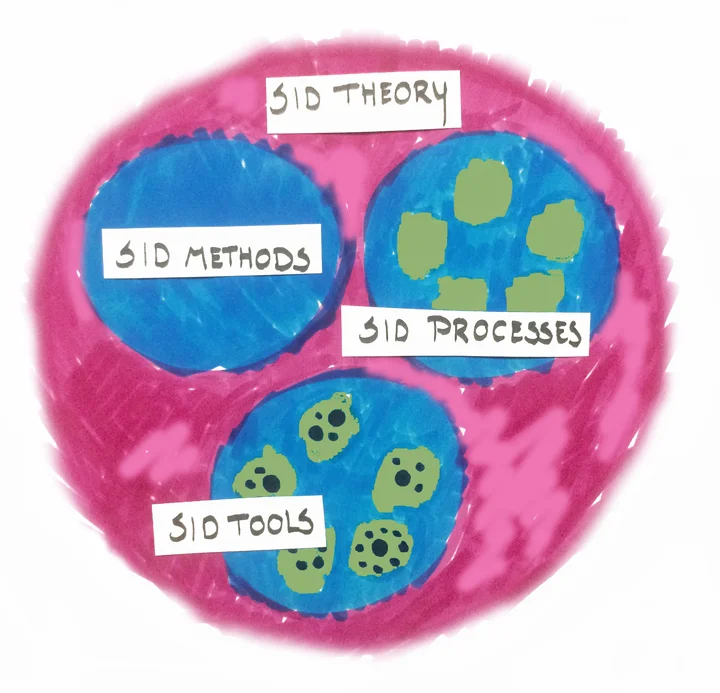
SiD consists of four nested components: Theory, Method, Process, and Tools.
SiD Theory covers the fundamental concepts at SiD’s core: the sustainability definition, the anatomy of systems, networks, objects, system dynamics, system transitions, and roadmaps.
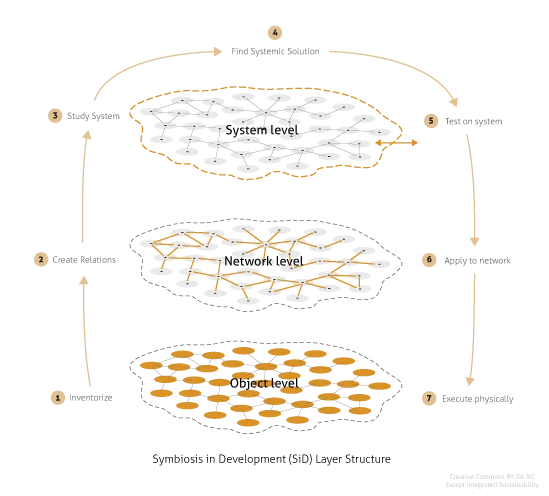
SiD Method describes how the theory is applied in a step-by-step process. This is the five-step method: Goals and Indicators, System Mapping, System Understanding, Solutioning and Roadmapping, and Evaluate and Iterate. The method is iterative; during a single project it is cycled through several times.
SiD Process focuses on day-to-day practice: how to apply the method in a practical project management approach, build a team, involve stakeholders, and run a working process from start to finish.
SiD Tools lists a variety of aids that can be used at various stages of a project.
How to use this course
This course works as a reference library. You do not need to go through it front to back. Jump from area to area depending on your interest.
The first part is theoretical, which can take effort to get through. The later sections are practical, step-by-step instructions. If you prefer to learn by doing, you may want to explore the practice sections before the in-depth theory.
Quick-start path: Read this introduction chapter, then read only the introductions and overviews of Theory, Method, and Process. Skip the Tools section until you find a reference worth following up. Then go back to the sections you want to know more about, and go as deep as you like.
SiD takes time
Mastering SiD (or any systemic sustainability approach) takes time and effort. Sustainability, with its many facets, is inherently complex and rich in knowledge. SiD streamlines and accelerates the learning, but cannot make the challenges simpler in their essence.
In our experience, it takes a few years of full-time engagement to master SiD and all its related facets for sustainable development from start to finish. Thankfully, mastery is not required for usefulness. Many tools and approaches work well on their own, so you can learn step by step and start implementing immediately. The practical chapters on Method and Process will help you get going quickly.
Our hope is that after a few SiD projects, once you have allowed yourself to become familiar with the theory, it becomes useful even in day-to-day contexts. Say, in the supermarket, choosing between peanut butter brands. We also hope it brings you ideas and solutions you did not know you could reach without complicated software or months of work. At that stage, practicing SiD becomes a straightforward affair, almost an invisible intuitive process running in the background.
Modular framework
SiD is a modular framework that allows existing tools from outside the framework to be integrated when necessary. SiD is not a belief, dogma, or certification system. It is flexible, adjustable, and open for you to add your own techniques and change it where you want. If you already know business analysis tools like SWOT analysis or Life Cycle Assessment (LCA), slot them in wherever they fit.
Solo or together?
Many examples and exercises in this course are geared toward small teams of 3 to 5 people working together. However, SiD was originally developed as a solo tool, and works just as well for that. It has also been tested in the field with up to 70 stakeholders working together. Sometimes it is better to do certain sections of a challenge alone and others as a group. The Process section gives pointers on this.
The a-ha machine
In our experience, SiD excels at producing those unique "a-ha" moments where you suddenly see it. That one insight that makes all the difference. That solution which afterward seems so obvious.
SiD’s method "uploads" available information about the system to your mind, where it is processed to recognize patterns. To suddenly see patterns in complex systems and derive a way forward, we have few tools to rely on but our own brains. These patterns are often the key to great solutions, but your brain needs to marinate in the challenge to find them.
This mental process is largely subconscious, which means it is vital to allow room for creativity and relaxation. Just as Archimedes needed his wife to force him into a bath (resulting in his "Eureka" moment), your brain needs mental rest to process in the background.
You cannot cram a SiD process into a few hours and expect miracles. Taking time away from the problem during the system understanding phases greatly accelerates breakthroughs. Allow this, no matter what format you choose to work in.
SiD Origins, Benefits, and Applications
Open source and sharing
SiD stands on the shoulders of giants, learning from ideas and frameworks developed by others. To support this, SiD is open source. Many of the diagrams and aids discussed here are free to download at ThinkSiD.org. If you want to alter or share these materials or any SiD resources, you can do so under the Creative Commons license at the end of the book. If you make tools or improve existing ones, please share them back with the community.
By making SiD open source, we hope SiD itself is sustainable, with a bright future in building a sustainable society.
SiD and the SDGs
SiD works hand-in-hand with the UN Sustainable Development Goals. The SDGs provide a shared language for sustainability targets; SiD provides the systemic framework to actually achieve them. A dedicated unit, SiD and the SDGs, covers this relationship in detail.
The next unit, The Alien Colony, walks through the thought experiment that explains why RAH matters and how system dynamics drive collapse or flourishing.
Takeaway
SiD is structured in four nested layers (Theory, Method, Process, Tools) and grounded in three survival requirements: Resilience, Autonomy, and Harmony (RAH). The next unit explores a real IKEA case study that shows what this looks like in practice.
Next up: The Theory chapter defines the foundational concepts in full, starting with what "sustainability" actually means in the SiD framework.
This knowledge is free because of our supporters. Join them.
Found a problem? Log in to report an issue.