Why Now
Where this fits
This chapter sets the stage. Before diving into what SiD is and how it works, you need to understand why a framework like this is necessary. The answer lives in five converging pressures: population growth, system fragility, network power, planetary boundaries, and the shift from growth to resilience. Together, they make the case that incremental improvement is no longer enough.
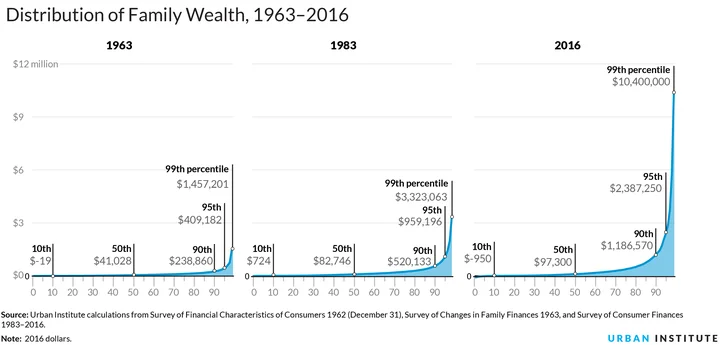
The goal is clear
We all want to continue living healthy, happy lives in a beautiful, safe world. A world with space for leisure and community, beauty, art, and excitement. A world where children grow up knowing the natural world is flourishing and capable of regenerating from whatever comes. A just and fair world, with peace and prosperity.
Those working on sustainability share the goal of societies where cities run on abundant resources, connected through resilient economies, where material and energy loops are closed and ecosystems provide abundance.
This is clearly not the world we are living in now, nor the direction we are heading.
We are washing dishes on the Titanic
Despite wholehearted initiatives to turn the tide, our problems are becoming more severe while our methods of resolving them grow increasingly inadequate. We try to combat large systemic societal, economic, and environmental effects by applying band-aids. We need new ways of thinking, activated by practical action plans for significant systemic change.
The old path of unmitigated growth and object-oriented thinking leads to our common enemy: hunger, mass migration, and war, driven by resource shortages, ecocide, and systemic societal fracturing. This is not a far-flung dystopian future. This is happening now.
Yet within the complexities of our society exist the seeds of solutions. Finding and nurturing those seeds, rearing them to overtake our old ways, is the joint challenge.
We can take advantage of our exponential times: new technologies, systemic insight, and a more holistically minded generation. The best part is that this is not just a way to steer clear of doom and gloom. It is a way to steer toward a fascinating, flourishing, and just future. Not just less bad, but genuinely better.
But how do we decide what to do first? How do we prevent mistakes made in the past? How do we start working on sustainable, equitable, and resilient systems? And what are they in the first place?
Welcome to Symbiosis in Development (SiD). Built from 20 years of hands-on practice, SiD provides a structured approach to answer these questions, a tool to improve the old world and build the new. If you have the patience and perseverance to make SiD your own, a new world awaits.

We are legion
We are the world's dominant species. We have permanently imprinted ourselves on this planet, in impact and in number. There are twice as many people now as there were in 1970. High-scenario projections predict another doubling within 40 years. We are legion, and we are growing. The great power this gives us allows formidable and terrible things alike. Great power demands great resources. What will we use it for?
What happens to a growing population with limited resources? How can we spread prosperity when vital resources are increasingly depleted? How can we use our collective power to prevent the seemingly inevitable?
Our system is failing us
This is not about the future. This is about now.
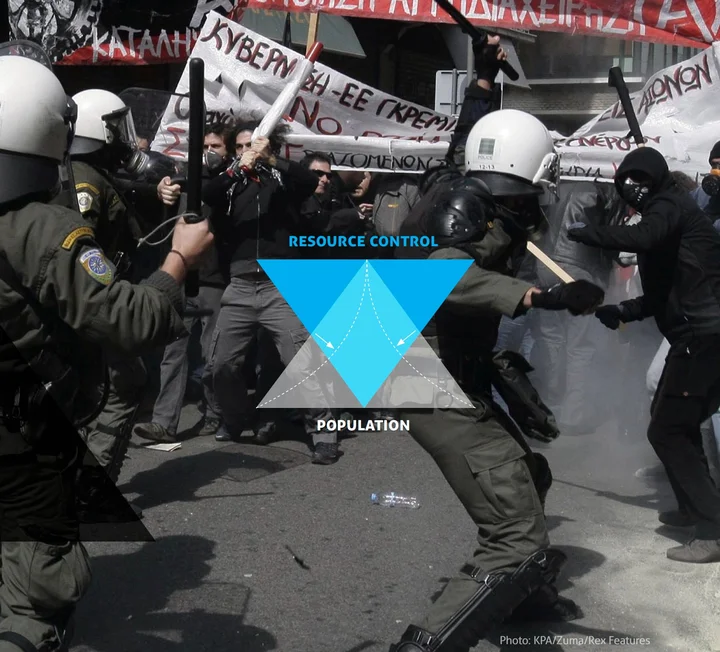
Population growth, combined with increasing resource use per capita, creates exponential impact: increasing scarcity and resource control imbalance.
In the last decade, violent riots against national governments have erupted in every major economic zone, including France, the United States, Greece, China, India, the Middle East, Germany, South America, and across Asia. The 2008 banking crisis saw more institutions close their doors than during the Great Depression. Food prices continue to rise. Access to good food, water, and employment is decreasing worldwide. Ecosystems decline at unprecedented rates. Biodiversity drops alarmingly.
These fractures are not from a lack of resources. They come from unequal distribution. And somehow we become accustomed to news like this. That may be the biggest problem of all. Because eventually we think: what are we to do?
We cannot care enough about this. The system that is our global habitat is failing us. We have stressed its limits. We grew ourselves into a corner. Something has to give. If that moment comes without control, which way will the system break? Who will suffer the consequences?
We cross planetary boundaries
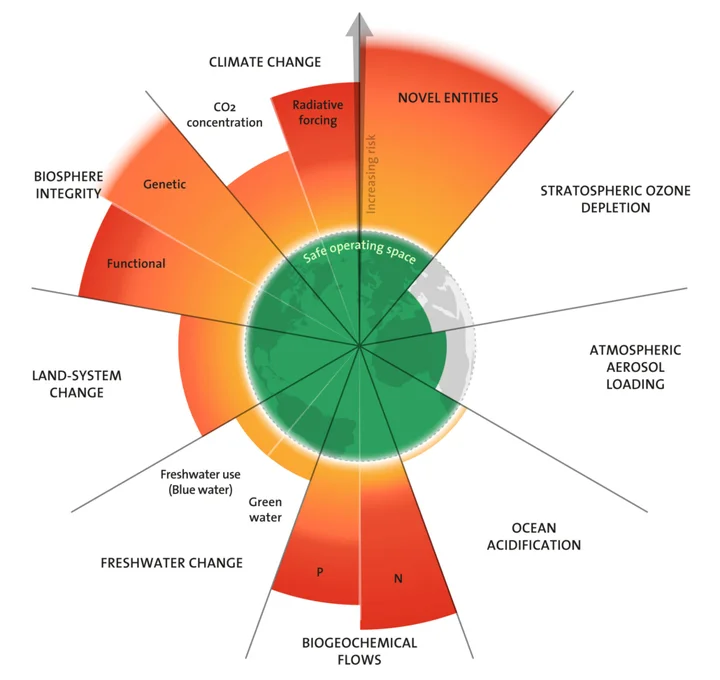
(Image: Marcus Lundstedt/Stockholm Resilience Centre, CC BY-NC-ND 3.0)
The Planetary Boundaries framework shows the 9 key systems required for Earth to function normally.
The Planetary Boundaries framework, developed by Johan Rockstrom at the Stockholm Resilience Centre and Will Steffen at the Australian National University, measures nine indicator groups representing critical resources for human survival on Earth. When a planetary boundary is crossed, there is a risk of "irreversible and abrupt environmental change."
Six of the nine boundaries have already been crossed. Two more approach capacity. The framework's boundaries are still in development, and assessments are adjusted yearly. The concept powerfully demonstrates the need for awareness and further research.
Network is power
Our communication, energy, food, and trade networks are the systems that control our lives. Without roads, no trade. Without wireless networks, no mobile communication. Without cables, no power. And underneath it all sits the network of our ecosystem, making life itself possible.
Our times have changed. Networks on all layers of society have superseded individual entities in power. We have seen the rise of network companies, new business models, and new operating paradigms. Social networks have outperformed other markets in their ability to influence people globally. We have also witnessed that centralized control of these networks can lead to great injustice, evaporation of basic rights, and new, often invisible power structures.
Those who control the connections between things control the things themselves. Like puppets commanded by invisible strings. We have also seen that new perspectives on the network can provide rapid, exponential change (social media and blockchain are only two examples). Building lightweight, decentralized, resilient networks is a powerful lever for change, and one of the few ways we can reduce consumption per capita while improving quality of life.
The object-oriented era, where building things was the route to power, is over. The future belongs to those who understand that creating and shaping networks of connections is the pathway to influence. It is not physical objects that control the system; it is the network.
From growth to resilience
The continuous growth of population and consumption has reached critical turning points across economic, environmental, and social realms. Our existing economy is built on the paradigm that growth is necessary for survival. The challenge now is to create an economy that shifts focus from growth as an ultimate goal to sustainability and, in particular, resilience.
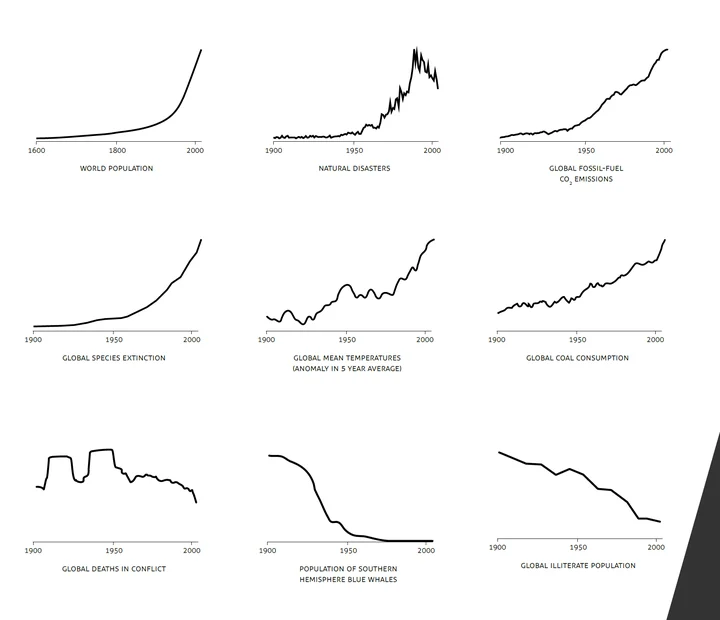
(image: Symbiosis in Development Omnibus, 2019)
An uncertain future brings inherent unpredictability. We cannot plot scenarios and rely on them as a safe way to plan ahead. The only way to navigate such uncertainty is by preparing to overcome the unknown. This is what resilience planning does. It strengthens society so it can manage, adapt to, and overcome unexpected challenges: erratic economic shifts, resource shortages, weather pattern changes, biodiversity loss, and social unrest.
A resilient society is built by reorganizing how the elements of our systems relate to one another, making them more flexible, adaptive, transparent, and diverse. For example:
- Moving from linear resource flows to circular ones
- From centralized power systems to decentralized, agent-based systems
- From monocultures to polycultures in agriculture and urban planning
While the network dominates the power of today's world, the companies, governments, and agents that understand resilience will lead the future.
Three places where this is already happening
The pressures described above are not abstract. They are measurable, in named places, on dated records. The three cases below are short on purpose. Each shows a different way a system fails, and each rests on a source you can go and read for yourself.
The Amazon: a forest that makes its own rain
Brazil's National Institute for Space Research (INPE) measures forest loss across the Legal Amazon every year with its PRODES satellite system. Between August 2024 and July 2025 it recorded 5,796 square kilometres cleared, 11.08 percent less than the year before and the third consecutive annual decline. That is an area slightly larger than Brunei, removed in twelve months, in what counts as a good year.
A good year is still alarming because of a feedback loop. The Amazon does not simply receive rainfall, it generates it: forest transpiration contributes up to half the region's rain, which sustains the forest, which sustains the rain. Remove enough trees and the loop runs the other way, as less forest produces less moisture, more drought stress, more fire, and less forest again. A 2024 assessment in Nature by Bernardo Flores and colleagues estimates that by 2050 between 10 and 47 percent of Amazonian forest will face compounding disturbances capable of triggering an ecosystem transition. The same paper proposes safe boundaries of no more than 10 percent accumulated deforestation and at least 1,800 mm of annual rainfall.
In SiD terms this is a reinforcing feedback loop approaching a threshold, and it is why a falling rate of damage is not the same thing as recovery. Deforestation is a flow. Forest cover is a stock. Slowing the flow while the stock keeps shrinking still carries the system toward its tipping point.
Sources: INPE, PRODES annual deforestation estimate for the Legal Amazon, announced 30 October 2025 (Brazilian government announcement); Flores, B. M. et al., "Critical transitions in the Amazon forest system", Nature 626, 555-564, February 2024 (nature.com).
Ogoniland, Nigeria: pollution that outlives the polluter
Oil production in Ogoniland, in the Niger Delta, stopped in 1993. Eighteen years later the United Nations Environment Programme published Environmental Assessment of Ogoniland (2011), the result of fourteen months of fieldwork: more than 200 locations examined, 122 kilometres of pipeline rights of way surveyed, over 4,000 samples taken, more than 5,000 medical records reviewed, and some 23,000 people met at community meetings.
In a place where the wells had been shut for a generation, the team found families at Nisisioken Ogale drinking water containing benzene at more than 900 times the World Health Organization guideline, with an eight-centimetre layer of refined oil floating on the groundwater that feeds those wells. UNEP estimated that cleaning up Ogoniland and restoring it would take 25 to 30 years, and recommended an Environmental Restoration Fund capitalised with an initial one billion US dollars to cover the first five years alone.
This is the difference between a flow and a stock again, and it is why SiD keeps the two apart. Stopping an activity does not undo its damage, because the contamination is stored in soil and groundwater and releases on a schedule of its own. It also shows harm travelling across layers: a decision taken in the economic layer arrives decades later in the ecological layer as poisoned aquifers, and in the social layer as drinking water, food, and health.
Source: United Nations Environment Programme, "Environmental Assessment of Ogoniland", 2011 (unep.org).
Indonesia, 2015: burning carbon that took millennia to store
Between June and October 2015, fires lit to clear land for agriculture burned 2.6 million hectares of Indonesian forest and farmland, an area about the size of Rwanda. Roughly a third of it was peatland. Peat is not ordinary ground cover. It is carbon laid down over thousands of years, and when it burns that carbon does not grow back the way a forest does. The Global Fire Emissions Database put the 2015 Indonesian fires at around 1,750 million tonnes of CO2 equivalent, set against Indonesia's own estimate of 1,800 million tonnes for its entire annual economy. One fire season nearly doubled a nation's yearly carbon output.
The World Bank costed the crisis at 16.1 billion US dollars, or 1.9 percent of Indonesia's 2015 GDP, more than twice what it cost to rebuild Aceh after the 2004 tsunami. The haze contributed to 19 deaths and more than 500,000 cases of acute respiratory infection. At its worst, in October, it closed 24,773 schools and interrupted the education of 4.7 million children.
A land-clearing decision taken for one crop on one plantation is, on paper, a local and rational economic choice. Aggregated, those choices emptied a country's classrooms and cost it more than a tsunami. Closing that gap between local rationality and systemic outcome is the work systems thinking exists to do, and it is why SiD evaluates an intervention at the scale where its effects actually land rather than the scale at which the decision was made.
Source: World Bank, "The Cost of Fire: An Economic Analysis of Indonesia's 2015 Fire Crisis", Indonesia Sustainable Landscapes Knowledge Note 1, February 2016 (documents.worldbank.org).
Roadmaps to resilience
Rebuilding the foundations of society, changing the operations of multinationals, and altering the patterns of cities are challenges we have never faced before. They are unusually complex and numerous. We have a choice: proclaim it impossible, or find reasonable ways to proceed.
We are not without help. We have an increasing workforce, intelligence, knowledge and data, technology and insight. And we have a growing awareness that a new pathway is necessary.
To move forward with the speed we need, we must find the right balance between evolution and revolution. We replace growth-focused organizations with resilience-based systems step by step. Some systems are eradicated. Some are optimized.
For several vital ones, we start new systems in parallel to the old, until the old is no longer necessary and the new takes over. Each part of our system is different and requires a different approach. For each, we need a pathway. Because all will need to change.
Progressive pathways for change are a realistic approach: start moving on the short term, head toward the full goal in the long term. This works when we create significant benefit for all parties involved.
Each party takes care of its own interest, but as a whole, we move in the right direction. Like instruments in an orchestra, everyone has a part to play. We bundle these pathways into roadmaps: cooperative models of orchestrated change, always leading toward the goal of a truly sustainable society.
Let's get started
What are the steps? First, develop a systemic understanding of how our world works, and where we can best intervene. We look at layers where stakeholders and systemic forces operate: ecological processes, market forces, social patterns, law, and engineering. We then use system mapping to see connections and the character of the network. From this, we use creative problem solving to discover intervention points that bring benefits across the board.
These interventions provide the notes in our symphony. To compose the symphony, we plot them in time to maximize supportive effects and build long-term strategies. We map each party's contribution into action plans (benefit, cost, impact) and weave them together into a unified roadmap for change toward a resilient, just, and self-sufficient society.
SiD provides a structured, step-by-step approach for developing these roadmaps. It applies to any industry, institution, or complex societal challenge. SiD helps teams cooperate, understand systems, develop resilient solutions, and build the roadmaps we need toward a flourishing future.
Twenty years in the making, SiD is a tool to improve the old world and build the new. The first step in the revolution of evolution.
Takeaway
The convergence of population growth, ecosystem decline, network power concentration, and planetary boundary breaches makes this moment different from any that came before. Band-aids will not work. What is needed is systemic intervention, guided by a practical framework, delivered through progressive roadmaps that create benefit at every step. That is what SiD is built to do.
Next up: The Essence of SiD introduces the framework's structure, core concepts, and the alien colony thought experiment that makes it all click.
This knowledge is free because of our supporters. Join them.
Found a problem? Log in to report an issue.