Skip to content
Method & Process

Step 1: Goals and Indicators

12 min read Video Exercise
Video Lectures

Goals, Vision and Indicators

Where This Fits

This is the first step of the SiD five-step method (Goals and Indicators, System Mapping, System Understanding, Solutioning and Roadmapping, Evaluate and Iterate). Here we set the destination for the entire project. Everything that follows depends on getting this right.

The goal-setting stage is where a project's external conditions find a home: stakeholder demands, time and budget restrictions, ambitions. It is also the stage where major revisions typically happen in later method cycles.


The Parts of This Stage

  1. Goal setting on System, Network, and Object levels (the SNO hierarchy)
  2. Developing a vision (optional but recommended)
  3. Setting the project and system boundary
  4. Setting performative indicators

Setting Good Goals

Goals determine the final destination. They are usually set with your entire team including the client, and later revisited with stakeholders.

Your goal is the dot on the horizon. A bad goal distracts from what matters. A good goal keeps everyone motivated and moving in the same direction. Good goals share two qualities: they are expressed on a system level and they are performative.

Here is an example of a good goal:

"Our goal is for our company to maximally contribute to a sustainable society."

In this sentence, "sustainable society" is the system. The company is the object within that system. "Maximally contribute to the system's sustainability" is the performative aspect.

System-level goals can feel broad and generic. That is fine. Sub-goals provide further refinement. For example:

"We want our neighborhood to be sustainable in 30 years, meaning resilient, autonomous, and harmonious."

Those three qualities, Resilience, Autonomy, and Harmony (RAH), are the core performance indicators in SiD. If this is where you start, you will refine this goal across multiple method cycles into detailed sub-goals. One important principle: do not limit the ambition of the overall systemic goal. Aim high. The sub-goals and boundaries will keep the work manageable.


Performative Goals

Goals are best expressed performatively. This means describing the intended outcome without predetermining the solution. A performative goal keeps the solution space as wide as possible and prevents suboptimization.

A bad, prescriptive goal:

"All the buildings in this neighborhood should use solar panels to provide the neighborhood with its own electricity."

While solar panels might be part of the answer, this goal locks in a specific technology. It is a solution masquerading as a goal.

A performative version:

"The neighborhood provides its own source of renewable energy."

Solar panels may still be used. But so might wind, geothermal, or an approach nobody has thought of yet. The performative framing leaves room for the best solution to emerge.

Going further, to a system-level goal:

Why do we want the neighborhood to provide its own energy? Because it makes the community less dependent on fossil fuels and more resilient. Because it protects the environment and climate. Because it provides economic stability and educational value.

Each of these reasons points toward a system-level goal. "Make the system more resilient" is a system-level goal. "Protect the environment so we continue to enjoy its benefits" is another. Expressed this way, these goals may also lead to solutions beyond energy.

In practice, the goal is often already set before you arrive, but not on a system level. In that case, use internal systemic goals to guide the solution process while ensuring they also satisfy the client's stated requirements. Client goals often function more as boundary conditions (budget, timeline, specific deliverables) than as true directional goals.


Setting Sub-Goals

After the main goal is set, break it down into performance-based sub-goals at the network or object level. When the project involves designing a specific building, for example, sub-goals might address its influence on the surrounding environment, the people who will live and work in it, related businesses, and material use.

Use the ELSI-8 categories (Energy, Land use, Materials, Ecosystems, Species, Culture, Economy, Health and Happiness) and the Network Parameters as tools for formulating sub-goals. They help ensure you cover all dimensions. The main overarching goal should still remain at the system level.

Sometimes it is necessary to understand the system before you can set the right goal. Without prior understanding, goal setting can be ineffective. In many SiD processes, a preliminary mapping exercise precedes goal setting.


Visioning

For certain projects, a vision statement can supplement or replace the usual goal statement. This is especially useful for long-term trajectories involving large groups of people and multiple stakeholders. A strong vision energizes people and provides a qualitative point on the horizon that helps direct the process.

A vision is not a systemic goal. It can, however, be used to bring a goal to life or to arrive at one.

When creating a vision, the team (often with stakeholders) formulates their dreams and ideals of where they want to end up. This vision can be specific and expressed through many media: drawings, videos, written stories. After the visioning process, extracting specific goals, indicators, and a system boundary is usually straightforward.

A good vision also enables back-casting: running through a SiD method cycle in reverse to check whether clear pathways exist toward the desired end result, and to identify potential pitfalls early.


Setting the Project and System Boundary

Project Boundary

The project boundary defines the external conditions placed on the investigation: budget, time, resources, team, level of detail. These "edge conditions" create clarity and ensure the project is completed within its constraints.

System Boundary

The system boundary is an artificial edge at which we stop investigating specifics and treat everything beyond it as "external." We still account for external factors, but in simplified form.

The system boundary determines depth and scale. A smaller boundary makes the system simpler to map and solve, but it also shrinks the solution space, because there are fewer levers available. A larger boundary expands the possibilities, but increases the effort needed for analysis.

The system boundary must always be set large enough to find adequate solutions and small enough to remain manageable.

Rules of thumb for system boundaries:

  • System boundaries are usually not singular. They can have different values in time, space, and sometimes for individual sub-goals. The boundary for investigating energy flows can differ from the boundary for ecosystems.
  • System boundaries do not have to be fixed. They can be irregular, gradient, or loosely defined, and they may be adjusted as understanding grows through iteration.
  • System boundaries do not have to be set at the start. For innovative projects especially, keep the boundary as open as possible in the early stages.
  • If a project requires defensible, reproducible research (for example, peer-reviewed science), the system boundary must eventually be set precisely, documented according to a recognized standard.

Externalized Factors

A critical aspect of setting a system boundary is recognizing what has been externalized: elements outside the boundary that still interface significantly with the system inside it.

If the boundary is drawn around a neighborhood, externalized factors might include food production, sunlight, air, rain, employment areas beyond the boundary, and water purification plants. These factors still need to be represented, for example as simple inputs or outputs on a system map. Externalized factors can be important measures of system performance and may serve as starting points for performance indicators.

Another form of external boundary is a system's embedded resources: the energy output of the sun, groundwater volume, the amount of copper on the planet, the number of people in an organization. These are usually fixed and provide limits to the system's capacity. For example, you cannot increase the sunlight falling on a given area of land. These become fixed resources that inform calculations about carrying capacity and help determine possibilities for maximizing a system's autonomy.


Determining Performance Indicators

Performance indicators measure how well a system operates. Setting them in Step 1 allows evaluation in Step 5. The logic is simple: measure before you intervene, and measure after, to see whether things actually improved.

To prevent externalizing problems, the set of indicators must be broad enough to catch unintended consequences. You might lower energy use through a new technology, but if you do not also measure toxic outputs, you may be shifting from an energy problem to a toxicity problem. This happens often in reality. The ELSI-8 categories and Network Parameters help ensure indicator coverage is comprehensive.


Wrapping Up Step 1

At the end of this phase, you have:

  • A system-level goal (and possibly a vision)
  • Clear boundaries for your operations
  • A comprehensive set of indicators to measure performance

When goals and indicators are clear and shared by all stakeholders, it is time to explore the system before thinking about solutions. That exploration happens through system mapping, in Step 2.


Real-World Examples

Public Transport Rotterdam

Except developed a public transportation strategic development plan for the city region of Rotterdam. The original goal: "make the public transport system more sustainable." During a SiD session with stakeholders from major transport organizations, the goal was redefined:

"To increase the sustainability of the city region of Rotterdam by means of the public transportation system."

This "flipping" of the goal testifies to the mental shift a systemic inquiry produces. The group realized that a "sustainable public transport system" is meaningless in isolation. The PT system is a means to an end, not an end in itself. Object-oriented thinking would at best produce incremental interventions like energy efficiency. The systemic reframing focused the group on the performance of the city as a whole, using public transport as a lever. The subsequent roadmap was broader, more ambitious, and more effective.

Sustainable Schiebroek-Zuid

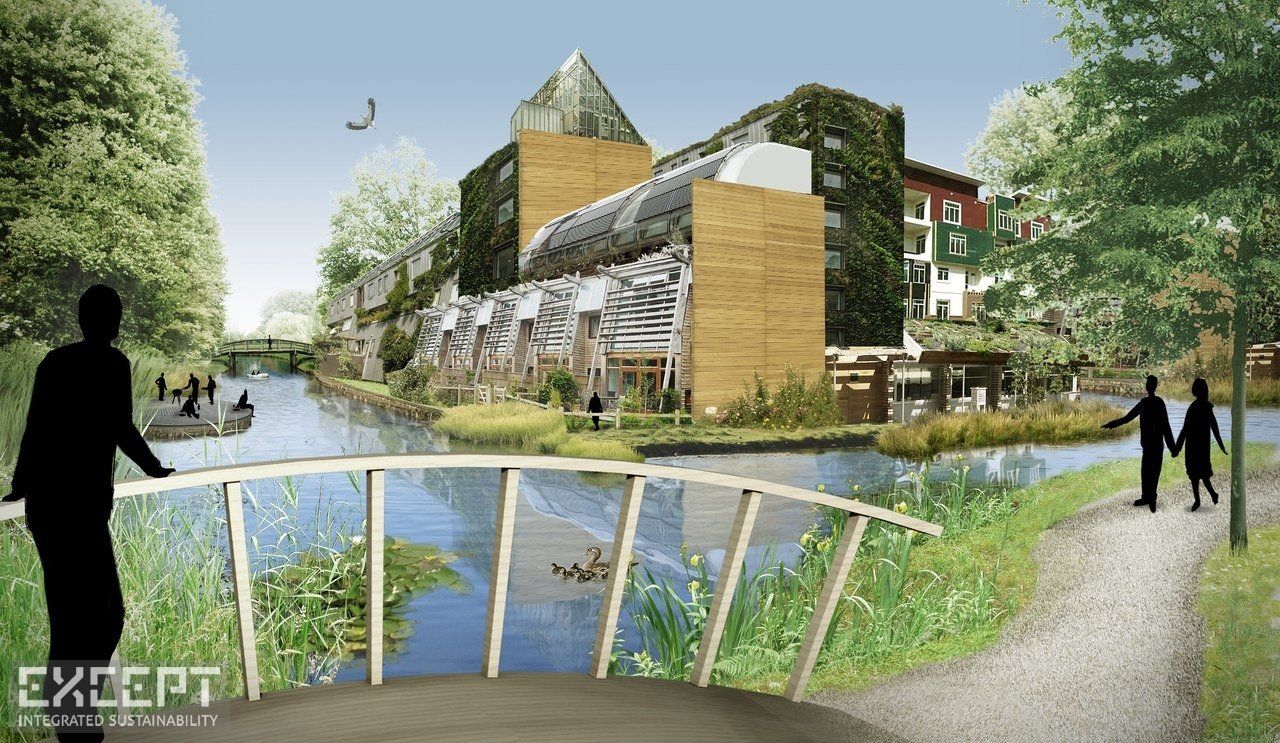
Schiebroek-Zuid is a post-war social housing neighborhood in the Netherlands. The primary goal was simple at the system level: "To realize a sustainable Schiebroek-Zuid." After an extensive stakeholder involvement trajectory, sub-goals were defined on an object level using the ELSI categories:

Energy and Materials: Close all energy and material cycles. Generate energy from local renewables. Export surplus energy. No imports of water or fossil fuels. Minimize waste and close local loops. Toxic-free, carbon-neutral.

Ecosystems and Species: Landscape as a source of recreation and education. Rich biodiversity supporting food generation and ecosystem services (water filtration, energy generation). Self-maintaining and regenerating.

Culture and Economy: Low costs of living. Strong social dynamic. Flexible support for new economic initiatives. Cooperation with surrounding neighborhoods. Financial self-sufficiency.

Health and Happiness: Support residents in a healthy, fulfilling life. Challenge residents to optimize their physical and mental state. Inspiring, healthy living environment fed by productive ecosystems and local economic opportunities.

A Sustainable Company

A large company (approximately 50,000 employees) in the US service sector asked Except to help improve sustainability performance, initially focusing on energy efficiency, waste recycling, and water management.

During a strategic session with the board, we asked the company's officially stated goal. The directors answered with their mission of providing the best service to customers. After a joint systemic inquiry, the group realized that by far the company's largest positive impact on society was not its services, but its ability to provide and sustain quality employment for its workforce. That positive impact was an order of magnitude larger than its negative resource footprint.

Where the company had previously focused on reducing its negative footprint (energy savings, recycling), they now saw that strengthening their positive societal impact mattered more. In that moment, the board understood that sustainability encompassed their entire strategic planning, not a side issue.

Reoriented around quality employment, the company discovered opportunities that strengthened and expanded its workforce while generating new service offerings. A key component: their service workers could positively affect the sustainability performance of customers, exponentially increasing the company's positive impact. This became part of the core service offering, embedding societal value into the business and opening markets previously inaccessible, including government and NGO sectors.

This result flows directly from reorienting a system's goal. By understanding the systemic position of the organization and using its positive impact to drive reduction of negative impact across its larger network, exponentially more positive performance is possible than through object-level footprint reduction alone.

BK City: Architecture Faculty as Didactic Tool

BK City is a listed monument of more than 30,000 m2, serving as the architecture faculty of TU Delft in the Netherlands. After a 2008 fire destroyed the original faculty building, the university relocated to a historic 1920s structure. Beautiful, labyrinthine, and expensive to heat.

Except was invited to design a sustainable vision. We applied SiD with a team of an architect, environmental scientist, engineer, ecologist, and business analyst.

The systemic goal: Transform the building from a structure that houses knowledge into one that imparts it. The building becomes a didactic tool that anticipates and responds to the shifting field of architecture, with influence extending beyond its walls through the actions of those it educates.

The approach used the ELSI-8 categories to ensure integrated sustainability: Energy and Materials, Ecosystems and Species, Culture and Economy, Health and Happiness. Each intervention had cross-cutting benefits, and each phase built on the one before.

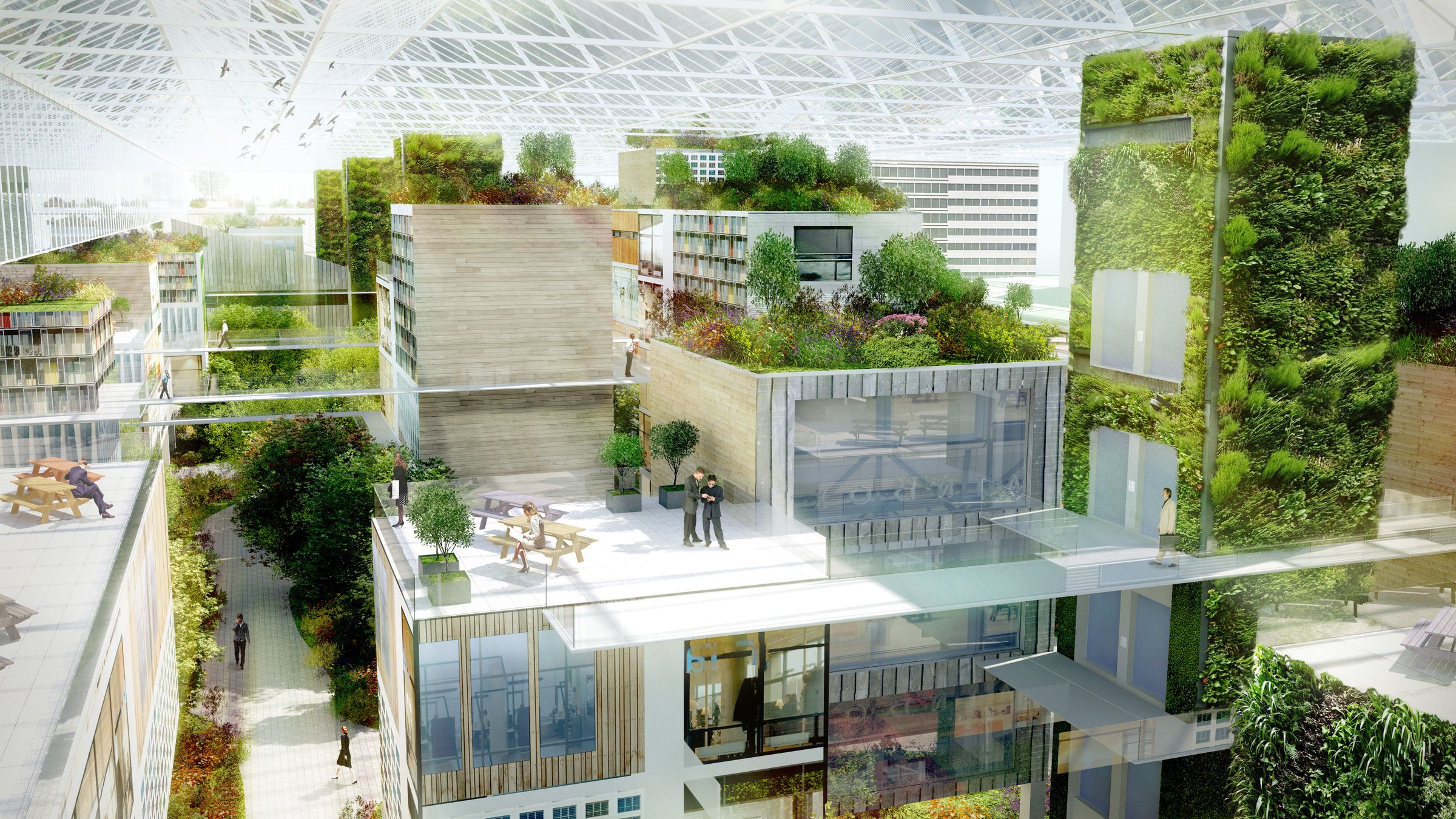
The outcome: A plan for a highly didactic building with exemplary environmental quality, an indoor plant ecosystem, more than 10,000 m2 of reclaimed space, operationally sustainable energy and water use, phased over ten years for less than 25 million euros.

Key interventions included wall, roof, and window insulation (67% heat savings), an enclosed atrium garden ("the Green Lung"), a plant-based climatization system, water self-sufficiency through bio-based filtering, an open-source participatory framework, and a natural environment delivering a projected 12% performance gain for occupants.

BK City is more than a building. It connects the lives of many individuals, serves as a learning platform for generations of architects and urban planners, and functions as the social and functional hub of its disciplines.


Takeaway

The goal is the single most consequential decision in a project. Get it right, and every subsequent step gains clarity and momentum. Get it wrong, and even brilliant solutions will solve the wrong problem. Set goals on a system level. Express them performatively. Define clear boundaries. Establish indicators that catch unintended consequences. And revisit all of it in every cycle.

Next: Chapter 2.2 takes you into Step 2, System Mapping, where we build the maps that reveal the territory between where we are and where we want to go.

Exercise

Reflect and Apply

  1. SiD distinguishes between performative goals (describing system performance) and prescriptive goals (specifying a predetermined solution). Examine a goal from your current work. Is it performative or prescriptive? How would reframing it as a performative goal change the solution space?
  2. The chapter recommends setting goals at the System level using the SNO hierarchy, then developing sub-goals at the Network and Object levels. Take a project goal you are familiar with and rewrite it as a system-level goal. Then draft one sub-goal each for the Network and Object levels.
  3. RAH (Resilience, Autonomy, Harmony) are SiD's core performance indicators. For a system you work within, which RAH dimension is the weakest? What indicator could you define to track improvement in that dimension?

Share your reflections in the exercise submission below to earn 25 points.

Feedback

Community Responses

This knowledge is free because of our supporters. Join them.

This content is free and open, made possible by our supporters. Support SiD
← Previous Solution Phase Next → Step 2: System Mapping
SiD Tutor
Your learning guide
Welcome to SiD Learning. I am here to help you explore and understand the material. What would you like to discuss?